Personal Sovereignty in Israel, WV
Viable for self-reliance. Generally workable, though some barriers may limit total independence.
What does Personal Sovereignty tell us?
Personal Sovereignty measures your capacity for self-reliance and independence with minimal government friction. Higher scores mean fewer barriers between you and the way you want to live... but it assumes you have the space you need and good neighbors.
What does this tell us?
Personal Sovereignty measures your capacity for self-reliance and independence with minimal government friction. Higher scores mean fewer barriers between you and the way you want to live... but it assumes you have the space you need and good neighbors.
State Policy
Energy independence: Net exporter (754% of energy produced in-state)
Personal Liberty
Homesteading

Personal Liberty Analysis
Israel, West Virginia, sits in a state that consistently ranks among the most individualistic in the nation for personal sovereignty, with no state income tax on most earnings and a regulatory climate that leans heavily toward personal discretion. For a relocation researcher, the autonomy environment here is defined by a light-touch state government that leaves significant room for individual decision-making on property, self-defense, and family matters. The trade-off is a rural infrastructure that demands more self-reliance from residents than a suburban or urban setting would, making personal capability a practical necessity rather than a philosophical preference.
Tax burden and regulatory posture in West Virginia
West Virginia’s tax structure is one of the most favorable in the country for individuals prioritizing financial autonomy. The state has no personal income tax on wages, salaries, or retirement income — a major draw for those looking to keep more of their earnings. The state sales tax sits at 6%, with local option taxes potentially adding up to 1%, and property taxes are notoriously low compared to national averages, particularly for owner-occupied residences. For context, West Virginia’s effective property tax rate is roughly 0.55% of home value, about half the national average, and the state offers a homestead exemption for seniors that reduces taxable value on primary residences.
Regulatory posture at the state level is generally permissive. West Virginia operates under a "Dillon's Rule" framework for municipalities, meaning local governments only have powers explicitly granted by the state, which keeps county and city ordinances from piling on extra restrictions. The state has also passed preemption laws that block local jurisdictions from enacting their own minimum wage mandates, paid leave requirements, or landlord-tenant regulations that exceed state law. For a resident in Israel, this means the regulatory environment is largely set by Charleston, not by local boards, and Charleston has trended toward deregulation in recent years — particularly in areas like occupational licensing and land use. The permitting process for building a home or starting a small business is generally streamlined compared to states like Oregon or New York, though rural counties still enforce basic septic and well regulations that require state approval.
Self-defense and gun law specifics in West Virginia
West Virginia is a constitutional carry state, meaning no permit is required to carry a concealed firearm for anyone legally allowed to possess a gun. This has been the law since 2016, and it applies to both residents and non-residents visiting the state. For those who do want a permit — often for reciprocity when traveling to other states — the process is shall-issue, with the sheriff’s office required to approve applications from qualified individuals within 45 days. The permit requires an eight-hour training course, but there is no live-fire qualification mandated by state law, and the fee is typically around $50 to $100 depending on the county.
Use-of-force law in West Virginia is favorable to the defender. The state has a "stand your ground" statute, codified in West Virginia Code § 55-7-23, which removes any duty to retreat before using deadly force if a person is lawfully present and reasonably believes force is necessary to prevent death or serious bodily harm. Castle doctrine protections extend to vehicles and workplaces, not just homes. There is no state-level assault weapons ban, no magazine capacity limit, and no universal background check requirement for private sales between individuals. The state also prohibits local governments from enacting their own gun control ordinances, so the legal landscape is uniform across all 55 counties. For a family moving from a restrictive state like California or Illinois, the difference in legal posture is stark — what might be a misdemeanor in one jurisdiction is simply lawful conduct here.
Self-reliance and homesteading viability in the Israel area
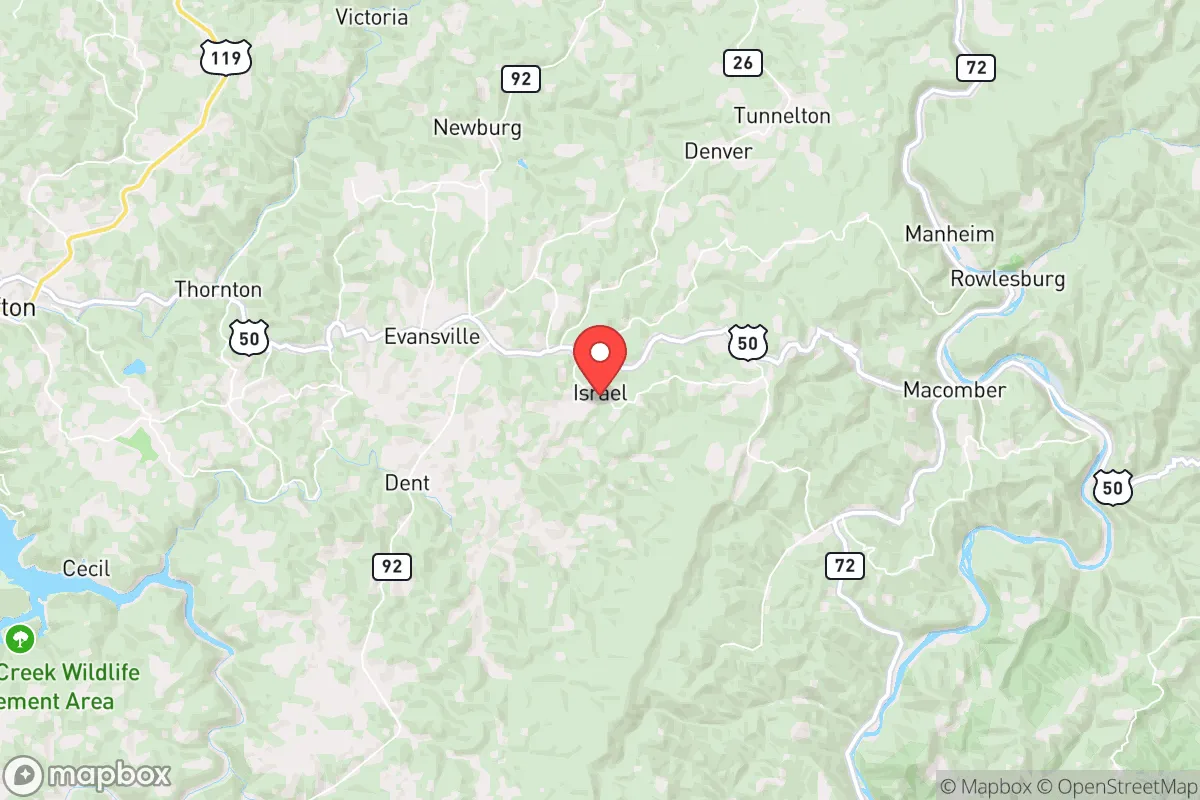
Israel is an unincorporated community in Wirt County, which means there is no municipal zoning authority telling residents what they can do with their land. This is one of the most significant factors for homesteading viability — in unincorporated areas of West Virginia, county commissions have limited land-use authority, and there is no county-wide zoning in Wirt County at all. A resident can keep livestock, build outbuildings, operate a home business, or set up a workshop without seeking a conditional use permit or variance. The practical constraint is not government approval but the land itself: the area is hilly, heavily wooded, and dominated by small parcels that were historically farmsteads, so flat, tillable acreage is at a premium.
Lot sizes in the Israel area vary widely, but the median parcel size in Wirt County is around 3 to 5 acres, with many larger tracts available for purchase at prices well below national averages — typically $2,000 to $5,000 per acre for raw land. Off-grid feasibility is high. West Virginia has no state law requiring connection to a utility grid, and the state’s net metering rules allow solar panel owners to sell excess power back to the utility at retail rates. Rainwater collection is legal and unregulated at the state level, and the state Department of Environmental Protection does not require permits for residential wells or springs used for personal consumption, though a water quality test is recommended. Septic systems do require a permit from the county health department, and the state has adopted the 2015 International Residential Code for new construction, but enforcement in rural areas is often minimal — many existing homes in the region were built without formal inspections. For those willing to handle their own water, power, and waste, the regulatory hurdles are among the lowest in the eastern United States.
Personal liberties: parental rights, medical autonomy, and property
West Virginia has moved decisively toward parental authority in education and healthcare in recent years. The state passed the Parental Bill of Rights in 2021, which requires schools to notify parents of any changes in a student’s physical or mental health and prohibits schools from withholding information about a child’s well-being. In 2023, the state enacted the "Save Women’s Sports Act," restricting transgender participation in school athletics, and passed a law requiring parental consent for any medical treatment of minors, with no exceptions for gender-affirming care. Homeschooling is lightly regulated — parents must file a notice of intent with the county superintendent and provide an annual assessment, but there is no curriculum approval process, no standardized testing requirement, and no home visits.
Medical autonomy for adults is also relatively strong. West Virginia does not mandate COVID-19 vaccination for any population, and the state legislature passed a law in 2021 prohibiting employers from requiring vaccination as a condition of employment without allowing for medical or religious exemptions. The state has no certificate-of-need law for most outpatient facilities, which means independent clinics and direct-primary-care practices can open without proving "economic need" to the state. Property rights are protected by a constitutional amendment passed in 2012 that prohibits the taking of private property for private economic development — a direct response to the Kelo v. New London Supreme Court decision. Speech protections are robust, with no state-level hate speech laws and a public meeting law that requires open access to most government deliberations.
Relative to other regions, Israel and Wirt County offer one of the highest concentrations of personal sovereignty available east of the Mississippi. The combination of no income tax, constitutional carry, no zoning, minimal homeschooling oversight, and strong parental rights places this area in the top tier of American jurisdictions for autonomy-focused individuals. The trade-offs are real — rural isolation, limited healthcare access, and a thin job market — but for a reader whose primary relocation criterion is the freedom to live life on their own terms, this corner of West Virginia delivers on nearly every measurable axis.

* Values derived from national, state, county, city and local statistics and may differ in a specific area. Last updated: 2026-11-01T22:20:54.000Z
Narrative content on this page is AI-generated and may contain mistakes. Verify any details that matter before acting on them.
ReloMaps may earn a commission from affiliate links at no extra cost to you.

