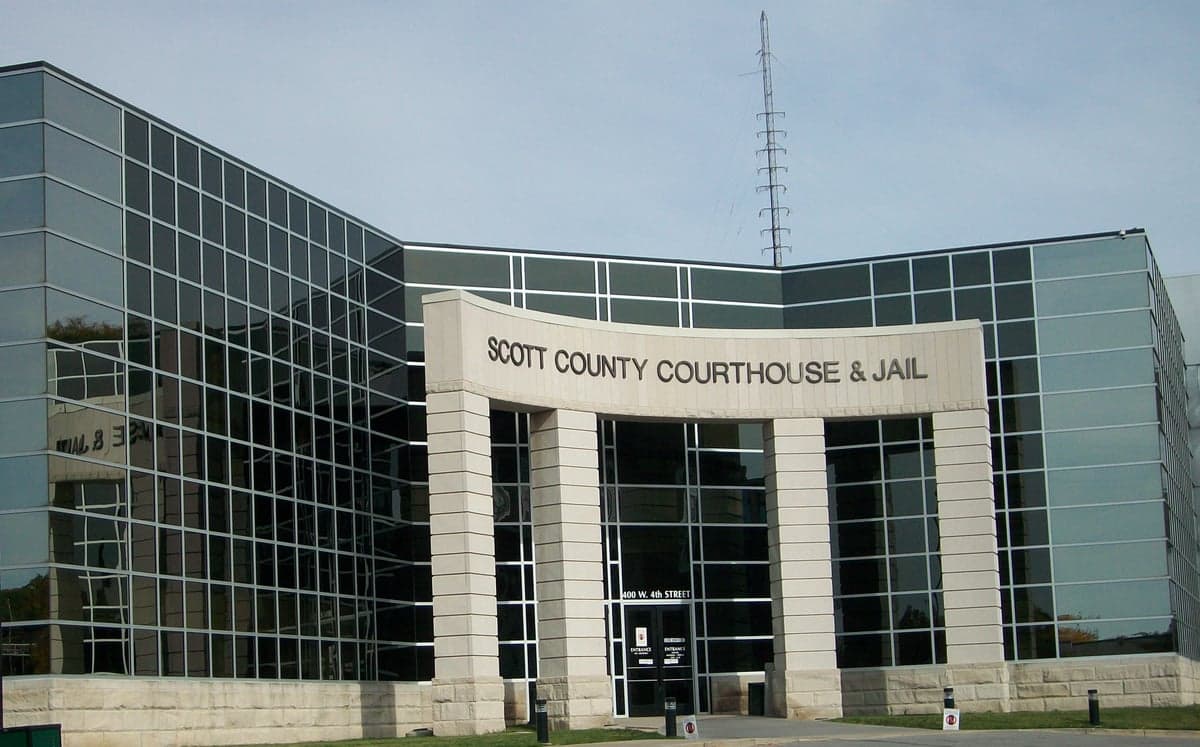
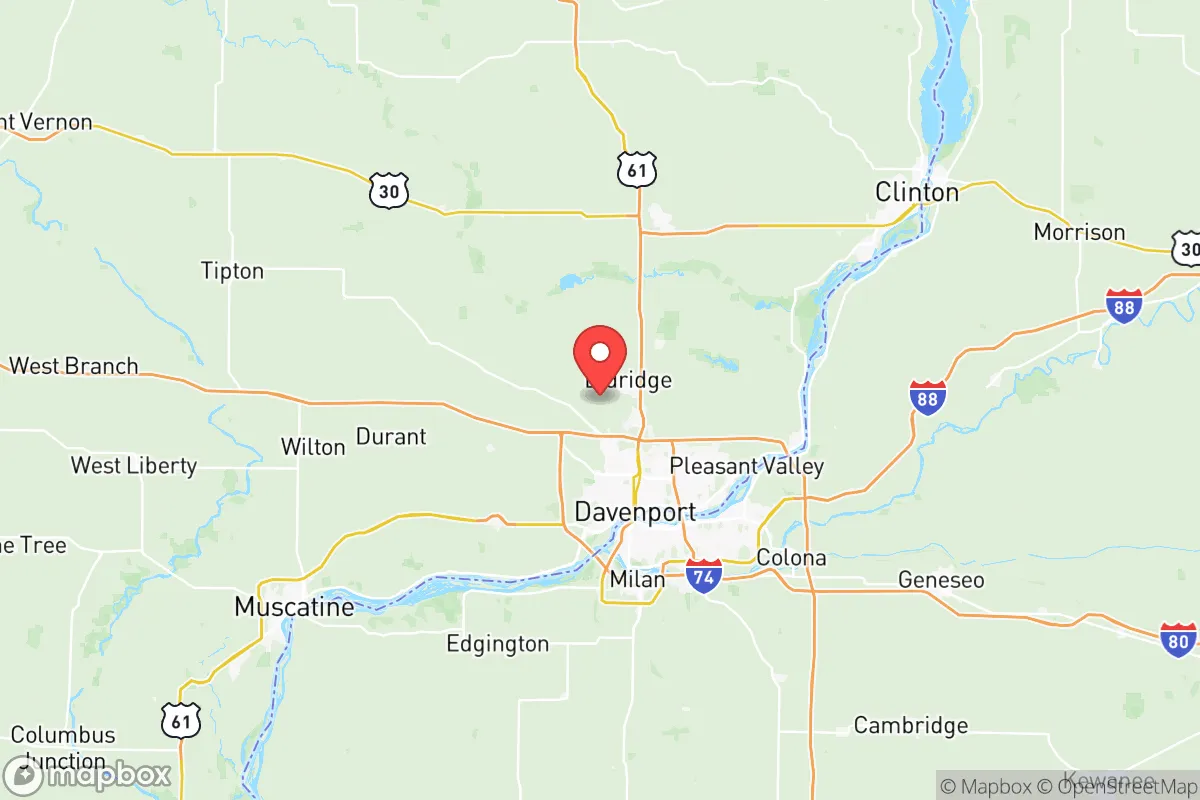
Photo: Wikipedia
Political ClimatePolitical Climate in Scott County
Showing district-level results — no local-only data available.
Local Political AnalysisPolitical Analysis of Scott County
Scott County, anchored by the Quad Cities metro area, is the most politically competitive large county in Iowa, with a Cook PVI of R+4 that masks a deep urban-rural split. While the state as a whole leans R+6, Scott County has trended toward Democrats in presidential years thanks to strong turnout in Davenport and Bettendorf, though it still votes Republican in most down-ballot races. The county flipped from Obama to Trump in 2016, then swung back to Biden by a narrow 2.5-point margin in 2020, making it a true bellwether where statewide races are often decided by a few thousand votes.
How it compares
Scott County's R+4 rating is two points more Democratic than Iowa's overall R+6, a gap that has widened slightly since 2020 as the rural parts of the state have shifted rightward faster than the Quad Cities. The real action is inside the county: Davenport's central and east-side precincts consistently vote 55-60% Democratic, while Bettendorf's western neighborhoods and the rural townships around Blue Grass and Walcott lean 60-65% Republican. The swing precincts are in the suburban donut around Davenport — places like the eastern edge of Bettendorf and the unincorporated areas near Eldridge — where independent voters break 50-50 in close races. Compared to Iowa's solidly red western counties (like Pottawattamie at R+12) or the deep-blue college towns (Johnson County at D+16), Scott County occupies a narrow middle ground that makes it a frequent target for both parties' field operations.
What this means for residents
For conservative residents, Scott County offers a more tempered political environment than much of Iowa — you'll find plenty of Republican representation at the county level, but you won't be in a deep-red echo chamber. The county board of supervisors has a 3-2 Republican majority as of 2025, and state legislative seats are split roughly evenly between parties. For liberal residents, the county is a rare blue foothold in eastern Iowa outside of Johnson County, with Davenport's city council and school board reliably progressive. Both sides can expect their votes to matter — a single precinct in Bettendorf or a turnout push in Davenport's 3rd Ward can flip a countywide race. The practical effect is that local policy tends toward moderation: tax levies and zoning decisions get negotiated rather than rammed through, and neither party can afford to ignore the other's base.
Culturally, Scott County feels more Midwestern-eclectic than the rest of Iowa — the Quad Cities' industrial and river-town history gives Davenport a grittier, more working-class vibe than Des Moines or Cedar Rapids, while Bettendorf's newer subdivisions lean toward the country-club Republicanism you'd find in the Chicago suburbs. Gun laws follow state preemption, so Scott County can't pass its own restrictions, but Davenport's city council has pushed symbolic resolutions on everything from immigration to climate policy that would never fly in rural counties. The biggest policy distinction is in education: the Davenport Community School District, which covers most of the county's urban core, has maintained a more diverse curriculum and stronger teachers' union than rural Iowa districts, while Bettendorf's schools are among the state's highest-performing and most parent-driven. If you're moving here, the political reality is that your neighbors will span the full spectrum, and local elections — especially for county supervisor and school board — are where the rubber meets the road.

State Political ClimatePolitical Climate in Iowa
State Political AnalysisPolitical Environment in the State
Iowa has been a reliably Republican state for the past decade, carrying a Cook Partisan Voting Index of R+6, but it wasn't always this way. As recently as 2012, the state was considered a true battleground, splitting its votes between Barack Obama and Mitt Romney. Over the last 10-15 years, a combination of rural realignment and suburban drift has pushed the state solidly red at the presidential level, though it still elects a mix of Democrats and Republicans in state and local offices. For a relocator, this means you’re moving into a state where conservative values dominate the legislature and governor’s office, but where you’ll still find blue pockets in college towns and a few suburban districts.
Urban vs. rural divide
The political map of Iowa is a textbook case of the urban-rural split. The state’s two largest metros, Des Moines and Iowa City, are the primary Democratic strongholds. Polk County (Des Moines) has been trending blue for years, delivering margins of 15-20 points for Democratic candidates in recent cycles. Johnson County, home to the University of Iowa in Iowa City, is the most reliably liberal county in the state, often voting Democratic by 30 points or more. In contrast, the vast rural expanse of the state—counties like Sioux, Plymouth, and Lyon in the northwest, and Decatur, Ringgold, and Wayne in the south—vote Republican by margins of 40 to 60 points. The suburbs around Des Moines, such as Ankeny and Waukee, have become key swing areas; they used to be reliably red but have shifted slightly toward Democrats in recent years, though they still lean right overall. The Cedar Rapids metro (Linn County) is another mixed bag, voting Democratic but by narrower margins than Iowa City. The real story is the rural exodus from the Democratic Party: counties that voted for Al Gore in 2000, like Buena Vista and Cherokee, now routinely go Republican by 20 points or more.
Policy environment
Iowa’s policy environment is shaped by a Republican trifecta—control of the governorship, state House, and state Senate—that has been in place since 2017. The state has a flat income tax rate of 3.8% (phasing down to 3.5% by 2027), one of the lowest in the Midwest, and no inheritance tax. Property taxes are relatively low compared to neighboring states like Illinois and Minnesota, though they vary by county. The regulatory posture is business-friendly, with a right-to-work law on the books and a strong tort reform environment. On education, Iowa has a robust school choice program: the Education Savings Account (ESA) law, passed in 2023, allows any family to use state funds for private school tuition, homeschooling expenses, or other educational costs. Healthcare policy is more mixed; the state expanded Medicaid under the Affordable Care Act, but the current administration has pushed for work requirements and privatization of the system. Election laws have tightened: Iowa now has one of the shortest early voting windows in the country (20 days), requires voter ID at the polls, and banned ballot drop boxes after the 2020 election. For a conservative relocator, the tax and education policies are strong draws; for a liberal one, the voting restrictions and limited abortion access (a six-week ban was signed in 2023) will be significant considerations.
Recent policy direction
The last few years have seen a sharp conservative turn in Iowa lawmaking. On gun rights, the state passed permitless carry (constitutional carry) in 2021, meaning no permit is required to carry a concealed firearm. On parental rights and education, the state passed a law banning instruction on sexual orientation and gender identity in K-6 classrooms (SF 496) and requiring schools to notify parents of any changes to a student’s health or well-being. On speech and privacy, Iowa has no broad surveillance law like some states, but it does have a strong open records law that can be used by citizens to access government documents. Medical and bodily autonomy is the most contentious area: the state’s 2023 fetal heartbeat law bans abortion after six weeks, with limited exceptions for rape, incest, and medical emergencies. Property rights are generally strong, with no statewide rent control and a relatively straightforward eminent domain process. On taxation, the trend is toward lower rates: the flat tax is scheduled to drop further, and the state has eliminated the inheritance tax entirely. Voting and ballot access have been restricted, as noted, with the shortened early voting window and voter ID requirements. For a relocator weighing these factors, Iowa is clearly moving in a direction that favors conservative priorities on guns, education, and taxes, while tightening restrictions on abortion and voting.
Civil unrest & political movements
Iowa is not a hotbed of civil unrest, but it has seen its share of political flashpoints. The most visible in recent years was the 2020 protests in Des Moines and Iowa City following the murder of George Floyd, which included marches and some property damage, but nothing on the scale of larger cities. Organized activist movements are present but not dominant: on the left, groups like Iowa Citizens for Community Improvement and the Iowa Democratic Party’s progressive wing push for environmental justice and expanded voting access; on the right, the Iowa Faith & Freedom Coalition and the Iowa Gun Owners are active in lobbying for conservative policies. Immigration politics have been relatively quiet, though the state has seen a rise in Latino populations in towns like Storm Lake and Denison, which has led to some local tensions but no major sanctuary city debates. Election integrity controversies flared after 2020, with some Republican county officials questioning the results, but the state’s Republican Secretary of State, Paul Pate, has defended the integrity of Iowa’s elections. There is no serious secession or nullification movement. For a new resident, the political climate is generally calm: you’ll see yard signs and bumper stickers, but not the kind of street-level conflict you might find in a state like Oregon or Pennsylvania.
Projection
Over the next 5-10 years, Iowa is likely to remain solidly Republican, but the margins may narrow slightly due to demographic shifts. The state is aging and losing population in rural areas, while the Des Moines metro and Iowa City continue to grow, attracting younger, more diverse residents who lean Democratic. However, the rural counties that vote Republican by huge margins still outnumber the urban centers in raw votes, so a flip to blue at the presidential level is unlikely unless national trends shift dramatically. The in-migration pattern is interesting: Iowa is attracting some conservative-leaning migrants from high-tax states like Illinois and California, which could reinforce the red lean. For a relocator moving in now, expect the state to remain a conservative policy leader on taxes and education, with continued battles over abortion and voting rights. The flat tax will likely drop further, and school choice will expand. The wildcard is the state’s aging population: as older, more conservative residents pass away, the electorate could become slightly more competitive, but that shift will take a decade or more to materialize.
For a new resident, the bottom line is that Iowa offers a stable, predictable political environment where conservative policies are the norm. If you’re a conservative, you’ll find a state that aligns with your values on taxes, guns, education, and abortion. If you’re a liberal, you’ll find strong communities in Des Moines and Iowa City where your views are shared, but you’ll be living under a state government that is actively moving in the opposite direction. The practical takeaway: choose your county carefully. If you want a conservative environment, look at the suburbs of Des Moines like Ankeny or Waukee, or rural counties like Sioux or Dallas. If you want a liberal enclave, stick to Johnson County or the core of Des Moines. Either way, the state’s politics are clear, stable, and unlikely to surprise you.
* Values derived from national, state, county, city and local statistics and may differ in a specific area. Last updated: 2026-07-21T22:39:08.000Z
Narrative content on this page is AI-generated and may contain mistakes. Verify any details that matter before acting on them.
ReloMaps may earn a commission from affiliate links at no extra cost to you.

