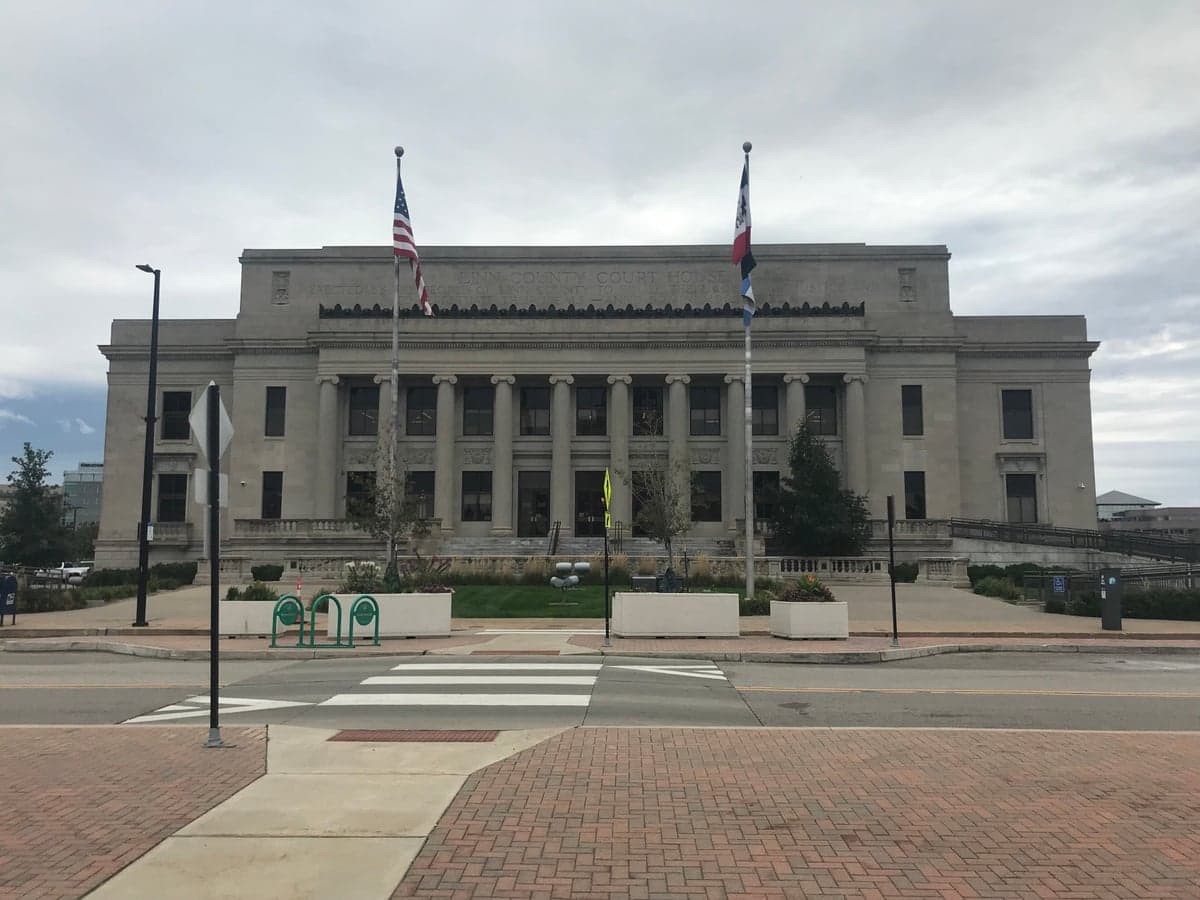
Photo: Wikipedia
Political ClimatePolitical Climate in Linn County
Showing district-level results — no local-only data available.
Local Political AnalysisPolitical Analysis of Linn County
Linn County, Iowa, is a classic blue island in a red state, with a Cook PVI of R+4 that actually undersells its Democratic lean in local elections. The county has voted for the Democratic presidential candidate in every election since 1988, and in 2020, Joe Biden carried it by nearly 12 points, even as the state of Iowa shifted to R+6 overall. That gap between county and state is the real story here — Linn County is getting bluer as the rest of Iowa gets redder, driven largely by the growth of its urban core, Cedar Rapids, and the suburban and exurban towns that surround it.
How it compares
Iowa as a whole is a solidly Republican state at the presidential level, with a Cook PVI of R+6, but Linn County is one of the few places where Democrats can still reliably win. The contrast is stark: while rural counties like Benton and Jones to the east and north vote Republican by 20-30 points, Linn County's Democratic margin comes almost entirely from Cedar Rapids and its inner-ring suburbs like Marion and Hiawatha. These three cities form a contiguous blue corridor along the Cedar River. Meanwhile, the southern and western parts of the county — towns like Fairfax, Walford, and Mount Vernon — lean Republican, though not by the margins seen in neighboring counties. The swing precincts are in the newer subdivisions around Ely and North Liberty, where transplants from Johnson County (home to liberal Iowa City) have started to shift the balance slightly leftward in recent cycles.
What this means for residents
For conservative residents, living in Linn County means being in the political minority locally but part of the statewide majority. You can expect Republican candidates to lose countywide races by 5-10 points, but your vote still matters in state legislative districts — the county has a mix of safe Democratic and competitive seats, particularly in the suburban fringe. For liberal residents, the county offers a rare sense of political alignment in an otherwise red state. Local government in Cedar Rapids and Marion tends to be center-left, with a focus on infrastructure, flood control, and economic development rather than culture war issues. That said, the county's Democratic establishment is more moderate than what you'd find in Johnson County or Polk County, so progressive activists sometimes feel the local party moves too slowly on issues like police reform or climate policy.
Culturally, Linn County is distinct from the rest of Iowa in a few noticeable ways. The Cedar Rapids Metro Economic Alliance is a powerful force that keeps local politics pragmatic and business-friendly, even under Democratic leadership. You won't see the same kind of partisan gridlock that plagues county governments in more evenly split parts of the state. The county also has a stronger union presence than most of Iowa, thanks to the legacy of manufacturing at Rockwell Collins (now Collins Aerospace) and Quaker Oats, which gives local Democrats a working-class flavor that differs from the white-collar liberalism of Des Moines or Iowa City. For anyone moving here, the bottom line is this: if you're a conservative, you'll find plenty of like-minded neighbors in the exurbs and rural towns, but you'll lose most countywide elections. If you're a liberal, you'll feel at home in the urban core, but you'll need to drive 30 minutes to find a reliably blue state legislative district.

State Political ClimatePolitical Climate in Iowa
State Political AnalysisPolitical Environment in the State
Iowa has shifted from a classic purple swing state to a solidly Republican one, carrying a Cook PVI of R+6 that reflects a decade-long rightward march. The state backed Donald Trump by 8 points in 2016 and 2020, and while Democrats still hold sway in a few urban pockets, the rural and exurban surge has been decisive. The old "Iowa nice" political moderation has given way to a sharper partisan edge, driven by a combination of cultural realignment and in-migration from more conservative neighboring states.
Urban vs. rural divide
The political map of Iowa is a study in contrasts. The state's two largest metros, Des Moines and Iowa City, are the Democratic anchors. Polk County (Des Moines) voted for Joe Biden by 13 points in 2020, while Johnson County (Iowa City) went for him by a staggering 40 points. These are the islands of blue in a sea of red. Drive 30 minutes outside Des Moines into Dallas County, and you'll find a rapidly growing exurban area that flipped from blue to red in the last decade — it went for Trump by 5 points in 2020 after backing Romney in 2012. The rural counties along the Mississippi River, like Dubuque and Scott (Davenport), are more competitive but trending right. Meanwhile, the northwest corner of the state — places like Sioux County and Lyon County — are among the most Republican in the entire country, routinely delivering 80%+ margins for the GOP. The divide isn't just urban vs. rural; it's also a story of the Iowa City-to-Des Moines corridor versus everything else.
Policy environment
Iowa's policy environment has been aggressively conservative since the GOP took full control of state government in 2017. The state has a flat income tax of 3.8% (phasing down to 3.5% by 2027), one of the lowest in the Midwest, and no inheritance tax. Property taxes are moderate, with a median effective rate around 1.5%, though they vary significantly by county — higher in urban Polk County, lower in rural areas like Kossuth County. The regulatory posture is business-friendly, with a right-to-work law on the books and no state-level minimum wage above the federal $7.25. Education policy has been a flashpoint: the state passed a universal school voucher program in 2023, allowing any family to use public funds for private or homeschool expenses. On healthcare, Iowa expanded Medicaid under the Affordable Care Act but has since pursued a conservative managed-care model. Election laws tightened in 2021 with a law reducing early voting days, closing polls at 8 p.m. instead of 9 p.m., and requiring stricter ID at the polls. The state also banned abortion at roughly six weeks in 2023, with no exceptions for rape or incest, though the law is currently tied up in court.
Recent policy direction
The last five years have seen Iowa move decisively on a full spectrum of liberty-related issues. On gun rights, the state enacted permitless carry in 2021, allowing any legal adult to carry a concealed firearm without a permit. On parental and education rights, the 2023 "Students First" Act created the universal voucher system, and a 2022 law banned instruction on sexual orientation and gender identity in K-6 classrooms. On speech, the state passed a law in 2024 prohibiting public universities from requiring diversity statements in hiring. On privacy and surveillance, Iowa has no broad data privacy law, though a 2023 bill restricted the use of facial recognition by law enforcement without a warrant. On medical and bodily autonomy, the near-total abortion ban is the headline, but the state also passed a law in 2023 banning gender-affirming care for minors. On property rights, Iowa is a "Dillon's Rule" state, meaning local governments have only the powers explicitly granted by the state — a posture that limits local zoning and rent control experiments. On voting and ballot access, the 2021 law shortened the early voting window from 29 days to 20 days and required absentee ballot applications to be returned by mail, not dropped off. The overall direction is clear: Iowa is consolidating a conservative legal framework across nearly every policy domain.
Civil unrest & political movements
Iowa has not seen the kind of large-scale civil unrest common in coastal states, but there have been notable flashpoints. The 2020 Black Lives Matter protests in Des Moines and Iowa City were significant, with several nights of demonstrations and some property damage, but they were smaller and less violent than in Minneapolis or Portland. On the right, the "Parents' Rights" movement has been highly organized, particularly in suburban school board races in places like Ankeny and Waukee, where conservative slates have won majorities and pushed for curriculum transparency and book bans. Immigration politics are less heated than in border states, but a 2024 law made it a state crime for someone to be in Iowa if they are deportable under federal law — a direct challenge to federal authority that has drawn lawsuits. Election integrity controversies have been muted compared to states like Arizona or Georgia, though the 2021 voting law was passed in response to unsubstantiated claims of fraud. There is no serious secession or nullification movement in Iowa, though the state has joined multi-state lawsuits against federal vaccine mandates and environmental regulations. A new resident would notice the political energy most in school board meetings and county party gatherings, not in street protests.
Projection
Over the next 5-10 years, Iowa is likely to become more Republican, not less. The demographic trends are clear: the state's population is aging, with a median age of 38.5, and younger, more liberal Iowans are leaving for Minneapolis, Chicago, or Denver. In-migration is coming from conservative-leaning states like Illinois and Minnesota, particularly to the Des Moines suburbs and the western part of the state. The rural counties will continue to bleed population but vote even more heavily Republican, while the Des Moines metro will grow but not fast enough to offset the rural shift. The Iowa City area will remain a Democratic stronghold, but its influence is limited by its small size. The wild card is the state's growing Latino population, concentrated in meatpacking towns like Storm Lake and Denison — these communities lean Democratic but have low turnout, and both parties are competing for their votes. Realistically, someone moving to Iowa now should expect a state that is R+8 or R+10 within a decade, with a policy environment that continues to push right on taxes, education, and social issues.
For a new resident, the bottom line is this: if you're conservative, you'll find a state government that largely shares your values and is actively implementing them. If you're liberal, you'll find a state where your vote matters most in local elections in Des Moines or Iowa City, but where state-level policy will consistently run against your preferences. Either way, Iowa offers a stable, low-cost, and safe environment — the political climate is intense in policy but not in daily life. You won't see political arguments on every street corner, but you will see the effects of the state's direction in your tax bill, your child's school options, and your access to healthcare. It's a state that has made its choice, and it's sticking with it.
* Values derived from national, state, county, city and local statistics and may differ in a specific area. Last updated: 2026-07-24T14:21:29.000Z
Narrative content on this page is AI-generated and may contain mistakes. Verify any details that matter before acting on them.
ReloMaps may earn a commission from affiliate links at no extra cost to you.

