
Photo: Wikipedia
Personal Sovereignty in Linn County
Viable for self-reliance. Generally workable, though some barriers may limit total independence.
What does Personal Sovereignty tell us?
Personal Sovereignty measures your capacity for self-reliance and independence with minimal government friction. Higher scores mean fewer barriers between you and the way you want to live... but it assumes you have the space you need and good neighbors.
What does this tell us?
Personal Sovereignty measures your capacity for self-reliance and independence with minimal government friction. Higher scores mean fewer barriers between you and the way you want to live... but it assumes you have the space you need and good neighbors.
State Policy
Energy independence: Importer (50% of energy produced in-state)
Personal Liberty
Homesteading

Personal Liberty Analysis
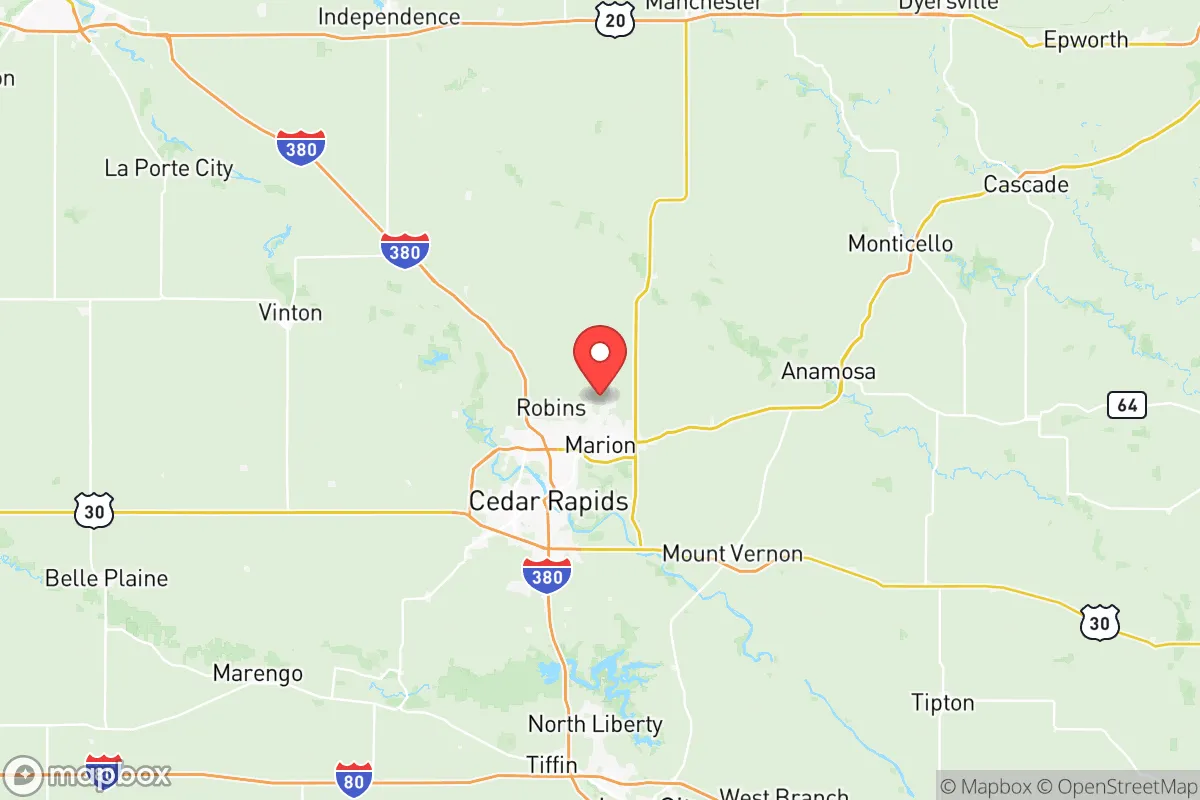
Linn County, Iowa, offers a notably high degree of personal sovereignty relative to many Midwestern urban centers, blending a conservative-leaning state legal framework with a local governance culture that generally respects individual autonomy. While the county seat of Cedar Rapids introduces some urban regulatory density, the broader county—including towns like Marion, Hiawatha, and rural areas near Mount Vernon and Central City—maintains a light-touch environment that appeals to those prioritizing self-reliance and minimal government interference. The balance between state-level protections and local ordinances creates a nuanced landscape where personal freedoms are robust but not absolute, making it a compelling option for single individuals and families seeking independence without the extremes of either rural isolation or metropolitan overreach.
Tax burden and regulatory posture: how Linn County compares to surrounding areas
Iowa's state-level tax structure is moderate, with a flat individual income tax rate of 3.8% as of 2025 and a state sales tax of 6%, which applies to most goods but exempts groceries and prescription drugs. Linn County adds a local option sales tax of 1%, bringing the total to 7% in most jurisdictions—competitive with neighboring Johnson County (home to Iowa City) but slightly higher than more rural counties like Benton or Jones. Property taxes in Linn County average around 1.5% of assessed value, which is typical for Eastern Iowa but notably lower than the 2%+ rates common in Illinois or parts of the Twin Cities metro. The regulatory posture is business-friendly at the state level, with Iowa ranking in the top 15 for economic freedom according to the Fraser Institute. Locally, Cedar Rapids has streamlined permitting for small businesses and home-based enterprises, while unincorporated areas of the county impose minimal zoning restrictions. Marion and Hiawatha maintain their own municipal codes but generally avoid the kind of overlay districts or design review boards that slow development in more progressive cities. For a reader comparing tax burdens, Linn County sits in a sweet spot: lower than the coasts and many Great Lakes states, but not as aggressively low-tax as South Dakota or Texas.
Self-defense and gun law specifics: what the Second Amendment landscape looks like in Linn County
Iowa is a shall-issue state for concealed carry permits, meaning the sheriff's office in Linn County must issue a permit to any qualified applicant who passes a background check and completes a training course. As of 2021, Iowa also became a permitless carry state, allowing any legal firearm owner aged 21 or older to carry a concealed handgun without a permit—a significant expansion of self-defense rights that applies uniformly across Linn County. The sheriff's office in Cedar Rapids processes permits efficiently, with typical turnaround times of 30 days or less. Local gun culture is strong but not ostentatious; ranges like the Cedar Valley Shooting Range near Central City and the Hawkeye Rod and Gun Club in rural Linn County provide training and practice facilities. There are no county-level magazine capacity restrictions or assault weapon bans, and the state preempts local governments from enacting their own firearm ordinances—meaning Cedar Rapids cannot impose stricter rules than the state allows, a critical protection for gun owners. Stand-your-ground laws are in effect, and there is no duty to retreat in any place where a person is lawfully present. For a family moving to the area, the legal environment is unambiguous: self-defense rights are broadly protected, and the county's law enforcement culture respects those rights without the friction seen in more restrictive states.
Self-reliance and homesteading viability: lot sizes, zoning, and off-grid feasibility across Linn County
Homesteading and self-reliance are highly viable in the rural and exurban portions of Linn County, though the feasibility varies significantly by location. Unincorporated areas and towns like Central City, Coggon, and Walker allow for large lot sizes—often 5 to 40 acres—with minimal building code enforcement beyond basic septic and well requirements. Zoning in these areas is permissive: raising livestock, keeping chickens, and maintaining gardens are generally unrestricted, and there are no county-level bans on rainwater collection or composting toilets. Off-grid living is legally feasible, though Iowa's building code requires a minimum square footage for new dwellings (typically 720 square feet) and connection to an approved water source, which can be a private well. Solar panels and small wind turbines are allowed without special permitting in unincorporated areas, and net metering is available through Alliant Energy and Linn County REC. In contrast, Cedar Rapids and Marion enforce stricter urban zoning: lot sizes are typically under a quarter-acre, and keeping livestock is limited to small flocks of chickens with a permit. Hiawatha falls somewhere in between, allowing backyard chickens but restricting larger animals. For a family serious about self-reliance, the recommendation is clear: look at properties outside the urban service area, particularly around Coggon or Walker, where regulatory friction is lowest and land prices remain under $10,000 per acre.
Personal liberties: parental rights, medical autonomy, speech, and property protections
Iowa's legal framework provides strong protections for parental rights, including a 2021 law that requires schools to notify parents of any medical or mental health services provided to students and to obtain parental consent for most non-emergency care. This applies uniformly across Linn County school districts, including Cedar Rapids Community Schools, Marion Independent, and the College Community district near Fairfax. Medical autonomy is more mixed: Iowa does not have a state-level vaccine mandate for adults, and COVID-era restrictions were lifted early compared to neighboring states, but the state maintains standard vaccination requirements for school attendance with limited opt-out provisions. Speech protections are robust, with no state-level hate speech laws that could chill expression, and public forums in Cedar Rapids and Marion have seen active political discourse without notable suppression. Property rights are well-protected under Iowa law, with eminent domain limited to public use projects and a requirement for just compensation that includes relocation assistance. Linn County does not have rent control or inclusionary zoning mandates, and short-term rental regulations are minimal outside of Cedar Rapids, where a registration system exists but no cap on permits. For a reader weighing personal liberties, Linn County offers a legal environment that leans heavily toward individual choice in family and property matters, with the primary constraint being the state's uniform school vaccination policy.
Overall, Linn County delivers a level of personal sovereignty that ranks among the highest in the Midwest for an area with urban amenities. The combination of permitless carry, low property taxes, permissive rural zoning, and strong parental rights creates an environment where self-reliant individuals and families can operate with minimal government friction. Compared to Johnson County to the south or Polk County to the west, Linn County strikes a more balanced posture—less regulatory than Iowa City, less politically charged than Des Moines, and more accommodating of traditional freedoms. For a conservative-leaning reader evaluating relocation options, the county represents a pragmatic choice: high autonomy without the trade-offs of extreme rural isolation or the hostility to personal independence found in many metropolitan areas of similar size.

* Values derived from national, state, county, city and local statistics and may differ in a specific area. Last updated: 2026-07-24T14:21:29.000Z
Narrative content on this page is AI-generated and may contain mistakes. Verify any details that matter before acting on them.
ReloMaps may earn a commission from affiliate links at no extra cost to you.

