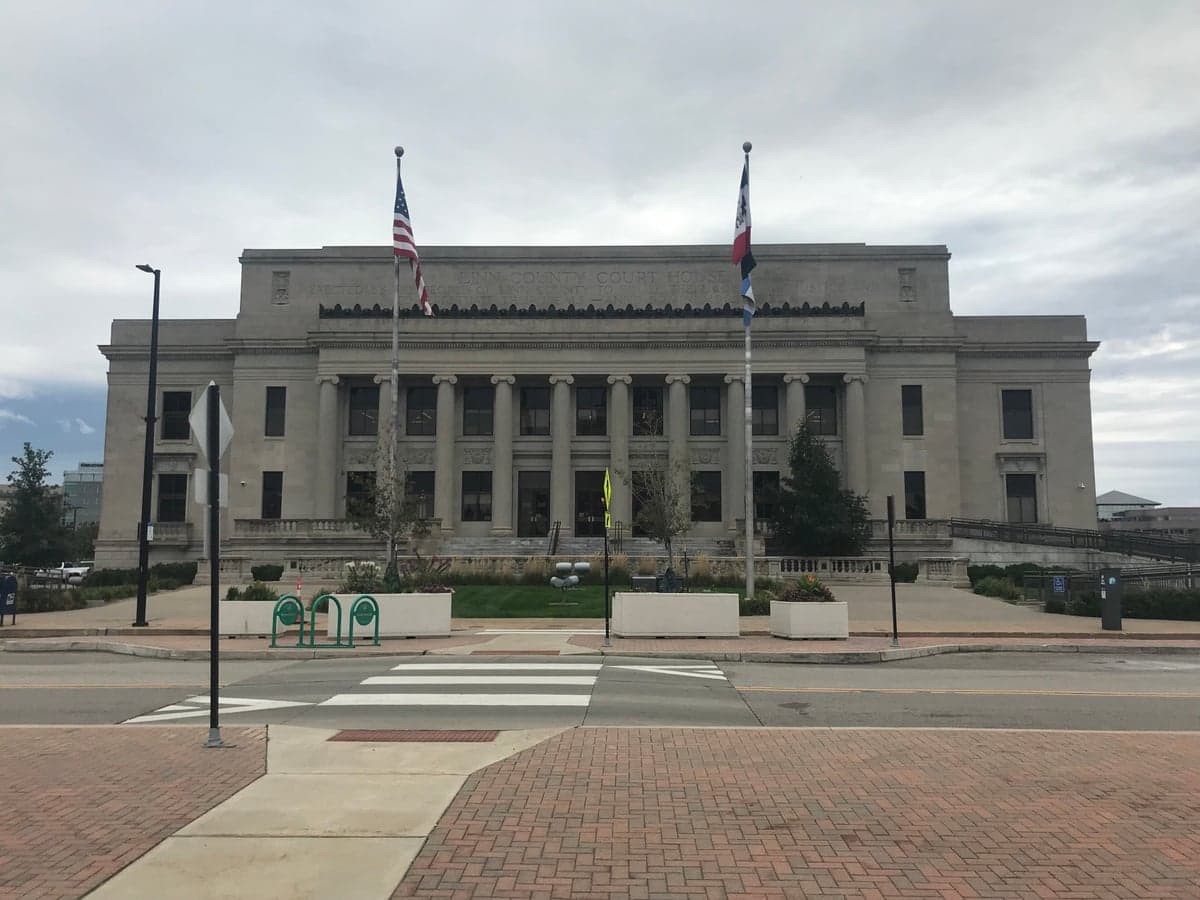
Photo: Wikipedia
Demographics of Linn County
Affluence Level in Linn County
A middle-class area roughly in line with national averages across income, home values, education, and employment.
People of Linn County
Linn County, Iowa, is home to 229,463 residents, making it the second-most populous county in the state, anchored by the manufacturing and insurance hub of Cedar Rapids. The population is predominantly white (83.0%) and native-born (only 2.4% foreign-born), with a character shaped by successive waves of European immigration, a modest but growing Black and Hispanic presence, and a strong Midwestern work ethic tied to the land and industry. The county’s distinctive identity is one of quiet stability: a place where Czech, German, and Irish heritage is still celebrated in small towns like Solon and Mount Vernon, and where the economy has historically been driven by meatpacking, grain milling, and later, high-tech manufacturing and insurance.
Settlement & growth (pre-1960)
Before American settlement, the area now known as Linn County was home to the Meskwaki (Fox) and Sauk nations, who used the Cedar River valley for seasonal hunting and fishing. The first permanent American settlers arrived in the 1830s and 1840s, primarily Yankees from New England and upstate New York, who were drawn by the federal government’s land grants in the Iowa District. These early settlers founded the county seat of Cedar Rapids in 1849, naming it for the rapids on the Cedar River that powered the first mills. The town of Marion, established in 1839, served as the original county seat and attracted a mix of farmers and tradesmen from the Ohio River Valley.
The major demographic wave came with the German and Czech immigration of the 1850s through 1880s. German Catholics and Lutherans settled heavily in Fairfax and Walford, where they established tight-knit farming communities and built churches that still anchor those towns today. Czechs (then called Bohemians) arrived in even larger numbers, particularly after the 1848 revolutions in Europe, and concentrated in Cedar Rapids’s Czech Village neighborhood and the surrounding rural areas of Lisbon and Mount Vernon. By 1900, Czech was the second-most-spoken language in the county, and the Czech Village area remains a cultural touchstone with its museums, bakeries, and annual festivals.
The Irish came in a smaller but significant wave during the 1860s and 1870s, many fleeing the Great Famine and finding work building the railroads that crisscrossed the county. They settled in Palo and Central City, where Irish Catholic parishes were established. The early 20th century brought a smaller influx of Swedish and Norwegian immigrants, who farmed in the northern part of the county near Coggon and Walker. By 1920, the county’s population was overwhelmingly white, native-born, and European-descended, a pattern that held through the Great Depression and World War II. The post-war boom saw suburbanization begin around Cedar Rapids, but the county’s ethnic character remained largely unchanged through 1960.
Modern era (post-1965)
The 1965 Hart-Cellar Act had a relatively muted effect on Linn County compared to coastal regions, but it did open the door for new immigrant groups. The most notable post-1965 arrivals were Vietnamese and Laotian refugees who resettled in Cedar Rapids in the late 1970s and 1980s, sponsored by local churches and social service agencies. Today, the East/Southeast Asian community (1.2% of the county) is concentrated in Cedar Rapids’s southeast side, near the Collins Aerospace and Rockwell Collins plants that provided manufacturing jobs. A smaller but growing Indian-subcontinent community (1.1%) arrived later, from the 1990s onward, drawn by professional jobs in the insurance and technology sectors; they are more dispersed, with clusters in Cedar Rapids’s western suburbs and in Hiawatha.
The Black population (5.7%) has deeper roots, dating to the Great Migration of the 1910s–1940s, when African Americans from the Deep South came to work in the meatpacking plants of Cedar Rapids. That community grew slowly through the 20th century and has become more suburbanized in recent decades, with significant numbers now living in Marion and Robins. The Hispanic population (4.0%) is the fastest-growing demographic, driven by Mexican and Central American immigration since the 1990s, primarily for work in food processing, construction, and agriculture. The Hispanic community is concentrated in Cedar Rapids’s southwest side and in the smaller towns of Fairfax and Walford, where meatpacking plants are major employers.
Domestic migration has been relatively modest. Linn County has not experienced the explosive Sun Belt growth of Texas or Florida, but it has seen a steady inflow from other Midwestern states, particularly Illinois and Minnesota, as people seek lower taxes and a lower cost of living. Suburbanization has pushed growth outward from Cedar Rapids into Marion, Hiawatha, and Robins, which have seen new housing developments and retail growth. The county’s foreign-born share (2.4%) remains low by national standards, but the diversity of that small share has increased markedly since 2000.
The future
Linn County is becoming slowly but steadily more diverse. The white share of the population (83.0%) is declining gradually, while the Hispanic and Black shares are rising. The East/Southeast Asian and Indian-subcontinent communities are growing from a small base, driven by professional recruitment at major employers like Collins Aerospace, Transamerica, and General Mills. The county’s overall population growth is modest—projected at 5–8% over the next decade—with most new residents settling in the suburban ring around Cedar Rapids rather than in the rural towns.
The cultural identity of the county is evolving from a historically Czech-German farming and manufacturing base toward a more pluralistic, service-oriented economy. The Czech Village and the annual Houby Day festival remain important cultural markers, but they are increasingly shared with Hispanic fiestas, Vietnamese Lunar New Year celebrations, and Indian Diwali events. The rural towns—Palo, Central City, Lisbon—are likely to remain predominantly white and older, while Cedar Rapids and its inner suburbs will absorb most of the demographic change. The county is not on track to become a majority-minority region in the foreseeable future, but its character is shifting from homogeneous to moderately diverse.
For someone moving to Linn County now, the bottom line is this: you are entering a stable, family-oriented Midwestern community where the economy is strong, the schools are good, and the cost of living is reasonable. The population is still overwhelmingly white and native-born, but the county is gradually opening to new cultures and new people. If you value a place where your neighbors have been here for generations but are welcoming to newcomers, Linn County offers that balance. The growth is steady, not explosive, and the character is rooted in its Czech and German heritage, even as new communities plant their own flags in Cedar Rapids, Marion, and Hiawatha.

* Values derived from national, state, county, city and local statistics and may differ in a specific area. Last updated: 2026-07-24T14:21:29.000Z
Narrative content on this page is AI-generated and may contain mistakes. Verify any details that matter before acting on them.
ReloMaps may earn a commission from affiliate links at no extra cost to you.

