Photo: Wikipedia
Political ClimatePolitical Climate in Dubuque County
Showing district-level results — no local-only data available.
Local Political AnalysisPolitical Analysis of Dubuque County
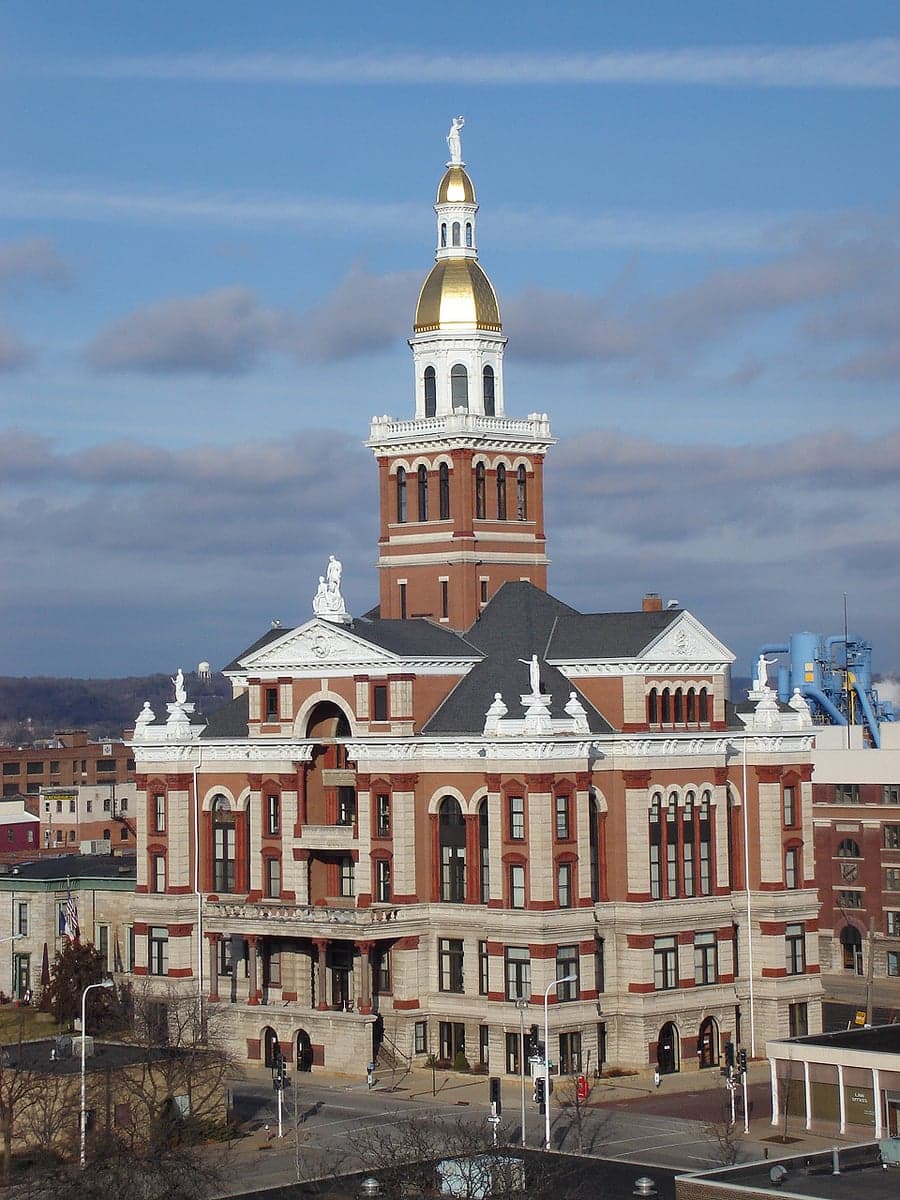
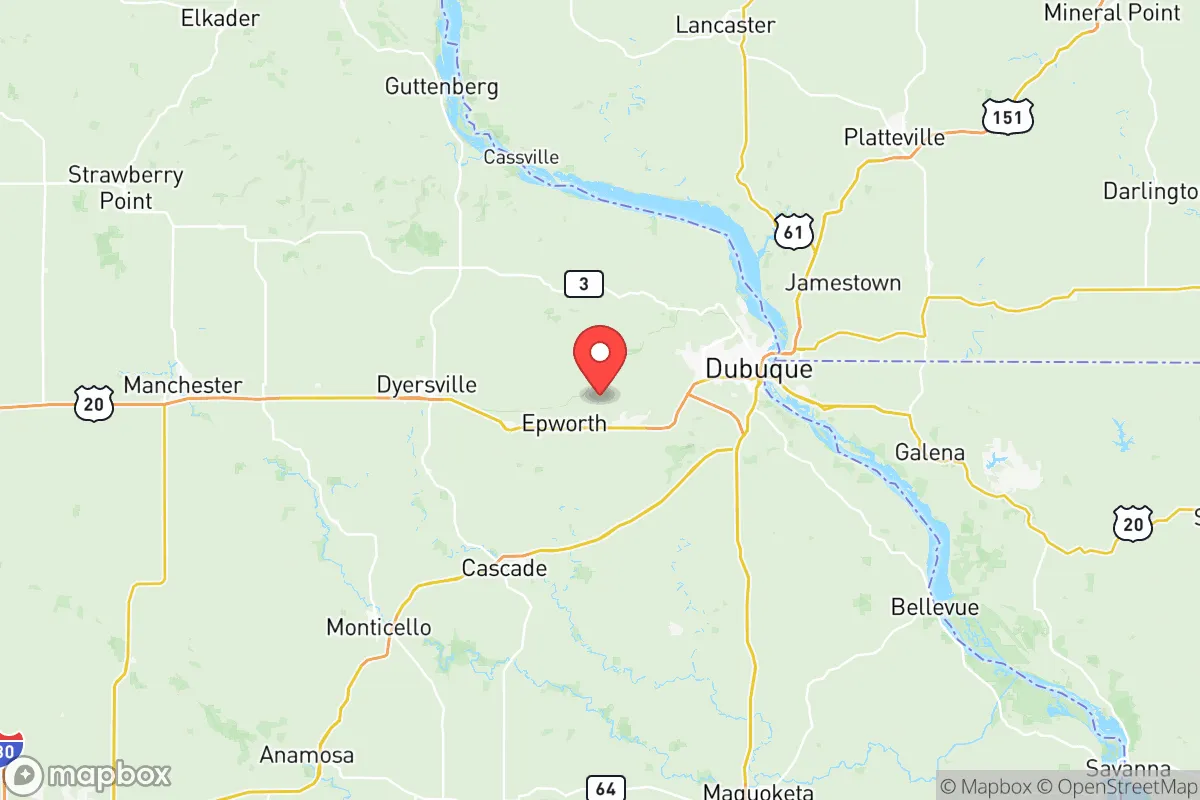
Dubuque County has been a classic bellwether in Iowa politics for decades, but its recent drift rightward is unmistakable. The county’s Cook Partisan Voting Index (PVI) of R+4 means it leans about four points more Republican than the nation as a whole, though it remains slightly more Democratic than the state of Iowa overall, which sits at R+6. This gap has narrowed significantly since the 2000s, when Dubuque County was a true swing county or even a lean-blue anchor in northeast Iowa. The shift is most visible in the county’s rural precincts and smaller towns, which have moved sharply red, while the city of Dubuque itself has held more steady as a Democratic-leaning island.
How it compares to Iowa as a whole
Dubuque County’s R+4 PVI makes it about two points more Democratic-leaning than the statewide R+6 average, but that’s a thinner cushion than it used to be. In the 2020 presidential election, Donald Trump carried the county by roughly 4 points, while he won Iowa by about 8 points — so the county tracked about 4 points to the left of the state. That’s a meaningful gap, but it’s half what it was a decade ago. The real story is the divergence within the county: the city of Dubuque, home to about 60,000 people, still votes reliably blue in most races, powered by union households, the University of Dubuque and Loras College communities, and a historic Catholic working-class base. Drive 15 minutes outside the city limits, though, and towns like Asbury, Peosta, and Farley vote heavily Republican, often by 20-30 point margins. The swing precincts are now concentrated in the suburbanizing fringe around Dubuque’s west and northwest sides — places like Sherrill and the rural areas near Sageville — where new housing developments are bringing in families who lean conservative on taxes and regulation but are less culturally hardline than deep-rural voters.
What this means for residents
For conservative residents, Dubuque County offers a comfortable environment where Republican candidates are competitive at every level, but the local Democratic minority is still large enough to keep politics from feeling like a monolith. The county GOP is active and well-organized, especially in the towns of Dyersville and Cascade, where conservative social values and agricultural policy priorities dominate local discourse. For liberal residents, the picture is more mixed: the city of Dubuque itself remains a place where progressive candidates can win city council and school board seats, and the county’s Democratic Party still fields strong candidates for state legislative races. But the countywide trend is undeniably rightward, and Democratic voters in rural towns like Holy Cross or Rickardsville often feel politically isolated. The practical effect is that local governance tends toward moderation — county supervisors and school boards usually include members from both parties, and policy debates are rarely as polarized as in deep-red western Iowa or deep-blue Johnson County.
Culturally, Dubuque County retains a distinct identity within Iowa. The area’s Catholic heritage, strong labor union presence (especially in manufacturing and construction), and historic Mississippi River trade economy create a political culture that is more pragmatic and less ideologically rigid than much of the state. Issues like local infrastructure funding, riverfront development, and support for the John Deere and Flexsteel plants often cross party lines. The county’s growing Hispanic population, concentrated in Dubuque’s south side and in Dyersville’s meatpacking workforce, is beginning to shift the demographic calculus, though it hasn’t yet produced a major electoral realignment. Looking ahead, Dubuque County will likely remain a competitive battleground — not as blue as it was in the 1990s, but not as red as the rest of Iowa, either. The key to watch is whether the suburban swing precincts around Asbury and Peosta continue trending Republican, or whether the city of Dubuque’s growing young professional and immigrant populations can offset that shift.

State Political ClimatePolitical Climate in Iowa
State Political AnalysisPolitical Environment in the State
Iowa has shifted from a classic purple swing state to a solidly Republican one, carrying a Cook PVI of R+6 after trending rightward for nearly two decades. The state backed Donald Trump by 8 points in 2020 and 13 points in 2024, a dramatic departure from 2000 and 2004 when it was decided by less than a single point. Democrats still hold sway in a handful of urban counties and college towns, but the GOP now controls the governorship, both legislative chambers, and both U.S. Senate seats, making the practical experience of living here heavily shaped by conservative policy.
Urban vs. rural divide
The political map of Iowa is a textbook case of the urban-rural split. The Democratic strongholds are concentrated in three main areas: Polk County (Des Moines), Johnson County (Iowa City), and Story County (Ames). In 2024, Johnson County voted for Kamala Harris by a 30-point margin, while Story County gave her a 15-point win. These three counties alone account for roughly 25% of the state's population, but they are increasingly isolated. The rest of the state — from the Mississippi River towns like Dubuque and Davenport to the agricultural heartland around Sioux City, Council Bluffs, and Mason City — has moved decisively red. Dubuque County, which voted for Barack Obama twice, flipped to Trump in 2016 and has stayed Republican since. The shift is most visible in the small industrial towns along the rivers, where manufacturing job losses and cultural anxiety have driven a realignment that feels permanent. For a relocator, this means your day-to-day political environment depends heavily on which part of the state you land in — Des Moines and Iowa City feel like blue islands, while the rest of Iowa is unmistakably conservative.
Policy environment
Iowa's policy landscape is defined by low taxes, limited regulation, and a hands-on approach to social issues. The state has a flat individual income tax rate of 3.8%, down from nearly 9% a decade ago, with a scheduled phase-down to 3.65% by 2026. Property taxes are moderate, and the state does not tax retirement income, which is a major draw for older relocators. On education, Iowa passed a universal school voucher program in 2023 — the Education Savings Account program — allowing any family to use public funds for private or homeschool expenses. This was a landmark shift in a state that historically prided itself on strong public schools. Healthcare policy has been mixed: Iowa expanded Medicaid under the Affordable Care Act, but the state also imposed work requirements for able-bodied adults, which were later blocked by courts. Election laws tightened in 2021 and again in 2024, with reduced early voting windows, stricter voter ID requirements, and a ban on drop boxes. For a conservative relocator, the tax and school choice environment is highly attractive; for a liberal one, the voting restrictions and social policy direction may give pause.
Recent policy direction
The last five years have seen Iowa pass a concentrated slate of legislation that signals where the state is headed. On gun rights, Iowa became a permitless carry state in 2021, meaning any law-abiding adult can carry a concealed firearm without a permit or training. Stand-your-ground laws are already on the books. On parental rights and education, the state banned teaching of critical race theory and gender identity concepts in K-12 schools (2022), and the 2023 voucher law effectively ended the traditional public school monopoly. On medical and bodily autonomy, Iowa passed a six-week abortion ban in 2023, which took effect after a court ruling in 2024; there are no exceptions for rape or incest, only for medical emergencies. On property rights, the state has strong eminent domain protections for landowners, particularly against carbon pipeline projects that have sparked fierce resistance. On privacy and surveillance, Iowa has no broad data privacy law comparable to California or Virginia, though it does regulate government drone use. On voting, the 2021 law (SF 413) shortened early voting from 29 days to 20, closed polls at 8 p.m. instead of 9, and banned county auditors from sending out absentee ballot request forms. The cumulative effect is a state that has moved decisively toward conservative positions on nearly every liberty axis a relocator might weigh.
Civil unrest & political movements
Iowa has seen its share of political friction, though it rarely makes national headlines. The most visible flashpoint in recent years has been the carbon pipeline controversy, where companies like Summit Carbon Solutions sought to build CO2 pipelines across hundreds of miles of farmland. Landowners — many of them conservative — organized massive resistance, leading to county-level ordinances restricting pipeline construction and a broader debate about eminent domain abuse. This movement has been genuinely bipartisan, uniting rural Democrats and Republicans against corporate interests. On the left, the Iowa City and Des Moines areas have seen periodic protests over abortion rights and racial justice, including large demonstrations after the Dobbs decision in 2022. Immigration politics are less heated than in border states, but Governor Kim Reynolds sent Iowa National Guard troops to the Texas border in 2021 and again in 2024, and the state passed a law allowing state officials to arrest and deport undocumented immigrants — a direct challenge to federal authority. Election integrity controversies flared after 2020, with some rural counties pushing for hand-count audits, though no widespread fraud was ever documented. For a new resident, the most tangible sign of political energy will be the yard signs and local meetings around pipeline fights and school board elections — these are the issues that actually animate Iowans day to day.
Projection
Over the next five to ten years, Iowa is likely to become more Republican, not less. The demographic trends driving this are clear: the state's population is aging and rural areas are shrinking, while the urban counties that vote blue are growing slowly. In-migration from Illinois and Minnesota tends to be conservative-leaning, as people move for lower taxes and housing costs. The college towns — Ames, Iowa City, and Cedar Falls — will remain blue, but they lack the population mass to flip statewide elections. The GOP's grip on the legislature is reinforced by gerrymandered maps drawn in 2021, which are widely considered among the most aggressive in the country. The wild card is the carbon pipeline fight and broader rural populism: if the GOP is seen as too cozy with corporate interests, a libertarian or independent backlash could emerge, but it would likely pull the state even further right rather than toward the center. For someone moving in now, expect a decade from now to find a state where conservative policy is the baseline, not the exception.
For a relocator, the bottom line is straightforward: if you are a conservative or libertarian-leaning individual or family, Iowa offers a policy environment that aligns closely with your values — low taxes, school choice, gun rights, and limited government interference in daily life. If you are a liberal, you will find welcoming communities in Des Moines, Iowa City, and Ames, but you will be living in a state where your vote has diminishing statewide impact and where state law will frequently conflict with your preferences on abortion, education, and civil rights. Either way, Iowa is a place where politics is felt in concrete ways — in your tax bill, your child's school options, and the laws that govern your daily life — and that is unlikely to change anytime soon.
* Values derived from national, state, county, city and local statistics and may differ in a specific area. Last updated: 2026-07-03T00:25:59.000Z
Narrative content on this page is AI-generated and may contain mistakes. Verify any details that matter before acting on them.
ReloMaps may earn a commission from affiliate links at no extra cost to you.

