
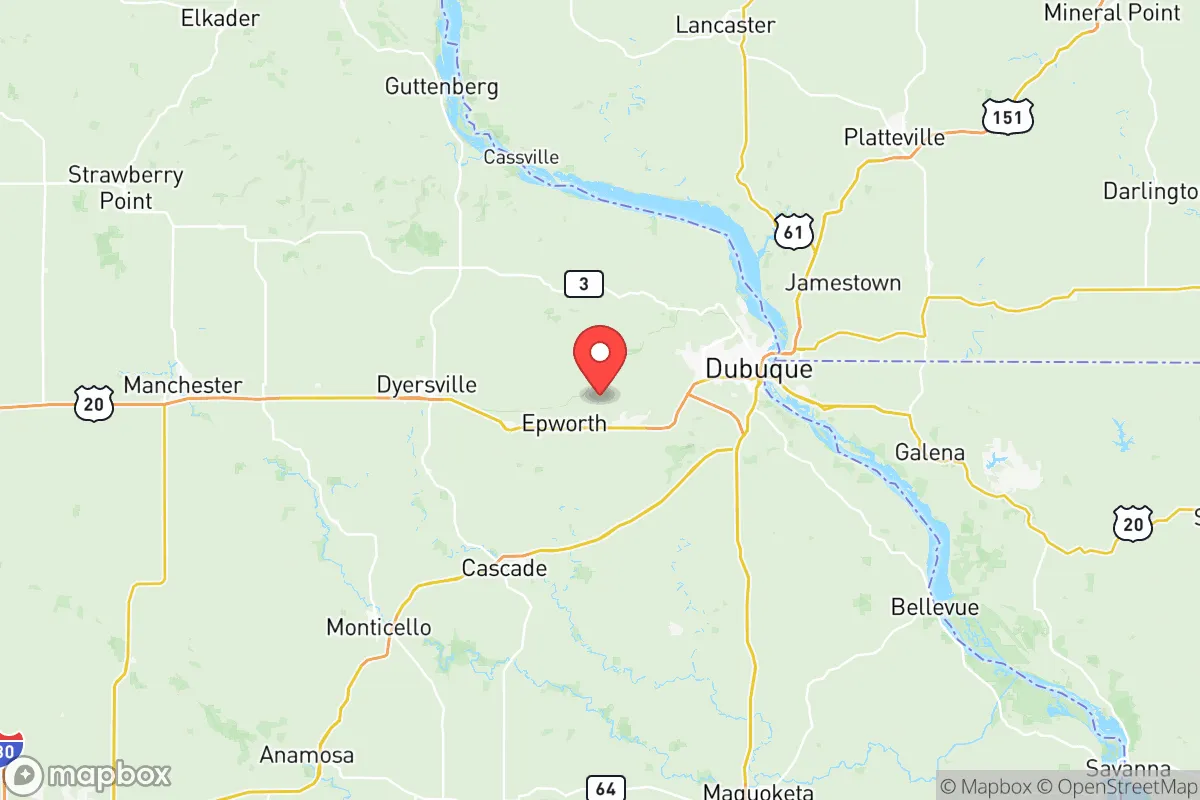
Photo: Wikipedia
Personal Sovereignty in Dubuque County
Viable for self-reliance. Generally workable, though some barriers may limit total independence.
What does Personal Sovereignty tell us?
Personal Sovereignty measures your capacity for self-reliance and independence with minimal government friction. Higher scores mean fewer barriers between you and the way you want to live... but it assumes you have the space you need and good neighbors.
What does this tell us?
Personal Sovereignty measures your capacity for self-reliance and independence with minimal government friction. Higher scores mean fewer barriers between you and the way you want to live... but it assumes you have the space you need and good neighbors.
State Policy
Energy independence: Importer (50% of energy produced in-state)
Personal Liberty
Homesteading

Personal Liberty Analysis
Dubuque County offers a notably high degree of personal sovereignty compared to many urbanized areas in the Midwest, largely due to Iowa’s statewide preemption laws that limit local government overreach on firearms, taxation, and property use. While the county itself is not a libertarian enclave, its regulatory environment is characterized by a light-touch approach in rural townships and a more structured, but still reasonable, posture within the city of Dubuque. For a relocation-minded individual or family prioritizing autonomy, the county presents a spectrum of freedom—from the near self-governance of rural plots to the predictable, rights-respecting framework of its county seat.
Tax burden and regulatory posture across Dubuque County
Iowa’s state-level tax reforms have significantly reduced the burden on residents, with a flat income tax rate of 3.8% scheduled to drop to 3.65% by 2026, and no inheritance tax. Dubuque County itself levies a property tax rate that is moderate for the state, typically falling between $32 and $38 per $1,000 of taxable valuation depending on the specific city or township. The regulatory posture is distinctly pro-business and pro-property owner: there is no county-level zoning in unincorporated areas like Table Mound Township or Peru Township, meaning landowners face fewer hurdles for building sheds, fences, or home-based businesses. In contrast, the city of Dubuque enforces standard municipal zoning and building codes, but even there, the permitting process is straightforward and fees are low relative to peer cities like Cedar Rapids or Davenport. For those seeking maximum regulatory freedom, the unincorporated townships of Center Grove and Moscow offer a near hands-off environment where county oversight is limited to basic health and safety codes.
Self-defense and gun law specifics in Dubuque County
Iowa is a constitutional carry state, and Dubuque County fully respects that right. No permit is required to carry a concealed firearm for any law-abiding adult 21 or older, and the county sheriff’s office issues permits to acquire and professional permits on a shall-issue basis with minimal wait times. The county itself is not a hotbed of gun culture, but it is decidedly gun-friendly: the city of Dubuque has no local ordinances restricting magazine capacity, ammunition types, or storage requirements beyond state law. In the more rural communities like Balltown and St. Donatus, firearm ownership is common and socially accepted, with many residents using guns for hunting and sport shooting. The nearest indoor range is in Dubuque, and outdoor shooting areas are accessible in the county’s public hunting grounds. Stand-your-ground laws apply statewide, and there are no red-flag laws on the books, giving residents a strong legal foundation for self-defense.
Self-reliance and homesteading viability in Dubuque County
Homesteading and off-grid living are viable in Dubuque County, particularly in its rural townships where lot sizes are generous and zoning is minimal. In unincorporated areas like Table Mound Township, minimum lot sizes for agricultural parcels are typically 5 acres, while smaller rural residential lots can be as small as 1 acre. There are no county-level restrictions on rainwater collection, composting toilets, or solar panel installation, making off-grid setups feasible. The city of Dubuque does require connection to municipal water and sewer within city limits, but in towns like Sherrill and Durango, well water and septic systems are the norm. Livestock ordinances are lenient in rural areas—chickens, goats, and even a few head of cattle are common on parcels of 2 acres or more. For those seeking true self-reliance, the county’s agricultural extension office offers soil testing and crop planning resources, and local feed stores in Dubuque and Asbury supply everything needed for small-scale farming.
Personal liberties in Dubuque County
Parental rights are strongly protected in Iowa, and Dubuque County schools generally defer to parents on matters of curriculum objections, medical decisions, and opt-outs. The county’s school districts, including Dubuque Community Schools and Western Dubuque Community Schools, have transparent policies on instructional materials and allow parents to review and challenge content. Medical autonomy is similarly robust: Iowa has no state-level vaccine mandate for adults, and while schools require standard immunizations, medical and religious exemptions are available. Free speech is fully protected, and the county has no history of suppressing political expression, whether at public meetings or on private property. Property rights are the cornerstone of local sovereignty—eminent domain is rarely used, and the county assessor’s office provides clear, appealable valuations. In the rural townships, property owners enjoy near-total control over their land, with no HOA-style restrictions or overlay districts.
Overall, Dubuque County ranks among the more sovereignty-respecting areas in the Upper Midwest, offering a balance of rural freedom and urban predictability. For a conservative-leaning individual or family, the county’s combination of constitutional carry, low taxes, minimal zoning in unincorporated areas, and strong parental rights creates an environment where personal autonomy is the default. Compared to counties in Illinois or Minnesota with similar population sizes, Dubuque County stands out for its light regulatory touch and respect for individual decision-making, making it a strong candidate for those who prioritize self-reliance and independence.

* Values derived from national, state, county, city and local statistics and may differ in a specific area. Last updated: 2026-07-03T00:25:59.000Z
Narrative content on this page is AI-generated and may contain mistakes. Verify any details that matter before acting on them.
ReloMaps may earn a commission from affiliate links at no extra cost to you.

