Photo: Wikipedia
Demographics of Dubuque County
Affluence Level in Dubuque County
A middle-class area roughly in line with national averages across income, home values, education, and employment.
People of Dubuque County
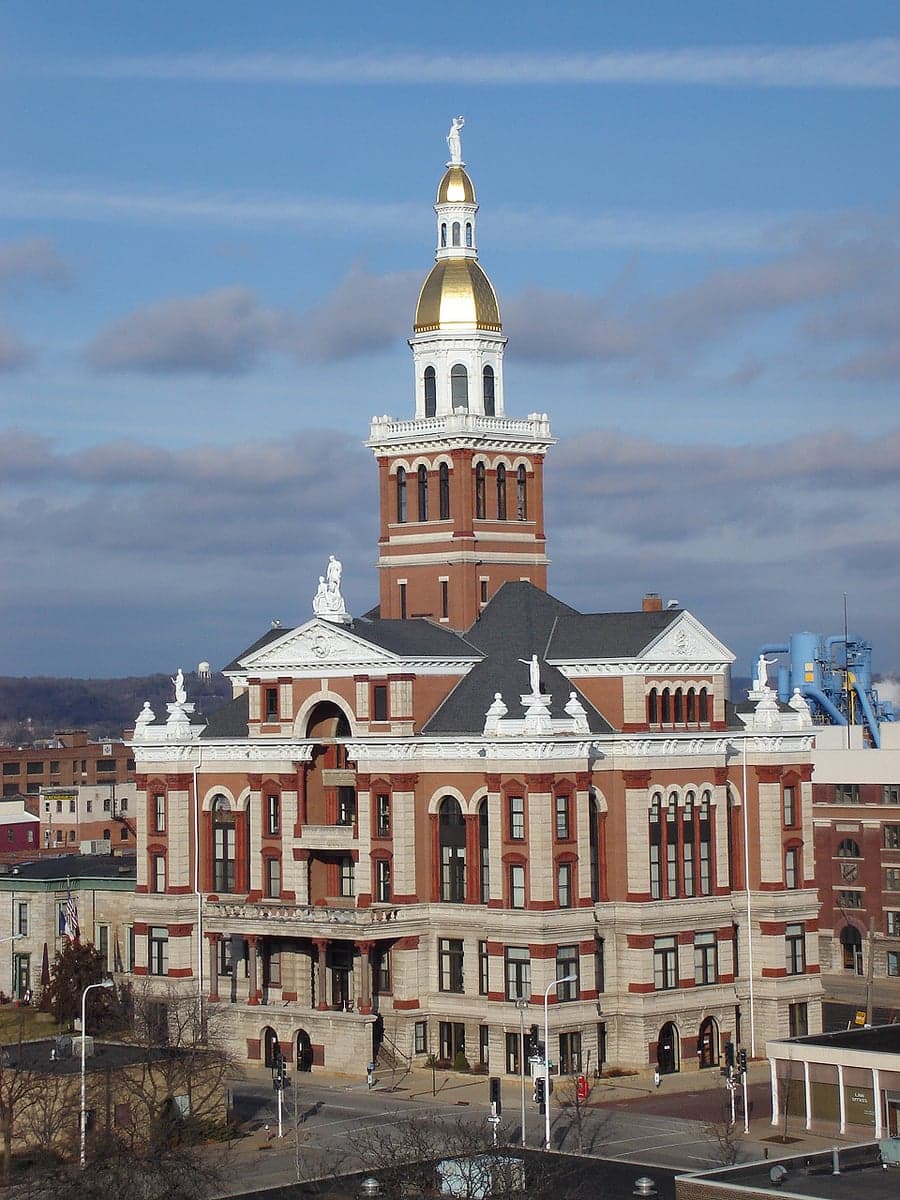
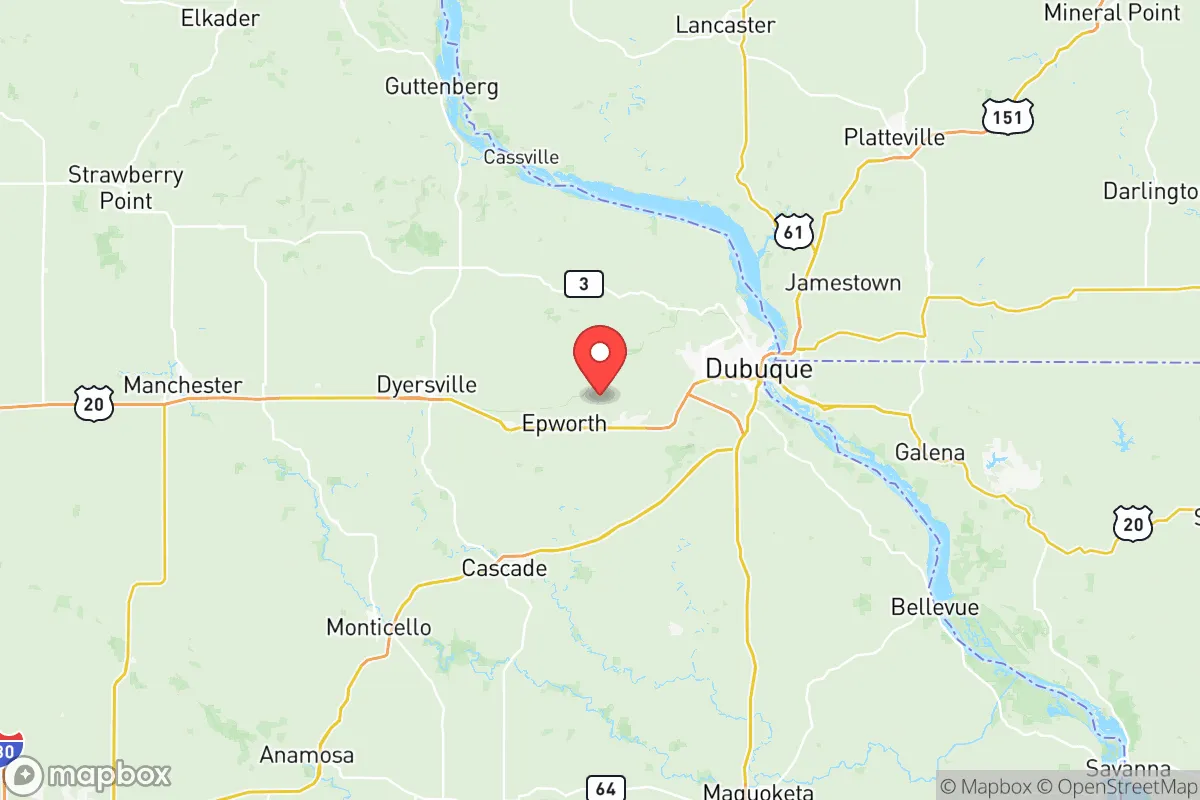
Today, Dubuque County is home to roughly 98,948 residents, a population that is notably older and more rooted than the national average, with a strong European-heritage character that is 88.9% white and only 2.1% foreign-born. The county’s identity is shaped by its Mississippi River bluff geography, a resilient manufacturing and healthcare economy, and a distinct tri-state regional culture that blends Midwestern reserve with a strong Catholic and Lutheran institutional presence. While the city of Dubuque dominates as the urban core, the county’s smaller towns—from the historic mill town of Cascade to the river hamlet of Bellevue—each carry their own settlement stories that still define local life.
Settlement & growth (pre-1960)
Long before European settlement, the area now known as Dubuque County was home to the Meskwaki and Sauk peoples, who used the Mississippi River as a highway and hunted the wooded bluffs. The first permanent non-Native presence came in 1788, when French-Canadian fur trader Julien Dubuque secured rights from the Meskwaki to work lead mines near the river—making this one of the oldest continuously settled European sites in the Upper Midwest. The region passed from French to Spanish to American control, but the lead rush that followed the 1833 Black Hawk Purchase brought the first major wave of American settlers: Cornish miners, who were experienced hard-rock miners from England, and Yankees from New England and New York, who established the city of Dubuque as a booming lead-mining and river-trading hub by the 1840s.
The second and far larger wave came with German immigration, beginning in the 1840s and accelerating through the 1880s. German Catholics and Lutherans were drawn by cheap land, the lead mines, and later the railroad and meatpacking industries. They settled heavily in the city of Dubuque, where they built St. Raphael’s Cathedral and founded the German-language newspaper Der Demokrat, and also fanned out into the countryside, establishing farming communities like Holy Cross and Luxemburg—the latter named by settlers from the Grand Duchy of Luxembourg. Irish immigrants arrived in significant numbers during the same period, fleeing the Great Famine, and concentrated in the city of Dubuque’s lower North End and along the riverfront, working on the railroads and in the mills. A smaller but notable wave of Swiss and French-speaking Belgians settled in the rolling hills around New Vienna and St. Donatus, where the latter town still preserves its distinctive Luxembourgish stone architecture.
By 1900, Dubuque County was overwhelmingly white, German-Catholic, and rural, with the city of Dubuque serving as a regional industrial center for lumber, brewing, and farm equipment. The early 20th century brought a modest influx of Eastern European immigrants—Poles and Czechs—who worked in the meatpacking plants and foundries, settling in the city’s North End and near the stockyards. The Great Migration of Black Americans from the South largely bypassed Dubuque County; the county’s Black population remained below 1% until the late 20th century. The post-World War II era saw suburbanization begin in earnest, with families moving to new developments in Asbury and Peosta, but the county’s overall growth was slow, as the industrial base began to contract and young people left for larger cities.
Modern era (post-1965)
The 1965 Hart-Cellar Act had a muted effect on Dubuque County compared to coastal or Sun Belt regions. The foreign-born population remains just 2.1% today, far below the national average. However, the county has seen a slow but steady diversification since the 1990s, driven by two main forces: the arrival of Hispanic workers in the meatpacking and food-processing industries, and the resettlement of refugees through Catholic Charities. Hispanic residents now make up 3.1% of the population, with concentrations in the city of Dubuque’s West End and in Dyersville, where the agricultural economy has attracted Mexican and Central American families. The Black population, at 2.9%, includes a significant number of refugees from Bosnia and Africa—particularly Liberian and Sudanese communities—who were resettled in the city of Dubuque through church-sponsored programs in the 1990s and 2000s.
East and Southeast Asian communities, at 0.9%, are small but present, with Vietnamese and Chinese families concentrated in the city of Dubuque, often working in healthcare and higher education. The Indian-subcontinent population, at 0.3%, is primarily composed of professionals employed at John Deere’s Dubuque Works and at the University of Dubuque and Loras College. Domestic migration has been modest: the county has lost some young adults to Des Moines and the Twin Cities, but has attracted retirees and remote workers drawn to the lower cost of living and the scenic river bluffs. Suburbanization has continued, with Asbury growing as a bedroom community and Peosta expanding along the Highway 20 corridor, while the city of Dubuque has invested in revitalizing its downtown and riverfront to retain younger residents.
The future
Dubuque County’s population is projected to remain stable or decline slightly over the next decade, as the native-born white population ages and out-migration of young adults continues. The county’s median age is already above the national average, and the school-age population in the city of Dubuque has been shrinking. However, the Hispanic and refugee communities are younger and have higher birth rates, so the county will slowly become more diverse: the Hispanic share could reach 5-6% by 2035, and the Black share may rise to 4-5% as secondary migration from other Midwestern cities brings more families. The foreign-born share will likely remain below 5%, as the county lacks the large immigrant-service infrastructure or ethnic enclaves that drive chain migration in larger metros.
New residential development is concentrating in Asbury and Peosta, where new subdivisions are attracting families and commuters, while the city of Dubuque is seeing infill development in its downtown and near the University of Dubuque campus. The county’s cultural identity is evolving from a purely German-Catholic bastion to a more pluralistic, though still predominantly white, Midwestern community. The challenge ahead is economic retention: keeping young people and attracting new residents will require continued investment in healthcare, advanced manufacturing, and the growing tourism sector around the Mississippi River and the Field of Dreams movie site in Dyersville.
For someone moving in now, Dubuque County offers a stable, safe, and affordable environment with strong community institutions and a deep sense of place. The population is not changing rapidly, but it is changing—becoming slightly more diverse, slightly more suburban, and slightly more connected to the broader Midwest economy. The kind of person who will thrive here is someone who values rootedness, outdoor recreation, and a slower pace of life, and who is comfortable in a community where most people have been here for generations.

* Values derived from national, state, county, city and local statistics and may differ in a specific area. Last updated: 2026-07-03T00:25:59.000Z
Narrative content on this page is AI-generated and may contain mistakes. Verify any details that matter before acting on them.
ReloMaps may earn a commission from affiliate links at no extra cost to you.

