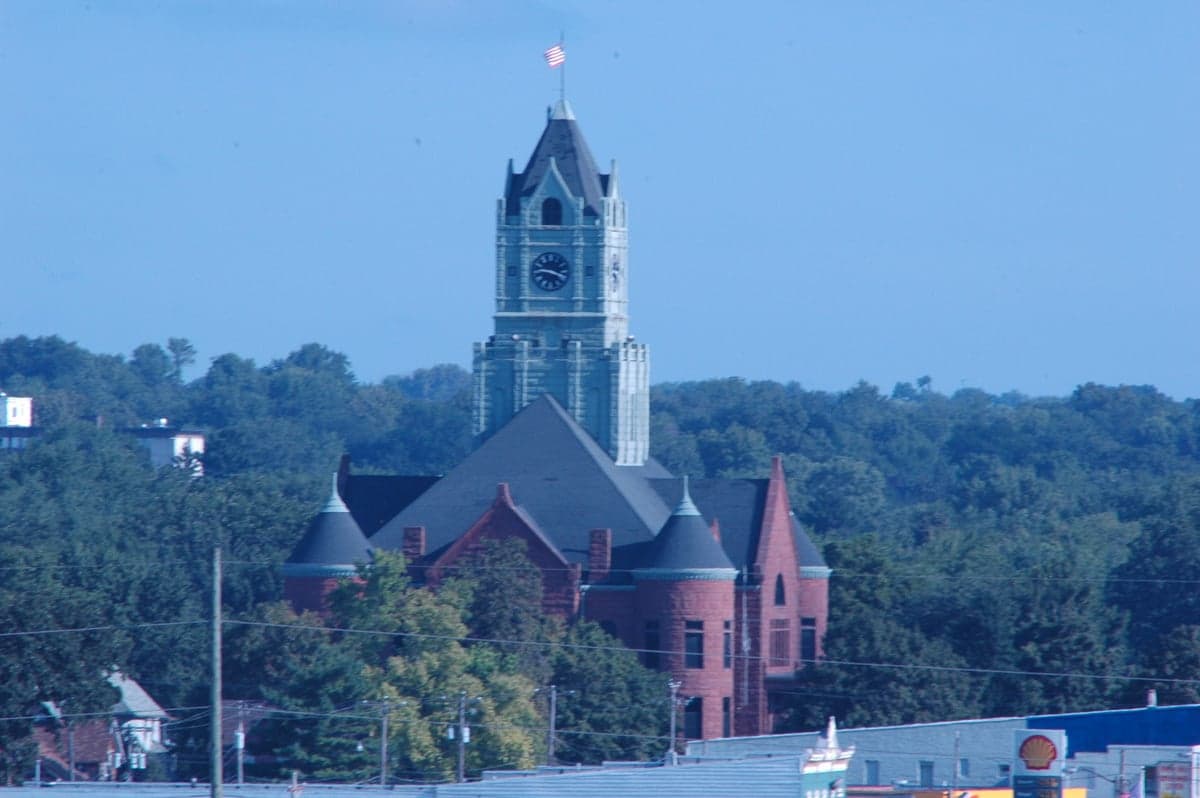
Photo: Wikipedia
Political ClimatePolitical Climate in Clinton County
Showing district-level results — no local-only data available.
Local Political AnalysisPolitical Analysis of Clinton County
Clinton County sits in a political gray zone that's more nuanced than its R+4 Cook PVI suggests. While the county has drifted rightward over the past decade — mirroring rural Iowa's broader shift — it still maintains a genuine two-party dynamic that sets it apart from the deep-red farm counties to its west. The county's political soul is split between its industrial, union-heavy Mississippi River towns and its more conservative rural townships, creating a battleground where margins rarely exceed single digits. In the 2024 presidential race, Clinton County voted for Donald Trump by about 8 points, noticeably closer than neighboring Jackson County (R+12) or the statewide R+6 margin.
How it compares
At first glance, R+4 vs. R+6 doesn't seem like a huge gap, but it masks real differences in political behavior. Clinton County is roughly 4-6 points more Democratic than Iowa as a whole in most statewide races, thanks to the unionized manufacturing base in the city of Clinton itself and the lingering Democratic machine in Camanche. The 2022 governor's race tells the story: Kim Reynolds won Iowa by 19 points, but only carried Clinton County by 10. By contrast, the southern part of the county — towns like Charlotte, Goose Lake, and Grand Mound — voted +20 to +30 R, more in line with the rest of rural Iowa. The swing precincts cluster in the middle: DeWitt, the county seat, tends to split almost evenly, finishing within 2-3 points of the statewide average in most elections. Wheatland and Calamus lean reliably red but by smaller margins than the deep south. So while Iowa as a whole has become a solidly red state in presidential years, Clinton County remains one of the few places where a Democrat can still win a county-level race (sheriff, supervisor) if they run a moderate, culturally conservative campaign.
What this means for residents
For liberal residents, especially in Clinton city proper, this creates a political landscape where local offices are legitimately winnable. Democrats hold several county supervisor seats as of 2025, and the county Democratic party remains more organized than in most eastern Iowa counties. You'll see yard signs for both parties on the same block in the city's older neighborhoods. For conservatives, the county's history of unionism means you're less likely to encounter the hard-right cultural orthodoxy found in, say, Cedar County. Abortion access and gun rights are debated here, but with less heat than in the state legislature — local candidates tend to focus on jobs, infrastructure, and the Mississippi River's economic future rather than culture wars. The practical effect: a Republican voter in Clinton won't feel isolated, but they'll encounter more political diversity at the grocery store than they would 20 miles west in Maquoketa.
Cultural and policy distinctions
The Mississippi River shapes everything, including politics. The county's reliance on barge traffic, manufacturing (like Arconic in Clinton and Grain Processing Corporation in Muscatine just north), and union labor gives economic issues a prominence that sometimes overrides national partisan loyalties. Both parties here support river infrastructure funding and oppose federal Clean Water Act overreach that would hinder industrial ports — a rare bipartisan consensus. Socially, the county is more religiously conservative than the Des Moines metro but less than central Iowa's evangelical belt. You'll find more Catholic and Mainline Protestant churches than megachurches, which tends to soften the edges of the culture war. The city of Clinton has a small but visible LGBTQ-friendly scene (a Pride event every June draws 500+ people), while rural townships remain more traditional. In practice, that means a liberal resident will find Clinton city a comfortable blue bubble within a purple county, while a conservative can live in DeWitt or the countryside and rarely feel outnumbered. The trajectory leans redder as retirees from farm country move into town and younger voters leave for the Quad Cities or Iowa City, but the shift is gradual — expect this county to remain a genuine swing seat for at least another decade.

State Political ClimatePolitical Climate in Iowa
State Political AnalysisPolitical Environment in the State
Iowa has shifted from a classic purple swing state to a solidly Republican-leaning one, carrying a Cook PVI of R+6. Over the past 20 years, the state that went for Obama twice and then flipped hard for Trump has seen its rural and small-town base consolidate behind the GOP, while Democratic strength has become increasingly concentrated in a handful of college towns and urban cores. The trajectory is clear: the state is redder and more reliably conservative than at any point since the 1980s, though it still holds some competitive pockets that keep things interesting.
Urban vs. rural divide
The political map of Iowa is a textbook study in the urban-rural split. The two major metros—Des Moines and Iowa City—are the blue anchors. Polk County (Des Moines) has been trending Democratic for years, and in 2020 it went for Biden by about 12 points, powered by the growing suburbs of West Des Moines and Ankeny that are becoming more moderate as they fill with white-collar transplants. Johnson County, home to the University of Iowa in Iowa City, is the bluest county in the state, routinely voting Democratic by 30+ points. On the flip side, the rest of the state is deeply red. Counties like Sioux County in the northwest (home to conservative Orange City) and Plymouth County near Le Mars routinely vote 70-80% Republican. The real story is the suburban ring around Des Moines—places like Dallas County (Waukee, Adel) flipped from blue-leaning to solidly red in the last two cycles, driven by a mix of evangelical voters and fiscally conservative families moving out from the city. The rural counties that once split tickets for local Democrats have almost entirely gone GOP, leaving the state's political geography starkly divided between the Des Moines-Iowa City corridor and everything else.
Policy environment
Iowa's policy environment is unmistakably conservative, but with a pragmatic Midwestern bent. The state has a flat income tax of 3.8% (phasing down to 3.5% by 2027), no inheritance tax, and a relatively low corporate tax rate. Property taxes are moderate, though local levies vary. The regulatory posture is business-friendly, with a right-to-work law on the books and a generally light touch on occupational licensing. On education, Iowa has a robust school choice program: the Students First Act (2023) created universal Education Savings Accounts, allowing any family to use state funds for private or homeschool expenses. The state also banned teaching of critical race theory and divisive concepts in K-12 schools. Healthcare is a mixed bag—Medicaid expansion was accepted under the Affordable Care Act, but the state has a conservative approach to abortion, banning the procedure after a fetal heartbeat is detected (around six weeks), with limited exceptions. Election laws have tightened: voter ID is required, absentee ballot drop boxes are restricted, and same-day registration was eliminated in 2021. The state also has a constitutional carry law (permitless carry for handguns) passed in 2021, reflecting a strong gun rights posture.
Recent policy direction
The last five years have seen a sharp rightward turn in Iowa's policy direction. On gun and self-defense law, the 2021 permitless carry law was followed by a "stand your ground" statute in 2022, removing the duty to retreat in public spaces. Parental and education rights have been a major focus: the 2023 law banning books with sexually explicit content from school libraries and requiring parental notification of any student requests for pronoun changes or mental health services. Speech and privacy have seen new limits—a 2024 law restricts public library access to minors for certain materials, and a 2022 law prohibits transgender girls from participating in girls' sports. On medical and bodily autonomy, the six-week abortion ban (signed in 2023) is among the strictest in the Midwest, though it's currently tied up in court challenges. Property rights have been strengthened with a 2022 law limiting eminent domain for carbon capture pipelines, a hot-button issue in rural areas. Taxation continues to trend downward: the 2022 tax reform package cut individual rates and accelerated the flat tax timeline. Voting and ballot access have tightened: the 2021 law shortened the early voting window, required absentee ballots to be received by election day (not postmarked), and banned private funding of election offices. The overall direction is unmistakably toward smaller government, more local control, and a conservative social agenda.
Civil unrest & political movements
Iowa has seen its share of political flashpoints, though they tend to be more organized and less chaotic than in some states. The Black Lives Matter protests in Des Moines and Iowa City in 2020 were large but largely peaceful, with some property damage downtown. The farm protest movement around carbon capture pipelines has been a major grassroots force since 2022, with landowners in counties like Story County and Hardin County organizing against eminent domain for CO2 pipelines—this has created a rare alliance of rural conservatives and environmental activists. Immigration politics are less visible than in border states, but the 2024 law making it a state crime to be in Iowa illegally (modeled on Texas's SB 4) has sparked legal challenges and some protests in Storm Lake, a town with a significant Latino population. Election integrity remains a live issue: the 2020 audit of the presidential results in Linn County (Cedar Rapids) found no widespread fraud, but the issue continues to animate GOP base voters. The Iowa caucuses themselves are a perennial political movement, drawing national attention every four years and giving the state an outsized role in presidential politics. New residents will notice a strong culture of civic engagement—people show up to school board meetings and county commission hearings—but also a palpable tension between the urban liberal enclaves and the rural conservative majority.
Projection
Over the next 5-10 years, Iowa is likely to become even more Republican, but with a twist. The Des Moines metro is growing faster than the rest of the state, attracting younger, more diverse, and more moderate residents—this could slowly shift Polk and Dallas counties toward purple. However, the rural counties are depopulating, and the ones that remain are getting older and more conservative. The net effect is that the state's overall partisan lean will probably stay R+6 to R+8, but the internal geography will become more polarized. The Iowa City area will remain a blue island, and the Quad Cities (Scott County) may trend slightly more Democratic as manufacturing diversifies. But the state's policy direction—lower taxes, school choice, gun rights, social conservatism—is likely to continue, as the GOP holds supermajorities in both legislative chambers. The wildcard is in-migration: if remote workers and retirees from blue states continue to move to places like Decorah or Pella, they could bring more moderate or even liberal voting habits, but so far the data shows most new Iowans are coming from other red states. Someone moving in now should expect a state that is reliably conservative on most issues, with a growing urban-rural cultural divide, but with enough economic dynamism in the Des Moines area to keep things from feeling stagnant.
For a new resident, the bottom line is this: Iowa offers a low-tax, business-friendly environment with strong protections for gun rights and parental control over education, but with a social conservatism that may feel restrictive to those from more liberal states. The political climate is stable and predictable—you won't see wild swings in policy from election to election. Conservative families will find a welcoming environment with good schools and a strong sense of community. Liberal residents will find their political home in Des Moines or Iowa City, but will need to accept that state-level policy will consistently lean right. The practical takeaway: if you value low taxes, school choice, and a slower pace of life, Iowa is a solid bet. If you need a state that's politically competitive or culturally diverse, you'll want to look closer at the specific metro you're considering.
* Values derived from national, state, county, city and local statistics and may differ in a specific area. Last updated: 2026-07-03T00:43:13.000Z
Narrative content on this page is AI-generated and may contain mistakes. Verify any details that matter before acting on them.
ReloMaps may earn a commission from affiliate links at no extra cost to you.

