
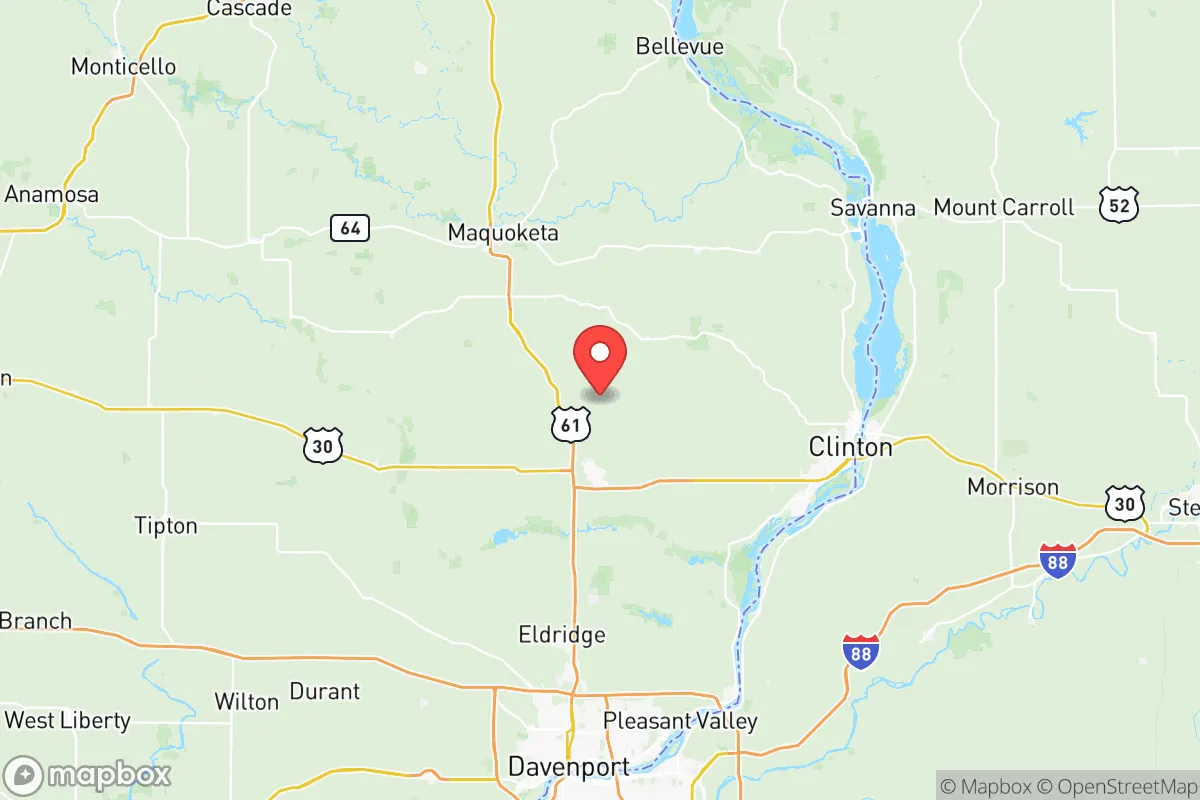
Photo: Wikipedia
Personal Sovereignty in Clinton County
Viable for self-reliance. Generally workable, though some barriers may limit total independence.
What does Personal Sovereignty tell us?
Personal Sovereignty measures your capacity for self-reliance and independence with minimal government friction. Higher scores mean fewer barriers between you and the way you want to live... but it assumes you have the space you need and good neighbors.
What does this tell us?
Personal Sovereignty measures your capacity for self-reliance and independence with minimal government friction. Higher scores mean fewer barriers between you and the way you want to live... but it assumes you have the space you need and good neighbors.
State Policy
Energy independence: Importer (50% of energy produced in-state)
Personal Liberty
Homesteading

Personal Liberty Analysis
Clinton County, Iowa, offers a notably high degree of personal sovereignty, particularly for those accustomed to the regulatory density of larger Midwestern cities. The county’s political and legal environment leans toward individual autonomy, with low taxes, permissive gun laws, and a regulatory posture that generally favors personal and economic freedom over government oversight. For single individuals and families seeking a place where self-reliance is both respected and feasible, Clinton County presents a compelling option within the broader context of Iowa’s already freedom-friendly legal framework.
Tax burden and regulatory posture: How Clinton County compares to surrounding areas
Clinton County’s tax burden is moderate by Iowa standards but remains low relative to many parts of the country. The county’s property tax rate averages around 1.5% of assessed value, which is slightly below the state median. For a $200,000 home, that translates to roughly $3,000 annually. Income tax is handled at the state level, where Iowa’s flat rate of 3.9% (as of 2026) is among the lowest in the Midwest. There is no county-level sales tax on top of the state’s 6% rate, keeping everyday purchases affordable. The regulatory environment is light-touch: zoning is minimal outside incorporated cities like Clinton and Camanche, where basic building codes apply. In unincorporated areas such as Elvira or Wheatland, land use restrictions are virtually nonexistent, allowing residents to operate home businesses, keep livestock, or build structures without excessive permitting. This stands in stark contrast to counties in Illinois or Minnesota, where environmental and land-use regulations can be far more burdensome.
Self-defense and gun law specifics: What Second Amendment protections look like in Clinton County
Iowa is a constitutional carry state, meaning no permit is required to carry a concealed firearm for anyone legally allowed to possess one. Clinton County fully embraces this framework. The county sheriff’s office issues permits to acquire handguns and professional permits for those who want reciprocity with other states, but the process is straightforward and typically completed within a few days. Stand-your-ground laws apply statewide, with no duty to retreat in any place where a person is lawfully present. Castle doctrine protections extend to vehicles and workplaces, not just homes. Gun ranges and firearm retailers are common in the area, particularly around Clinton and DeWitt, and local gun culture is strong. There are no county-level restrictions on magazine capacity, firearm types, or ammunition sales. For residents of Low Moor or Grand Mound, where police response times can exceed 15 minutes in rural areas, the ability to defend oneself without legal hurdles is a practical necessity, not just a philosophical preference.
Self-reliance and homesteading viability: Lot sizes, zoning, and off-grid feasibility across the county
Homesteading and off-grid living are highly viable in Clinton County, especially outside its few urban centers. Minimum lot sizes in unincorporated areas are typically one acre, though many parcels in townships like Bloomfield or Washington are sold in 5- to 40-acre increments. Zoning is permissive: raising chickens, goats, or even a few head of cattle requires no special permit in most rural zones. Off-grid systems are legal, though residents must comply with state-level well and septic regulations. Solar panels and rainwater collection are unrestricted, and several properties near Charlotte and Lost Nation already operate entirely off the grid. The county does not enforce building codes in unincorporated areas, so owner-built homes, tiny houses, and earth-sheltered structures are all feasible. However, in the city of Clinton itself, zoning is stricter—backyard chickens are allowed but limited to six hens, and off-grid utilities are not permitted within city limits. For those serious about self-reliance, the rural townships offer far more freedom than the county seat.
Personal liberties: Parental rights, medical autonomy, speech, and property protections
Iowa law provides strong protections for parental rights, including the Parental Rights in Education Act, which requires schools to notify parents of any medical or mental health services offered to minors. Clinton County’s school districts—including Clinton Community, Camanche, and Northeast—generally follow these guidelines, though enforcement varies by district. Medical autonomy is broad: there are no county-level vaccine mandates, and the state does not require masks or lockdowns outside of extreme public health emergencies. Religious and philosophical exemptions to vaccination are honored for school attendance. Free speech is robust, with no local ordinances restricting public assembly or political expression. Property rights are well-protected; eminent domain is rarely used, and the county has no rent control or landlord licensing schemes. For families in DeWitt or Goose Lake, the combination of school choice (open enrollment is allowed across district lines) and minimal government interference in daily life creates an environment where personal decisions—from healthcare to education to how one uses their land—remain largely in individual hands.
Overall, Clinton County ranks among the more sovereignty-friendly areas in the Midwest. Its combination of low taxes, constitutional carry, permissive land-use rules, and strong personal liberties places it well ahead of neighboring Illinois counties like Whiteside or Rock Island, where gun laws are stricter and property taxes are higher. While not as libertarian as some rural Western counties, Clinton County offers a balanced, practical freedom that appeals to families and individuals who value self-reliance without needing to live entirely off the grid. For those moving from high-regulation states, the transition to Clinton County’s lighter touch will feel like a significant expansion of personal autonomy.

* Values derived from national, state, county, city and local statistics and may differ in a specific area. Last updated: 2026-07-03T00:43:13.000Z
Narrative content on this page is AI-generated and may contain mistakes. Verify any details that matter before acting on them.
ReloMaps may earn a commission from affiliate links at no extra cost to you.

