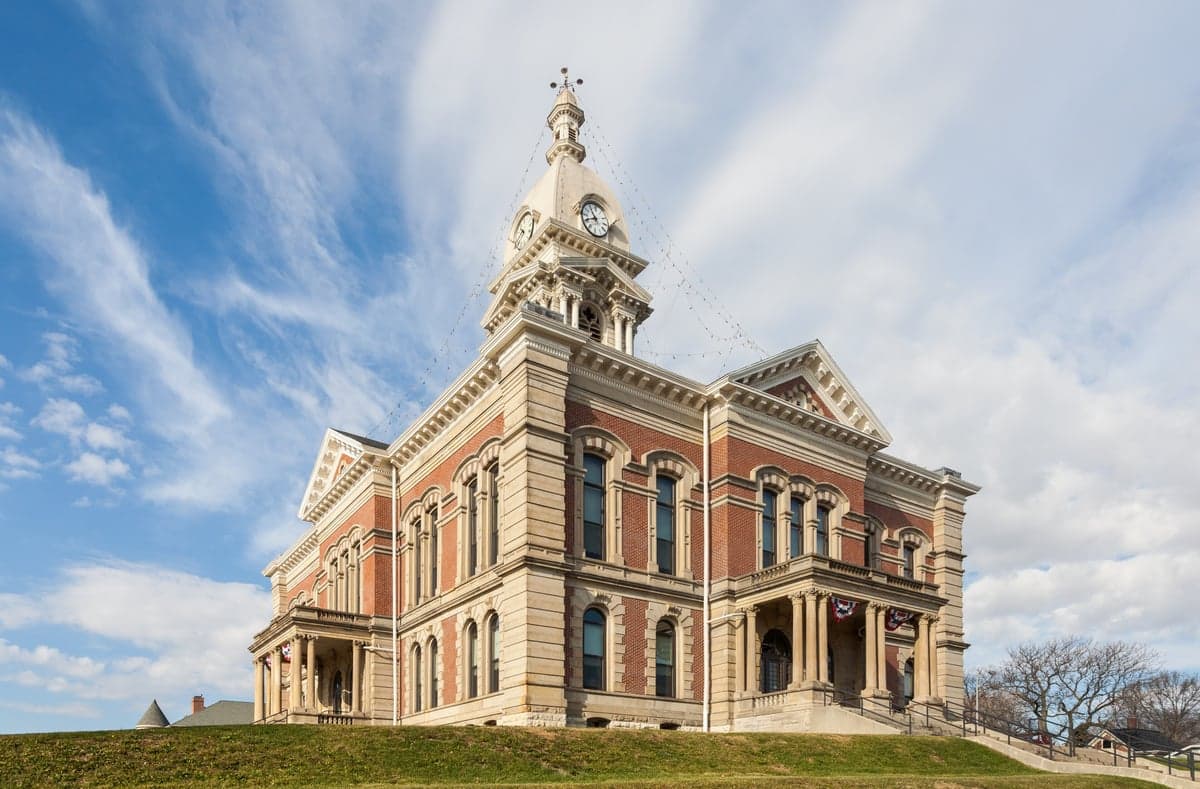
Photo: Wikipedia
Political ClimatePolitical Climate in Wabash County
Showing county-level results — no local-only data available.
Lean and PVI are calculated from this county’s 2020 and 2024 presidential results, Cook-style.
Political rankings in Indiana
- Most Conservative Cities in Indiana
- Most Liberal Cities in Indiana
- Best Liberal-Leaning Towns in the Midwest
- Safest Liberal-Leaning Towns in the Midwest
- Safest Conservative-Leaning Towns in the Midwest
- Affordable Small Towns for Conservatives
- Most Affordable Liberal-Leaning Small Towns in the U.S.
- Safest Conservative-Leaning Cities in the U.S.
- Most Conservative Counties in Indiana
- Most Liberal Counties in Indiana
Local Political AnalysisPolitical Analysis of Wabash County
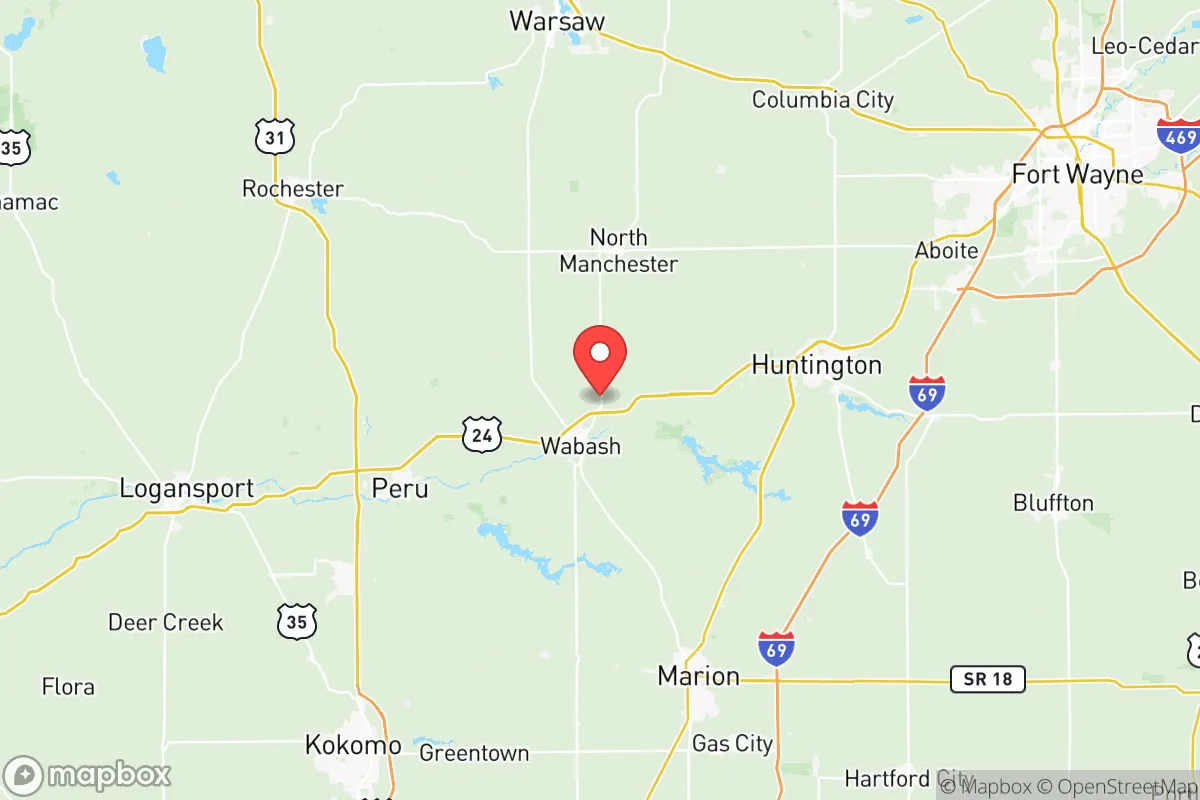
Wabash County is one of the most reliably Republican counties in Indiana, with a Cook Partisan Voting Index (PVI) of R+26—meaning it votes about 26 points more Republican than the national average. That’s a full 17 points redder than the state of Indiana as a whole, which sits at R+9. The county hasn’t voted for a Democratic presidential candidate since Lyndon Johnson in 1964, and in 2024, Donald Trump carried it by roughly 40 points. The trajectory is steady: the rural, manufacturing-heavy base has been shifting right for decades, and there’s no sign of that reversing.
How it compares
Indiana’s R+9 PVI already makes it a solidly red state, but Wabash County is in a different league. The county’s R+26 rating puts it in the same territory as deep-red strongholds like Oklahoma’s Panhandle or rural Texas. The gap is driven by the county’s small-town and agricultural character—places like North Manchester and Roann are deeply conservative, with precincts routinely delivering 75-80% Republican votes. The only real variation is in Wabash City itself, where the precincts around the downtown core and near the Honeywell Center sometimes dip to 60-65% Republican, thanks to a mix of union households and a small but visible liberal arts community tied to Manchester University. Even there, though, the city hasn’t elected a Democrat to a countywide office in over a decade. The swing precincts are essentially nonexistent—the county’s political spectrum runs from deep red to slightly less deep red.
What this means for residents
For conservative residents, Wabash County is a comfortable environment where their values are reflected in local policy—low taxes, limited regulation, and a strong emphasis on Second Amendment rights. The county commission and school boards are uniformly Republican, so there’s little friction over things like mask mandates or library book challenges. For liberal residents, the reality is more isolating. They’re a distinct minority, and while there’s no open hostility, they often feel their voices are sidelined in local debates. A progressive in Wabash City might find common ground with neighbors on issues like preserving the historic downtown or supporting the Honeywell Foundation’s arts programs, but they’ll rarely see their political preferences reflected in election results. The practical effect is that political activism tends to be low-key—there’s no real competition for most offices, so campaigns are often uncontested or decided in the Republican primary.
Culturally, Wabash County is a place where the Chamber of Commerce conservatism of the 1990s still holds sway. There’s a strong emphasis on community boosterism—the annual Wabash County 4-H Fair, the Honeywell Festival, and the local car shows are big deals. The county’s manufacturing base (including companies like Ford Meter Box and Wabash National) means there’s a pragmatic streak: residents support Republicans who deliver for local industry, even if they’re skeptical of national GOP culture wars. The biggest policy distinction from the rest of Indiana is the county’s aggressive push for right-to-work and local option income taxes—Wabash County was an early adopter of both, reflecting its business-friendly ethos. For anyone moving here, the political climate is straightforward: if you’re conservative, you’ll feel at home; if you’re liberal, you’ll need to find your community in the arts scene or at Manchester University. Either way, the pace of life is slow, the politics are predictable, and the biggest local controversies usually involve zoning for a new Dollar General.

State Political ClimatePolitical Climate in Indiana
State Political AnalysisPolitical Environment in the State
Indiana is a reliably Republican state with a Cook PVI of R+9, meaning it votes about nine points more Republican than the national average in presidential elections. Over the past 20 years, the state has shifted rightward, driven by the exurban growth around Indianapolis and the deep-red consolidation of its small towns and rural counties, while the core of Indianapolis and a few college towns have become more Democratic. For a conservative-leaning relocator, this means a state where Republican policies dominate state government, but the political reality is more nuanced than a simple red-state label.
Urban vs. rural divide
The political map of Indiana is a classic urban-rural split. The Indianapolis metro area, home to nearly 2 million people, is the state’s blue anchor. Marion County (Indianapolis) voted for Joe Biden by about 20 points in 2020, but the surrounding suburban counties—Hamilton, Hendricks, Johnson, and Boone—are solidly Republican, with Hamilton County (Carmel, Fishers, Noblesville) being one of the most affluent and GOP-friendly suburbs in the Midwest. Northwest Indiana, particularly Lake County (Gary, Hammond), is another Democratic stronghold, powered by union-heavy industrial towns and a large Black population. Meanwhile, the rest of the state is overwhelmingly red. Rural counties like Jasper, Newton, and Pulaski in the northwest, and most of the southern tier (e.g., Dubois, Orange, and Washington counties) routinely vote 70-80% Republican. The notable exception is Monroe County (Bloomington), home to Indiana University, which is a liberal island in a sea of red. Tippecanoe County (Lafayette) is a swing county, often tipping Republican but with a strong Democratic presence from Purdue University.
Policy environment
Indiana’s policy environment is consistently conservative. The state has a flat income tax rate of 3.15% (as of 2024, with a scheduled phase-down to 2.9% by 2027), and property taxes are capped at 1% of assessed value for owner-occupied homes, 2% for rental properties, and 3% for commercial. There is no inheritance tax. The regulatory posture is business-friendly, with a right-to-work law (2012) and a low corporate income tax rate of 4.9%. Education policy leans toward school choice: Indiana has one of the nation’s largest voucher programs (the Choice Scholarship Program), and charter schools are widespread. The state also passed a law in 2022 requiring schools to post curriculum materials online and allowing parents to opt their children out of certain lessons. Healthcare is a mixed bag: Indiana expanded Medicaid under the Affordable Care Act via a conservative waiver (the Healthy Indiana Plan), but the state has not expanded abortion access—in fact, a near-total abortion ban was enacted in 2023, with exceptions only for rape, incest, and life of the mother. Election laws are moderately restrictive: voter ID is required, early voting is available for 28 days, and absentee voting requires an excuse (though no-excuse absentee was allowed during the pandemic and remains a political flashpoint).
Recent policy direction
Indiana’s recent legislative direction has been aggressively conservative across multiple fronts. On gun rights, Indiana became a permitless carry state in 2022 (House Enrolled Act 1296), allowing any law-abiding adult to carry a handgun without a license. On parental rights and education, the state passed a law in 2023 banning instruction on human sexuality in grades K-3 (Senate Enrolled Act 17) and requiring schools to notify parents if a student requests a name or pronoun change. On speech and privacy, Indiana passed a law in 2023 restricting TikTok and other foreign-owned apps on state devices, and a 2024 law (House Enrolled Act 1047) requires age verification for adult websites. On medical and bodily autonomy, the 2023 abortion ban (Senate Enrolled Act 1) is one of the strictest in the Midwest, with no exceptions for rape or incest after a fetal heartbeat is detected (around 6 weeks), though a court injunction briefly blocked it before the near-total ban took effect. On property rights, Indiana has a strong eminent domain law, but a 2023 law (House Enrolled Act 1195) expanded protections for landowners in pipeline disputes. On taxation, the state is on a path to eliminate the income tax entirely, with a 2024 law setting a goal of zero by 2029. On voting, a 2021 law (Senate Enrolled Act 398) tightened absentee ballot rules, requiring a valid excuse and limiting drop boxes to one per county.
Civil unrest & political movements
Indiana has seen its share of political flashpoints. The 2020 Black Lives Matter protests in Indianapolis were large and occasionally violent, leading to property damage and a controversial police response. The state has a small but active militia movement, particularly in rural areas, and the 2021 “Stop the Steal” rally at the Statehouse drew a few hundred attendees. Immigration politics are relatively quiet compared to border states, but a 2022 law (House Enrolled Act 1402) requires local law enforcement to cooperate with federal immigration authorities, and there are no sanctuary cities in Indiana. Election integrity remains a live issue: the 2020 election saw Trump win Indiana by 16 points, but some Republican activists continue to push for stricter voter ID laws and audits. A notable flashpoint is the 2023 controversy over the Indiana University student government’s attempt to ban a pro-life group from campus, which led to a state law (Senate Enrolled Act 202) prohibiting public universities from denying recognition to student groups based on their beliefs. For a new resident, the most visible political movements are the annual March for Life at the Statehouse (one of the largest in the country) and the occasional counter-protests from reproductive rights groups.
Projection
Over the next 5-10 years, Indiana is likely to remain solidly Republican, but the margins may narrow slightly. The Indianapolis metro area is growing faster than the rest of the state, and its suburbs are becoming more diverse and slightly less Republican—Hamilton County, for example, went from 62% Trump in 2016 to 58% in 2020. Meanwhile, rural counties are aging and losing population, which could slowly erode the GOP’s base. In-migration is modest, with most new residents coming from Illinois and Ohio, and they tend to be slightly more moderate than native Hoosiers. The state’s tax-cutting trajectory is popular and likely to continue, but the abortion ban could become a liability if it drives away young professionals and women. Expect the state to remain a laboratory for conservative policy—more school choice, more gun rights, and continued fights over election laws and education curriculum. A relocator moving in now should expect a state that is politically stable but not static, with the Indianapolis suburbs becoming the key battleground for the next decade.
For a new resident, the bottom line is this: Indiana offers a low-tax, business-friendly environment with strong protections for gun rights and parental control in education. Conservatives will find a state government that largely aligns with their values, while liberals will find a few blue enclaves (Indianapolis, Bloomington, and parts of Lake County) where they can live comfortably but will have little influence on state policy. The political climate is not particularly volatile—Indiana is a “red state” in the traditional sense, not a swing state—so the day-to-day experience is one of stability rather than constant political drama. If you’re moving for a job in Indianapolis or a smaller city like Fort Wayne or Evansville, you’ll find a place where politics is important but not all-consuming, and where the practical benefits of low taxes and a business-friendly climate are tangible.
* Values derived from national, state, county, city and local statistics and may differ in a specific area. Last updated: 2026-11-15T19:54:37.000Z
Narrative content on this page is AI-generated and may contain mistakes. Verify any details that matter before acting on them.
ReloMaps may earn a commission from affiliate links at no extra cost to you.

