Photo: Wikipedia
Demographics of Wabash County
Affluence Level in Wabash County
A middle-class area roughly in line with national averages across income, home values, education, and employment.
People of Wabash County
Wabash County, Indiana, is home to roughly 30,900 residents, a population that is 92.9% white and notably homogenous even by rural Midwestern standards. With a foreign-born share of just 0.5% and a college attainment rate of 21.6%, the county’s identity is rooted in its deep agricultural and industrial heritage, shaped overwhelmingly by successive waves of European settlement. Today, its people are concentrated in the county seat of Wabash and the smaller towns of North Manchester, LaFontaine, and Roann, where a stable, family-oriented culture persists amid gradual population decline.
Settlement & growth (pre-1960)
Before European settlement, the area now known as Wabash County was part of the traditional homeland of the Miami and Potawatomi nations. The Miami, in particular, had established villages along the Wabash River and its tributaries, including a significant settlement near present-day Wabash. The region was ceded to the United States through a series of treaties in the 1820s and 1830s, most notably the 1826 Treaty of Mississinewas, which forced the Miami to relinquish much of their land. The Potawatomi were removed in the 1838 Trail of Death, a forced march that passed through the area.
American settlement began in earnest in the 1830s and 1840s, driven by the promise of fertile, inexpensive farmland. The first wave was predominantly of Scots-Irish and English stock, migrating from Kentucky, Ohio, and the upland South. These early settlers established the first permanent communities, including the town of Wabash (founded 1834), North Manchester (1837), and LaFontaine (1836). The Wabash and Erie Canal, completed through the county in the 1840s, accelerated growth by connecting the area to eastern markets, and the town of Lagro became a key canal port.
A second, larger wave arrived from Germany in the 1840s through the 1870s. German immigrants, many fleeing economic hardship and political unrest, were drawn by the availability of land and the growing industrial base. They settled heavily in and around Wabash and North Manchester, where they established farms, churches, and businesses. The German influence remains visible today in the area’s Lutheran and Catholic congregations and in the surnames common across the county. A smaller but notable group of Polish immigrants arrived in the late 19th and early 20th centuries, finding work in the county’s factories and railroads, particularly in Wabash and Roann.
Industrialization in the late 1800s and early 1900s brought a third wave of domestic migrants from rural Indiana and neighboring states. The county’s manufacturing base—including the Wabash Fibre Box Company, the Wabash Magnetics plant, and various automotive parts suppliers—pulled workers from the surrounding countryside into the towns. By 1900, Wabash County’s population had peaked at roughly 28,000, a figure it would not surpass until the post-World War II boom. The 1950s saw a modest suburbanization around Wabash and North Manchester, as returning veterans and their families sought single-family homes, but the county remained overwhelmingly rural and white.
Modern era (post-1965)
The 1965 Hart-Cellar Act, which dramatically reshaped U.S. immigration, had virtually no impact on Wabash County. The county’s foreign-born population today stands at just 0.5%, a figure that has not meaningfully changed in decades. Unlike many Midwestern counties that saw new waves of Hispanic or Asian immigration after 1965, Wabash County remained insulated from these trends, largely due to its small industrial base, lack of major transportation corridors, and distance from urban job centers.
The most significant demographic shift since the 1960s has been domestic out-migration. The county’s population peaked at 32,000 in 1970 and has since declined by roughly 3.5%, driven by the loss of manufacturing jobs and the departure of young adults seeking opportunities in larger cities. The Hispanic population, while small at 3.0%, has grown modestly since 2000, concentrated in Wabash and North Manchester, where a handful of factories and agricultural operations have drawn a limited number of Mexican and Central American workers. The Black population remains tiny at 1.1%, and East/Southeast Asian communities account for just 0.4%, with no significant enclave forming anywhere in the county. The Indian-subcontinent population is effectively zero.
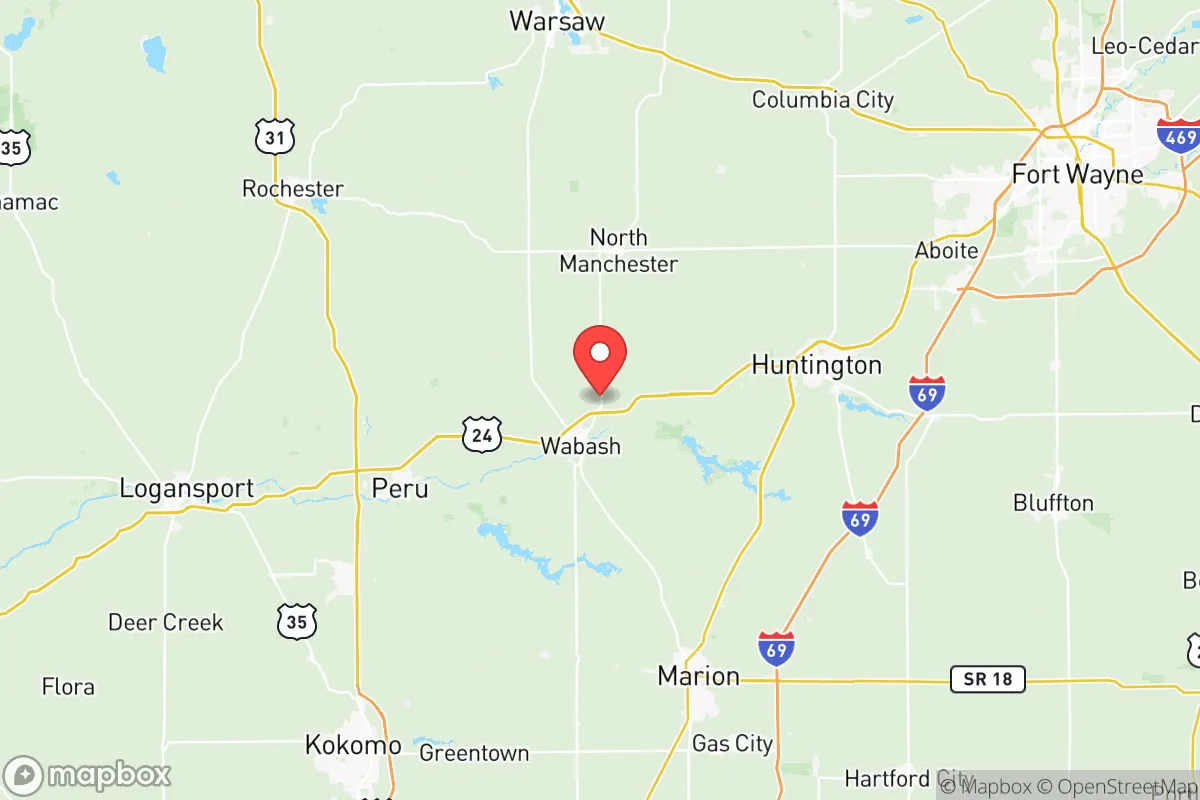
Suburbanization has been minimal. The county’s largest town, Wabash, has seen its population stagnate at around 10,000, while North Manchester (home to Manchester University) has held steady at roughly 5,000. Smaller towns like LaFontaine, Roann, and Lagro have experienced slow decline, losing population to both Wabash and larger cities like Fort Wayne (40 miles east) and Marion (20 miles south). The county’s housing stock remains dominated by older single-family homes, and new construction is limited to a few subdivisions on the outskirts of Wabash and North Manchester.
The future
Wabash County’s population is projected to continue its slow decline over the next 10-20 years, driven by an aging demographic profile and limited in-migration. The median age is already above the state average, and the county’s birth rate has fallen below replacement level. Without a significant influx of new residents—unlikely given the county’s remote location and limited job growth—the population could dip below 30,000 by 2040.
Diversity is expected to increase only marginally. The Hispanic share may rise to 5-6% over the next decade, as some families settle in Wabash and North Manchester for work in manufacturing and agriculture, but the county will remain overwhelmingly white. The East/Southeast Asian and Black populations are likely to remain below 2% each. The county’s cultural identity—rooted in its German and Scots-Irish heritage, conservative social values, and strong ties to agriculture and small-town life—will persist, though it may soften slightly as younger residents who leave for college or jobs in cities return with broader perspectives.
Efforts to attract new residents are underway, including the Wabash County Economic Development Corporation’s focus on tourism (the county’s historic covered bridges and the Honeywell Center) and remote-worker recruitment. However, these initiatives face headwinds from the county’s low college attainment rate (21.6%) and limited broadband infrastructure in rural areas. The most likely growth scenario is a slow, managed decline, with the county’s population becoming slightly older and slightly more Hispanic, but remaining culturally and demographically stable.
For someone moving in now, Wabash County offers a quiet, affordable, and safe environment with a strong sense of community, but it is not a place of rapid change or growing diversity. The county’s future is one of continuity rather than transformation, and new residents should expect a population that is stable, homogenous, and deeply rooted in its historical identity.

* Values derived from national, state, county, city and local statistics and may differ in a specific area. Last updated: 2026-11-15T19:54:37.000Z
Narrative content on this page is AI-generated and may contain mistakes. Verify any details that matter before acting on them.
ReloMaps may earn a commission from affiliate links at no extra cost to you.

