
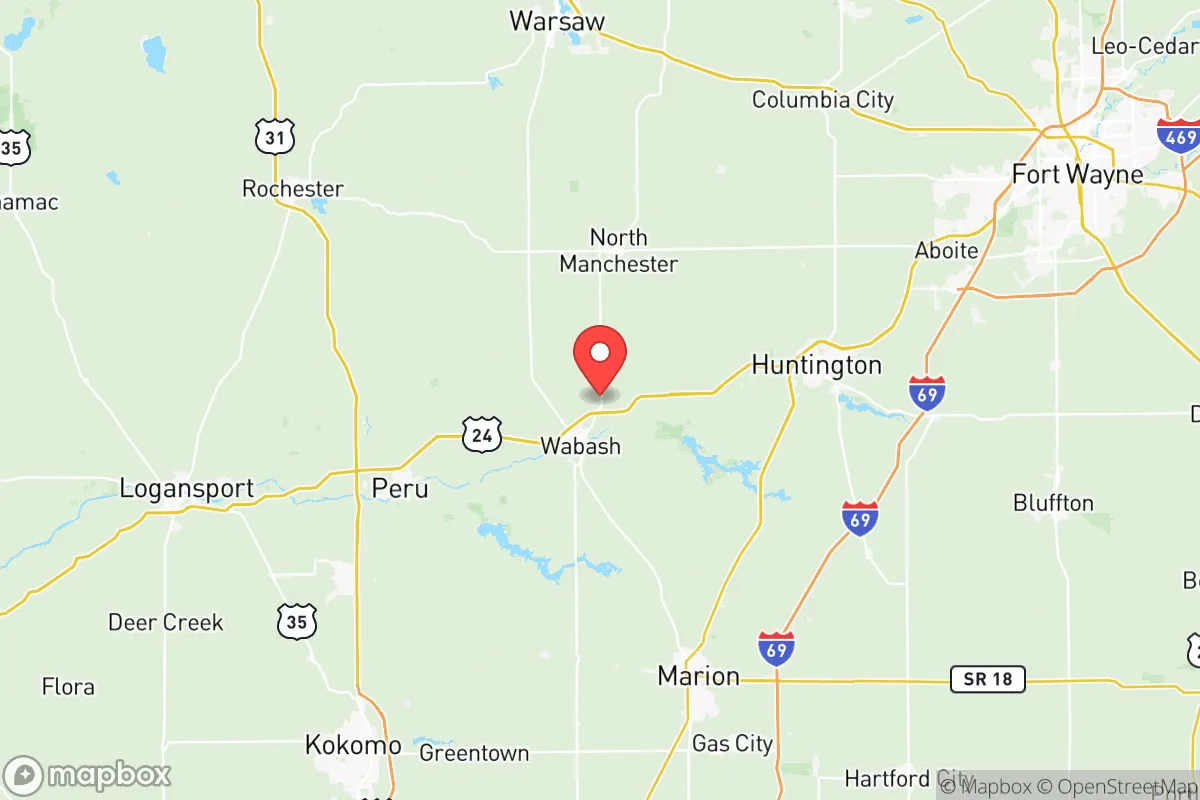
Photo: Wikipedia
Personal Sovereignty in Wabash County
Viable for self-reliance. Generally workable, though some barriers may limit total independence.
What does Personal Sovereignty tell us?
Personal Sovereignty measures your capacity for self-reliance and independence with minimal government friction. Higher scores mean fewer barriers between you and the way you want to live... but it assumes you have the space you need and good neighbors.
What does this tell us?
Personal Sovereignty measures your capacity for self-reliance and independence with minimal government friction. Higher scores mean fewer barriers between you and the way you want to live... but it assumes you have the space you need and good neighbors.
State Policy
Energy independence: Importer (29% of energy produced in-state)
Personal Liberty
Homesteading

Personal Liberty Analysis
Wabash County, Indiana, offers a notably high degree of personal sovereignty, particularly for those who value limited government interference in daily life, self-defense, and property rights. The county’s regulatory posture is light, its tax burden is moderate, and its culture strongly supports individual autonomy, making it a viable option for relocation-minded conservatives and self-reliant families. While not as libertarian-leaning as some rural Western counties, Wabash County provides a freedom-friendly environment that stands out in the Midwest, especially when compared to more regulated urban areas in Indiana like Indianapolis or Bloomington.
Tax burden and regulatory posture in Wabash County
Indiana’s state-level tax structure is generally favorable to personal sovereignty, and Wabash County aligns with that. The state’s flat income tax rate is 3.15% as of 2026, and property taxes in Wabash County are among the lowest in the state, with an average effective rate of roughly 0.85% of assessed home value. This is significantly lower than the national average of about 1.1%. The county government maintains a light regulatory touch: there is no county-wide zoning in unincorporated areas, though the city of Wabash and the towns of North Manchester and Roann have their own zoning ordinances. For a reader considering a small business or home-based enterprise, the county’s lack of occupational licensing beyond state requirements and minimal business registration fees are attractive. The regulatory environment is best described as permissive rather than restrictive, with local officials generally deferring to property owners’ rights. The city of Wabash does enforce building codes for new construction, but outside city limits, code enforcement is minimal, allowing for more flexibility in land use.
Self-defense and gun law specifics in Wabash County
Indiana is a constitutional carry state, meaning no permit is required to carry a handgun openly or concealed for anyone legally allowed to possess a firearm. Wabash County’s sheriff’s office is known for a pro-Second Amendment stance, and there are no county-specific restrictions beyond state law. The county has a strong hunting culture, with deer and turkey seasons drawing residents from towns like Lagro and Somerset. Gun ranges are accessible, including the Wabash County Conservation Club near the city of Wabash. Stand-your-ground laws apply statewide, and there is no duty to retreat in any place where a person is lawfully present. For a relocation reader, this means self-defense rights are robust and unlikely to face local pushback. The county’s gun-friendly atmosphere is reinforced by the presence of several firearms dealers and a local chapter of the Indiana Gun Owners association. In practical terms, a resident in rural areas like Liberty Mills or Laketon can expect no friction over firearm ownership, and the sheriff’s office routinely issues permits for those who still want a license for reciprocity with other states.
Self-reliance and homesteading viability in Wabash County
Wabash County is well-suited for homesteading and off-grid living, particularly in its unincorporated areas. Lot sizes in rural townships—such as Pleasant Township, Noble Township, and Paw Paw Township—commonly range from 1 to 10 acres, with larger parcels available for under $5,000 per acre. Zoning in unincorporated areas is minimal: no county-wide zoning means no setback requirements, no minimum square footage for dwellings, and no restrictions on keeping livestock or poultry. Off-grid feasibility is high: while the county requires connection to the electrical grid for new construction in some subdivisions, many rural parcels have no such requirement, and solar panels are permitted without special permits. Water wells are common, and septic systems are regulated by the county health department but with reasonable standards. The city of Wabash does have stricter codes, but towns like Roann and North Manchester are more permissive. For a family seeking to raise animals, grow food, or build a self-sufficient homestead, the regulatory barriers are low. The county’s agricultural extension office offers resources for small-scale farming, and local feed stores in Wabash and North Manchester support livestock owners. One caveat: the county does enforce health codes for commercial food production, so selling eggs or meat requires a license, but personal consumption is unrestricted.
Personal liberties in Wabash County
Parental rights are strongly protected in Indiana, and Wabash County reflects that. The state’s 2022 law requiring schools to notify parents of any changes in a student’s health or well-being is enforced locally, and the Wabash County school districts—including Wabash City Schools and Manchester Community Schools—have policies that generally defer to parental authority. Medical autonomy is less clear-cut: Indiana has no vaccine mandate for adults, but some employers may require them. The county has a low rate of vaccine mandates in the private sector, and local healthcare providers, such as Parkview Wabash Hospital, do not impose restrictions beyond state law. Speech rights are fully protected, and there is no local ordinance restricting political expression or signage. Property rights are strong: Indiana’s right-to-farm law protects agricultural operations from nuisance lawsuits, and Wabash County has no county-wide noise or light ordinances, though the city of Wabash has a noise ordinance that is rarely enforced. For a reader concerned about government overreach, the county’s culture is one of live-and-let-live, with local officials generally avoiding interference in private matters. The county’s small population—about 30,000—means that personal reputation matters more than bureaucratic oversight.
Overall, Wabash County ranks as a high-sovereignty area within Indiana, offering a blend of low taxes, minimal regulation, strong gun rights, and viable homesteading options that is rare in the Midwest. Compared to more regulated counties like Marion County (Indianapolis) or Monroe County (Bloomington), Wabash County provides a freedom-friendly environment that appeals to conservatives and self-reliant individuals. The county’s rural character, combined with its permissive zoning and pro-Second Amendment culture, makes it a strong contender for relocation, particularly for those who want to live independently without heavy government oversight. While not as extreme as some Western counties with no building codes or income taxes, Wabash County offers a practical, grounded version of personal sovereignty that is sustainable and community-supported.

* Values derived from national, state, county, city and local statistics and may differ in a specific area. Last updated: 2026-11-15T19:54:37.000Z
Narrative content on this page is AI-generated and may contain mistakes. Verify any details that matter before acting on them.
ReloMaps may earn a commission from affiliate links at no extra cost to you.

