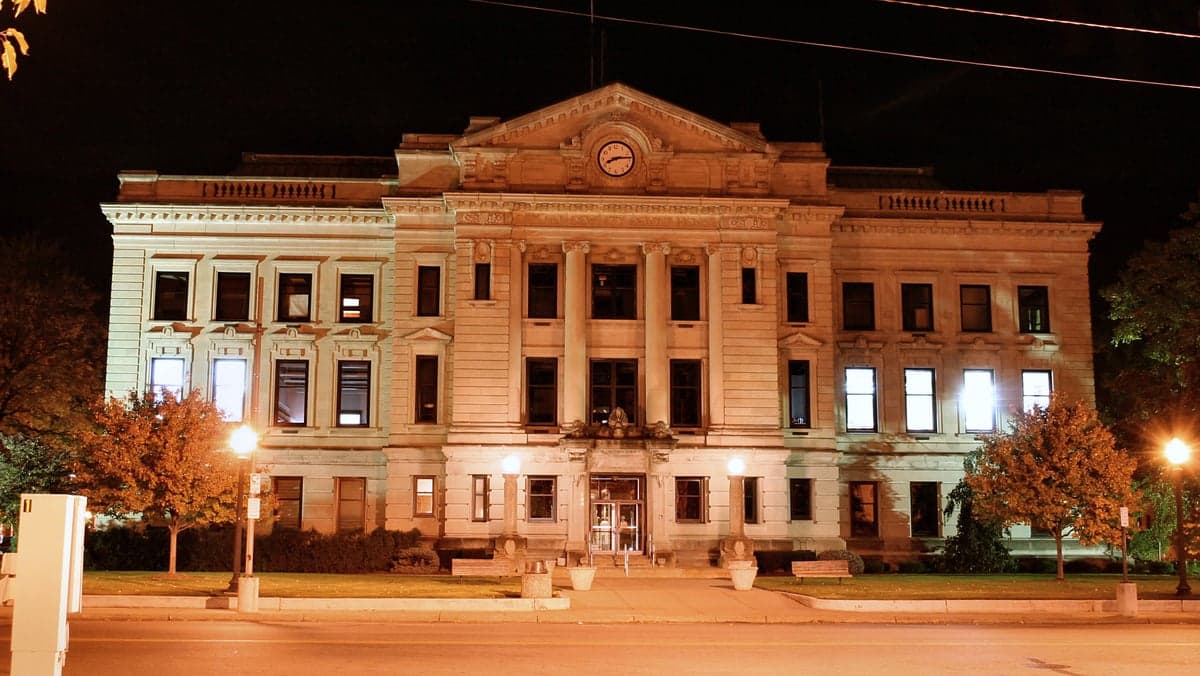
Photo: Wikipedia
Political ClimatePolitical Climate in Dekalb County
Showing district-level results — no local-only data available.
Local Political AnalysisPolitical Analysis of Dekalb County
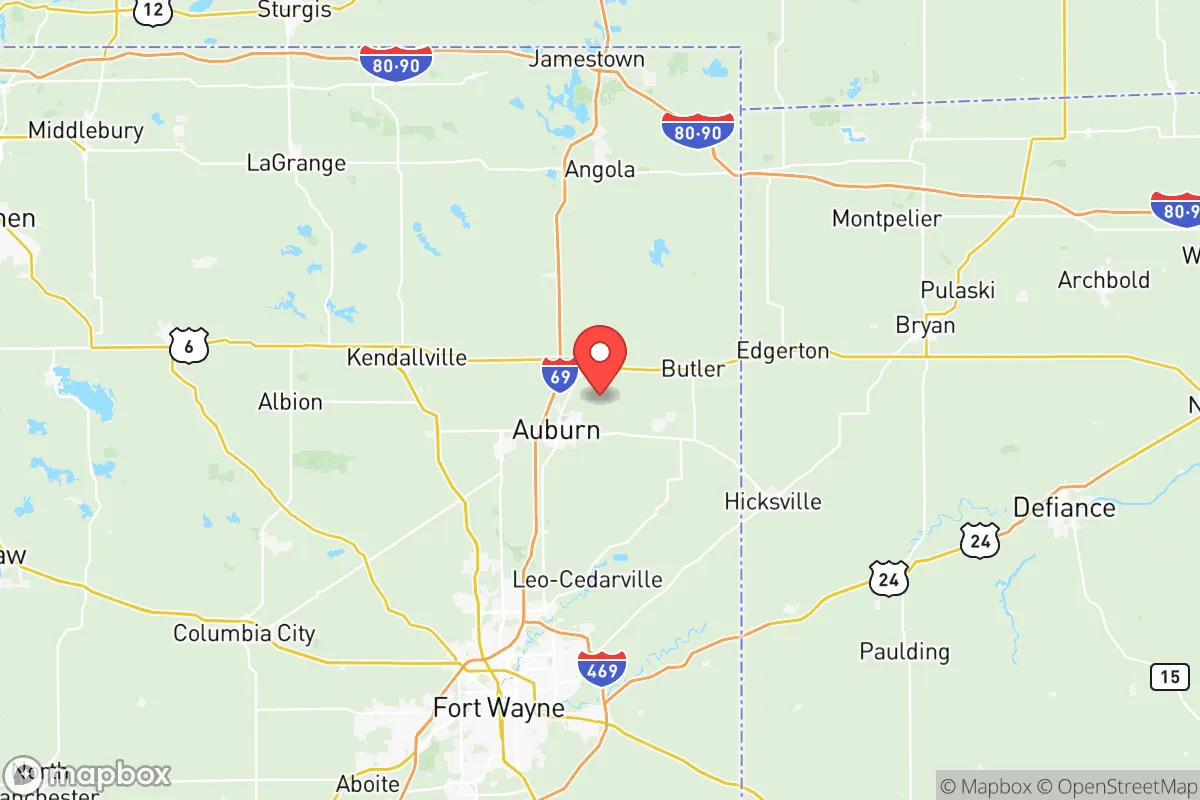
Dekalb County is a reliably Republican stronghold in northeastern Indiana, with a Cook PVI of R+16 that makes it significantly more conservative than the state of Indiana as a whole (R+9). The county has voted for the GOP presidential candidate in every election this century, and local races rarely see competitive Democratic challenges outside of a few specific precincts. The political trajectory here has been stable rather than shifting — unlike some rural areas that have swung harder right in recent years, Dekalb County has been consistently red for decades, with the real action happening in primary elections rather than general contests.
How it compares
The seven-point gap between Dekalb County's R+16 and Indiana's R+9 is meaningful in practical terms. While Indiana as a state has competitive pockets — Marion County (Indianapolis) votes reliably blue, and Lake County in the northwest is a Democratic stronghold — Dekalb County has no such counterbalance. The county's largest town, Auburn (population roughly 13,000), leans heavily Republican, with precincts around the downtown area and the Kruse Automotive campus consistently delivering 65-70% GOP margins. The smaller towns tell a more nuanced story: Garrett, with its historic railroad roots and working-class manufacturing base, has a small but persistent Democratic bloc concentrated in the older neighborhoods near the B&O Railroad depot, though it still votes Republican overall. Butler, the county's third-largest town, is the most conservative, regularly hitting 75%+ Republican in presidential elections. The swing precincts — those that occasionally see closer races — are in the rural townships between Auburn and the Steuben County line, where independent and libertarian-leaning voters can tip local races.
What this means for residents
For conservative residents, the political climate means their values are reflected in nearly every level of government — from the county commissioners to the school board to the state legislature. The county's GOP machine is well-organized, with the Dekalb County Republican Central Committee running active precinct operations and candidate recruitment. For liberal residents, the reality is more isolating. There is no organized Democratic Party presence in the county; the local Democratic committee is largely inactive, and progressive candidates rarely file for office. Socially liberal residents often drive to Fort Wayne (25 miles south) or even to Ann Arbor, Michigan (60 miles east) for community and events that align with their views. That said, the county is not hostile to dissent — political yard signs are common during election season, and there is no history of political intimidation. It's more a matter of being outnumbered than being unwelcome.
Culturally, the county's conservatism is rooted in its economic base: manufacturing (General Motors' Fort Wayne Assembly is a major employer just south of the county line), agriculture, and small business. The policy distinctions that matter most locally are tax policy — the county has one of Indiana's lowest property tax rates, a point of pride — and Second Amendment rights, which are broadly supported. The county's Republican lean also shapes its approach to development: zoning is minimal, and the "Auburn way" of doing things emphasizes low regulation and personal responsibility. For newcomers, the political climate is straightforward: if you're conservative, you'll feel at home; if you're not, you'll find a quiet, respectful community that simply doesn't prioritize the issues you care about most.

State Political ClimatePolitical Climate in Indiana
State Political AnalysisPolitical Environment in the State
Indiana has been a reliably Republican state for decades, with a Cook Partisan Voting Index of R+9, meaning it votes about nine points more Republican than the nation as a whole. The state hasn't backed a Democrat for president since 2008, when Barack Obama narrowly won it, and that was largely a fluke driven by the Great Recession and a strong ground game in the industrial northwest. Since then, the GOP has tightened its grip: Donald Trump won the state by 16 points in 2020 and by 11 points in 2024, while Republican candidates for governor and Senate routinely win by double digits. The shift has been steady but not dramatic — Indiana was already a red state in the 2000s, but the last decade has seen the rural and exurban areas harden their Republican margins while the few blue pockets have become smaller and more isolated.
Urban vs. rural divide
The political map of Indiana is a classic study in urban-rural polarization, but with a twist: the state's largest city, Indianapolis (Marion County), is only moderately Democratic, not a deep-blue stronghold like Chicago or Detroit. Marion County votes about 60-40 Democratic in presidential years, but the surrounding ring of suburban counties — Hamilton, Hendricks, Johnson, and Boone — are among the most Republican in the nation. Hamilton County, just north of Indianapolis, voted for Trump by 22 points in 2024, making it a GOP bastion of affluent, educated conservatives. The other major metros follow a similar pattern: Fort Wayne (Allen County) leans Republican by about 15 points, while Evansville (Vanderburgh County) is a toss-up county that usually breaks red by a few points. The real Democratic strongholds are the college towns: Bloomington (Monroe County) votes about 65-35 Democratic, driven by Indiana University, and West Lafayette (Tippecanoe County) is similarly blue thanks to Purdue. The rest of the state — the vast rural stretches of the Wabash Valley, the southern hill country, and the agricultural north — votes Republican by margins of 30 to 50 points. The only notable exception is Lake County in the far northwest, a historically Democratic, union-heavy area that includes Gary and Hammond; it still votes blue, but its margins have shrunk as the industrial base has eroded.
Policy environment
Indiana's policy environment is consistently conservative, with a low-tax, low-regulation posture that has been in place for decades. The state has a flat income tax rate of 3.05% (down from 3.23% in 2024, with a scheduled phase-down to 2.9% by 2027), and property taxes are capped at 1% of assessed value for owner-occupied homes, 2% for rental properties, and 3% for commercial. There is no inheritance tax and no estate tax. The state is a right-to-work state (enacted in 2012), and it has a "stand your ground" self-defense law. On education, Indiana has a robust school choice program: the Choice Scholarship voucher program is one of the largest in the country, and charter schools are widely available. The state also has a "parental bill of rights" law (2022) that requires schools to notify parents of curriculum changes and allows them to opt their children out of certain materials. On healthcare, Indiana expanded Medicaid under the Affordable Care Act in 2015 (the Healthy Indiana Plan), but it did so with a conservative twist — requiring premiums and copays for some enrollees. Abortion is heavily restricted: a near-total ban was enacted in 2022 (Senate Enrolled Act 1), with exceptions only for rape, incest, and to save the mother's life, and the ban has been upheld by the state supreme court. Election laws are moderately restrictive: voter ID is required, early voting is available for 28 days, and absentee voting requires an excuse (though the excuse requirement was temporarily suspended during COVID and has been a subject of debate since).
Recent policy direction
Over the past five years, Indiana has moved decisively to the right on a broad range of issues. On gun rights, the state adopted permitless carry (constitutional carry) in 2022, allowing any adult who can legally possess a firearm to carry it without a license. On education and parental rights, the 2022 "parental bill of rights" was followed by a 2023 law banning instruction on human sexuality in grades K-3 (House Bill 1608), and a 2024 law requiring schools to adopt policies on student use of restrooms and locker rooms based on biological sex at birth. On medical and bodily autonomy, the near-total abortion ban passed in 2022 was followed by a 2023 law restricting gender-affirming care for minors (Senate Enrolled Act 480), which bans puberty blockers, hormone therapy, and surgery for anyone under 18. On property rights, the state has strengthened eminent domain protections for landowners and passed laws limiting local government's ability to regulate short-term rentals. On taxation, the flat income tax is being phased down, and the state has eliminated the business personal property tax for many small businesses. On voting and ballot access, a 2021 law (Senate Enrolled Act 334) tightened absentee ballot rules, requiring a valid excuse and prohibiting election officials from sending unsolicited absentee ballot applications. On privacy and surveillance, Indiana has not passed a comprehensive data privacy law, but it has restricted the use of facial recognition technology by law enforcement without a warrant. The overall direction is unmistakably conservative, with a focus on limiting government regulation, expanding gun rights, restricting abortion and transgender care, and giving parents more control over education.
Civil unrest & political movements
Indiana is not a state known for frequent or large-scale civil unrest, but it has had its share of political flashpoints. The most visible in recent years was the 2020 George Floyd protests in Indianapolis, which saw several nights of clashes between demonstrators and police, including property damage and fires. The state also saw significant protests in 2022 after the Dobbs decision, with abortion rights rallies at the Statehouse in Indianapolis that drew thousands. On the right, the most organized movement has been the "parents' rights" groups that have been active in school board meetings since 2021, particularly in suburban counties like Hamilton and Hendricks. These groups have successfully pushed for conservative curriculum changes and book removals. Immigration politics have been relatively muted compared to border states, but there have been localized controversies: in 2019, the city of South Bend (St. Joseph County) saw protests after a police shooting of a Black man, and the city's then-mayor Pete Buttigieg became a national figure. There is no sanctuary city policy in Indiana; in fact, a 2011 state law (Senate Enrolled Act 590) requires local law enforcement to cooperate with federal immigration authorities. Election integrity controversies have been minimal — Indiana's voter ID law has been in place since 2005 and is widely accepted, though there were disputes in 2020 over absentee ballot procedures. The most notable political movement in the state is the gradual but steady shift of the Indianapolis suburbs from moderate Republican to hardline conservative, driven by an influx of culturally conservative families from the Midwest and the South.
Projection
Over the next 5-10 years, Indiana is likely to remain solidly Republican, but the nature of that Republicanism may shift. The state is experiencing modest population growth, driven largely by the Indianapolis metro area and the I-69 corridor from Indianapolis to Fort Wayne. These areas are attracting younger, more educated residents, many of whom are conservative but less focused on cultural issues than the current GOP base. At the same time, the rural areas that form the GOP's strongest margins are slowly depopulating, which could erode the party's raw vote totals over time. However, the Democratic Party shows no signs of becoming competitive statewide: the party's base is shrinking to a few college towns and the northwest corner, and it has not won a statewide race since 2012 (Senator Joe Donnelly, who lost in 2018). The most likely scenario is that Indiana remains R+9 to R+12, with the GOP continuing to pass conservative legislation on education, guns, and abortion, while the Democratic strongholds become even more isolated. A new resident moving in now should expect a state where conservative policies are the norm, where the political debate is dominated by cultural issues rather than economic ones, and where the major cities offer a more liberal environment but are surrounded by deeply conservative suburbs and countryside.
For a new resident, the bottom line is straightforward: if you are a conservative, Indiana will feel like home — low taxes, strong gun rights, school choice, and a government that generally stays out of your business. If you are a liberal, you will find welcoming communities in Bloomington, West Lafayette, and parts of Indianapolis, but you will be living in a state where your vote has little impact on statewide elections and where the legislature is actively passing laws you likely oppose. The political climate is stable, predictable, and unlikely to change dramatically in the next decade. The practical takeaway is to choose your location carefully: the difference between living in Carmel (Hamilton County) and Bloomington (Monroe County) is not just a matter of scenery — it's a difference in the entire political and cultural environment you will experience every day.
* Values derived from national, state, county, city and local statistics and may differ in a specific area. Last updated: 2026-10-22T20:53:12.000Z
Narrative content on this page is AI-generated and may contain mistakes. Verify any details that matter before acting on them.
ReloMaps may earn a commission from affiliate links at no extra cost to you.

