
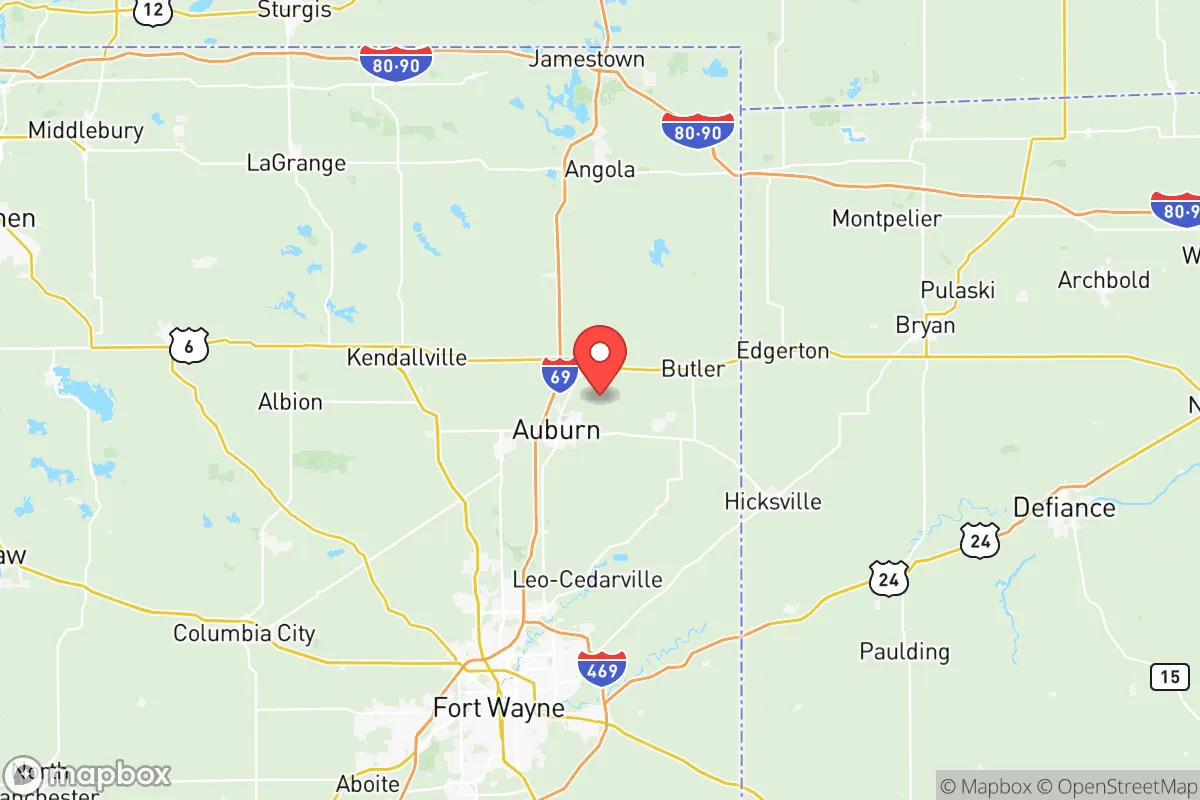
Photo: Wikipedia
Personal Sovereignty in Dekalb County
Viable for self-reliance. Generally workable, though some barriers may limit total independence.
What does Personal Sovereignty tell us?
Personal Sovereignty measures your capacity for self-reliance and independence with minimal government friction. Higher scores mean fewer barriers between you and the way you want to live... but it assumes you have the space you need and good neighbors.
What does this tell us?
Personal Sovereignty measures your capacity for self-reliance and independence with minimal government friction. Higher scores mean fewer barriers between you and the way you want to live... but it assumes you have the space you need and good neighbors.
State Policy
Energy independence: Importer (35% of energy produced in-state)
Personal Liberty
Homesteading

Personal Liberty Analysis
DeKalb County, Indiana, offers a notably high degree of personal sovereignty, grounded in Indiana’s strong preemption laws and a local culture that values self-reliance. The county’s regulatory environment is light-touch, with local governments in Auburn, Garrett, and Waterloo generally deferring to state-level frameworks on taxation, firearms, and property use. For individuals and families prioritizing autonomy, the area presents a consistent, predictable legal landscape where state law often overrides local ordinances, creating a uniform baseline of freedom across the county.
Tax burden and regulatory posture in DeKalb County
Indiana’s tax structure is among the most favorable in the Midwest for those seeking to keep more of their earnings. The state imposes a flat income tax rate of 3.15% (as of 2025), with no local income tax in DeKalb County, meaning residents pay only the state rate. Property taxes are assessed at 1% of gross assessed value for owner-occupied homes, with a standard homestead deduction of 60% on the first $200,000 of assessed value. In practice, a $250,000 home in Auburn or Butler typically carries an annual property tax bill of roughly $1,800–$2,200, well below national averages. The county’s regulatory posture is minimal: there is no county-wide zoning in unincorporated areas, though the cities of Auburn, Garrett, and Waterloo each have modest zoning codes focused on commercial and residential density. Business licensing is straightforward, with no county-level occupational licenses required for most trades. Indiana’s right-to-work law (2012) and lack of prevailing wage mandates further reduce regulatory friction for independent contractors and small businesses. The overall tax burden—combining state income, property, and sales taxes (7% state rate, no local add-ons)—ranks in the bottom third nationally, a clear advantage for those seeking fiscal autonomy.
Self-defense and gun law specifics in DeKalb County
Indiana is a constitutional carry state, effective July 1, 2022, meaning no permit is required to carry a handgun openly or concealed for any law-abiding adult 18 or older. DeKalb County fully reflects this posture. The sheriff’s office in Auburn does not impose additional local restrictions, and there are no county-level waiting periods, magazine capacity limits, or firearm registration requirements. Stand-your-ground and castle doctrine laws are codified in Indiana Code § 35-41-3-2, providing broad legal protection for use of force in self-defense, including no duty to retreat in any place where a person has a right to be. For those who still wish to obtain a License to Carry a Handgun (LTCH) for reciprocity purposes, the process is shall-issue, with a typical turnaround of 30–60 days in DeKalb County. The local gun culture is strong: the Auburn Gun & Knife Show is a regular event, and the DeKalb County Conservation Club in rural Spencerville offers a 500-yard rifle range and pistol bays. In the smaller towns of Corunna and St. Joe, firearm ownership is near-universal among households, and local law enforcement is known for a pro-Second Amendment stance. No city in the county—including the more populous Auburn—has attempted to pass any local firearm ordinance, as state preemption (IC 35-47-11.1) strictly prohibits such measures.
Self-reliance and homesteading viability in DeKalb County
DeKalb County’s rural character makes it highly viable for homesteading and off-grid living. Unincorporated areas have no county-wide zoning, allowing for a wide range of agricultural and residential uses without bureaucratic hurdles. Minimum lot sizes in unincorporated areas are typically 1–2 acres for a single-family home with a septic system, though many parcels in the northern part of the county near Butler and the southern area around Waterloo are available in 5–40 acre tracts. The county’s soil quality is excellent for small-scale farming, with much of the land classified as prime farmland by the USDA. Off-grid feasibility is strong: Indiana has no state-level prohibition on rainwater collection, and many rural residents use private wells and septic systems. Solar panel installation is unrestricted, though net metering is capped at 1 MW for residential systems. The Amish and Mennonite communities in the county—particularly around the town of Hudson—demonstrate that fully self-sufficient, non-grid-dependent living is both culturally accepted and legally straightforward. For those seeking a balance between rural autonomy and town amenities, the city of Garrett (population ~10,000) offers a small-town feel with its own water and sewer utilities, while the unincorporated areas of Fairfield Center and Sedan provide true rural isolation. The county’s building code applies only to commercial structures and multi-family dwellings; single-family homes in unincorporated areas are exempt from state building codes, allowing owner-builders to construct their own homes without permit fees or inspections.
Personal liberties in DeKalb County
Parental rights are strongly protected under Indiana law. The state’s “Parents’ Bill of Rights” (IC 20-33-2) grants parents the authority to direct their child’s education, medical care, and moral upbringing, and requires schools to notify parents of any changes in a student’s services or identity. DeKalb County’s school districts—DeKalb Central, DeKalb Eastern, and Garrett-Keyser-Butler—generally follow state law without local overreach. Medical autonomy is similarly robust: Indiana has no state-level vaccine mandate for adults, and the 2023 law (SB 8) prohibits COVID-19 vaccine mandates by private employers except in limited healthcare settings. Telehealth and direct-primary-care arrangements are legal and growing in the county, with several providers in Auburn offering cash-pay services. Speech and property rights are well-guarded: Indiana is a one-party consent state for recording conversations, and there are no county-level noise ordinances in unincorporated areas. Property rights are further secured by Indiana’s “Right to Farm” law (IC 32-30-6), which protects agricultural operations from nuisance lawsuits, a critical protection for those raising livestock or operating small farms. The county’s planning department in Auburn is known for a hands-off approach, rarely initiating enforcement actions unless a formal complaint is filed. This creates a de facto environment where personal choices—from homeschooling to building a workshop to keeping chickens or goats—are largely unregulated outside city limits.
Overall, DeKalb County ranks among the most sovereignty-friendly areas in the Midwest for those who value personal autonomy. The combination of constitutional carry, no county income tax, minimal zoning in rural areas, and strong state-level protections for parental rights and property use creates a consistent, low-friction environment. Compared to neighboring counties in Ohio or Michigan, which often have higher tax burdens or more restrictive local ordinances, DeKalb County offers a notably lighter regulatory touch. For individuals and families seeking a place where self-reliance is not just tolerated but structurally supported—from the gun-friendly culture in Auburn to the off-grid viability near Hudson—this county provides a solid, predictable foundation for personal freedom.

* Values derived from national, state, county, city and local statistics and may differ in a specific area. Last updated: 2026-10-22T20:53:12.000Z
Narrative content on this page is AI-generated and may contain mistakes. Verify any details that matter before acting on them.
ReloMaps may earn a commission from affiliate links at no extra cost to you.

