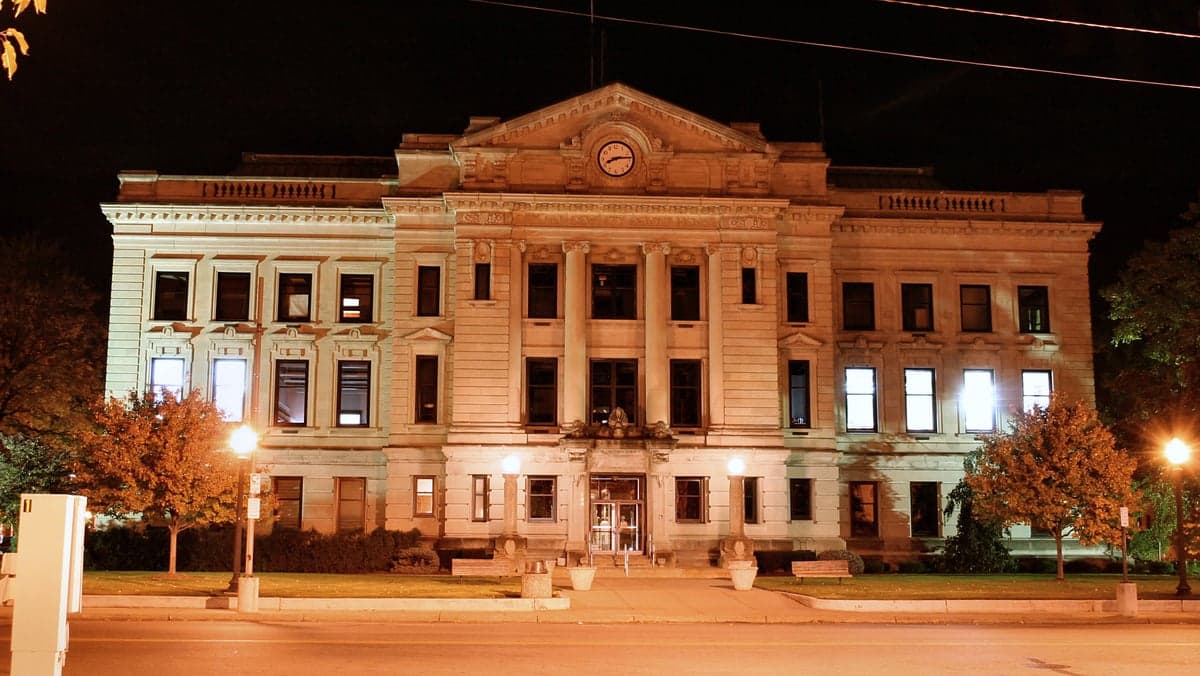
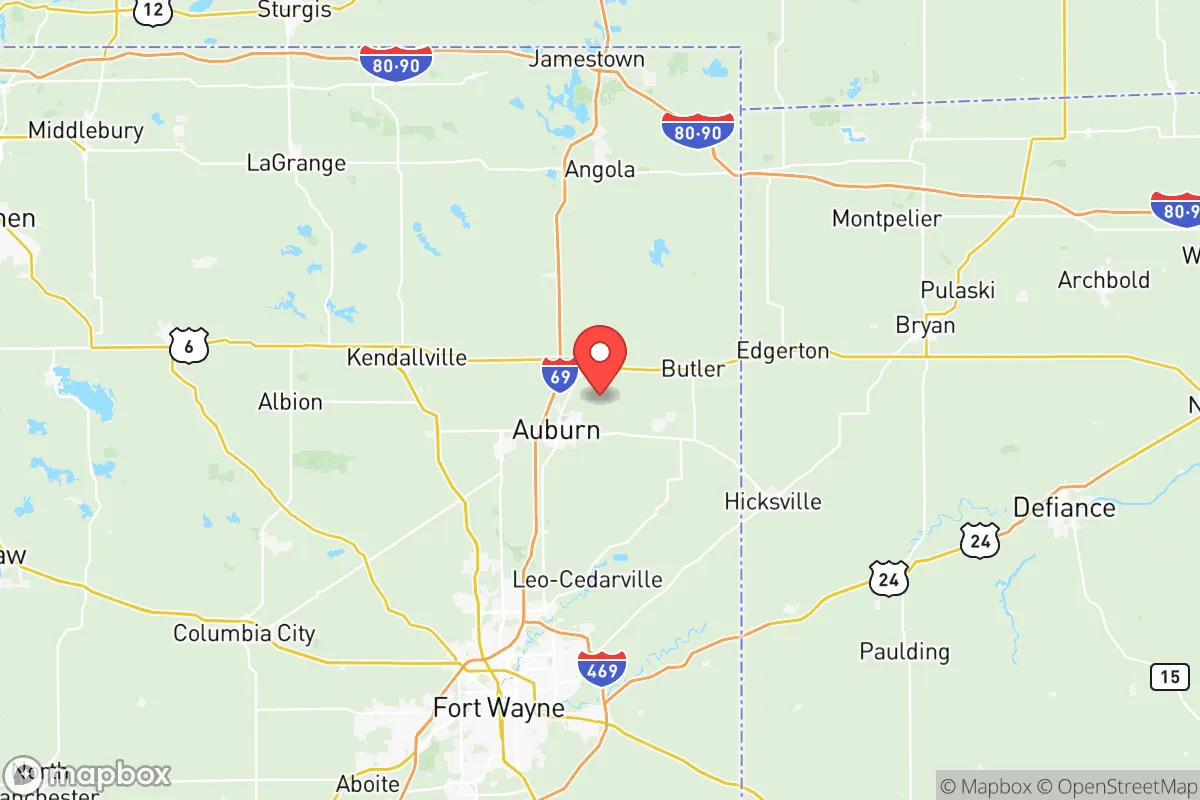
Photo: Wikipedia
Demographics of Dekalb County
Affluence Level in Dekalb County
A middle-class area roughly in line with national averages across income, home values, education, and employment.
People of Dekalb County
DeKalb County, Indiana, is a predominantly white, rural community of 43,584 residents where a strong agricultural and manufacturing heritage still defines daily life. The county is notably homogeneous, with a 93.9% white population and a foreign-born share of just 0.6%, making it one of the least diverse counties in the state. Its people are concentrated in small towns like Auburn, the county seat and home to the Auburn Cord Duesenberg Automobile Museum, and Garrett, a historic railroad town, with a character rooted in self-reliance, conservative values, and a quiet, family-oriented pace of life.
Settlement & growth (pre-1960)
Before European settlement, the area that is now DeKalb County was part of the hunting grounds of the Miami and Potawatomi nations, who used the region's forests and rivers for seasonal travel and trade. The first permanent white settlers arrived in the 1830s, following the forced removal of Native tribes under the Indian Removal Act. These early pioneers were primarily of Yankee stock—English-descended settlers from New England and upstate New York—who were drawn by the promise of cheap, fertile land in the newly surveyed Indiana Territory. They established the first farms and small hamlets, including Waterloo (1836) and Auburn (1836), which became the county seat in 1837.
A second, larger wave of settlement came in the 1840s and 1850s, when German immigrants arrived directly from the German states, fleeing economic hardship and political unrest. These families were attracted by the region's affordable farmland and the growing network of railroads that connected the area to larger markets. They settled heavily in and around Garrett, founded in 1875 as a railroad town, and in the rural townships of Butler and Spencerville. The German influence is still visible today in the county's Lutheran churches and the surnames common in local cemeteries. A smaller number of Irish immigrants, many of whom worked on the railroad construction crews, also settled in Garrett and Auburn during this period.
By the late 19th and early 20th centuries, the county's economy diversified beyond agriculture. The discovery of natural gas in the 1880s briefly spurred industrial growth, and the rise of the automobile industry in nearby Auburn—home to the Auburn Automobile Company (1900-1937)—brought a modest influx of workers from other parts of the Midwest. However, the county remained overwhelmingly rural and white, with little in-migration from outside the region. The Great Depression and World War II saw population stagnation, as young people left for factory jobs in larger cities like Fort Wayne and Detroit. By 1960, DeKalb County's population was 29,837, and its demographic character was firmly set: native-born, Protestant, and of Northern European ancestry.
Modern era (post-1965)
The post-1965 era, shaped by the Hart-Cellar Act, had almost no impact on DeKalb County's demographics. Unlike many parts of the United States that saw a surge in immigration from Asia, Latin America, and Africa, DeKalb County remained a demographic outlier. The foreign-born population today is just 0.6%, and the county's racial composition has barely shifted: the white share has declined only slightly from over 98% in 1970 to 93.9% today. The small Hispanic population (2.9%) is the most notable change, consisting largely of families who moved to the area for work in agriculture and light manufacturing, particularly in the poultry processing plants around Butler and Corunna. These families are dispersed rather than concentrated in a single enclave, and many have roots in Mexico and Central America.
The East/Southeast Asian population (0.4%) and Indian subcontinent population (0.1%) are negligible, consisting mostly of a handful of professionals employed by the county's largest private employer, Metaldyne (an automotive parts manufacturer) in Auburn, and by the DeKalb Health hospital system. The Black population (0.2%) is similarly tiny, with no historic Black neighborhood or community institution in the county. Domestic migration has been the primary demographic force since 1965, but it has been a slow trickle rather than a flood. The county has attracted some retirees and commuters from nearby Fort Wayne (about 20 miles south), who are drawn by lower housing costs and a slower pace of life. Suburbanization has been modest, with new subdivisions appearing on the outskirts of Auburn and Garrett, but the county has not experienced the explosive growth seen in Indiana's suburban counties like Hamilton or Hendricks.
The future
DeKalb County's population is projected to remain stable or grow very slowly over the next 10-20 years, with no major demographic transformation on the horizon. The county's low birth rate and aging population (median age 41.7) mean that natural increase will be minimal, and any growth will depend on domestic in-migration. The Hispanic share is likely to rise gradually, perhaps reaching 5-6% by 2040, as younger families move in for agricultural and manufacturing jobs, but the county will remain overwhelmingly white. The East/Southeast Asian and Indian populations are expected to stay tiny, as the area lacks the professional job base and ethnic infrastructure—such as temples, grocery stores, or cultural organizations—that attract larger immigrant communities.
The county's cultural identity is likely to remain conservative and rooted in its agricultural and small-town heritage. New residents are most likely to be white families from other parts of the Midwest seeking affordable land and a lower cost of living, or retirees from Fort Wayne looking for a quieter setting. The biggest demographic wildcard is the potential for growth in Auburn and Garrett if the Fort Wayne metro area's suburban sprawl continues to push northward, but this is far from certain. For now, DeKalb County is a place where the population is stable, the culture is traditional, and the future looks much like the present.
For someone moving in now, DeKalb County offers a predictable, low-diversity environment where community ties are strong and change comes slowly. It is a good fit for families and individuals who value rural quiet, conservative politics, and a close-knit social fabric, but it offers little in the way of ethnic diversity or the cultural amenities found in larger, more cosmopolitan areas.

* Values derived from national, state, county, city and local statistics and may differ in a specific area. Last updated: 2026-10-22T20:53:12.000Z
Narrative content on this page is AI-generated and may contain mistakes. Verify any details that matter before acting on them.
ReloMaps may earn a commission from affiliate links at no extra cost to you.

