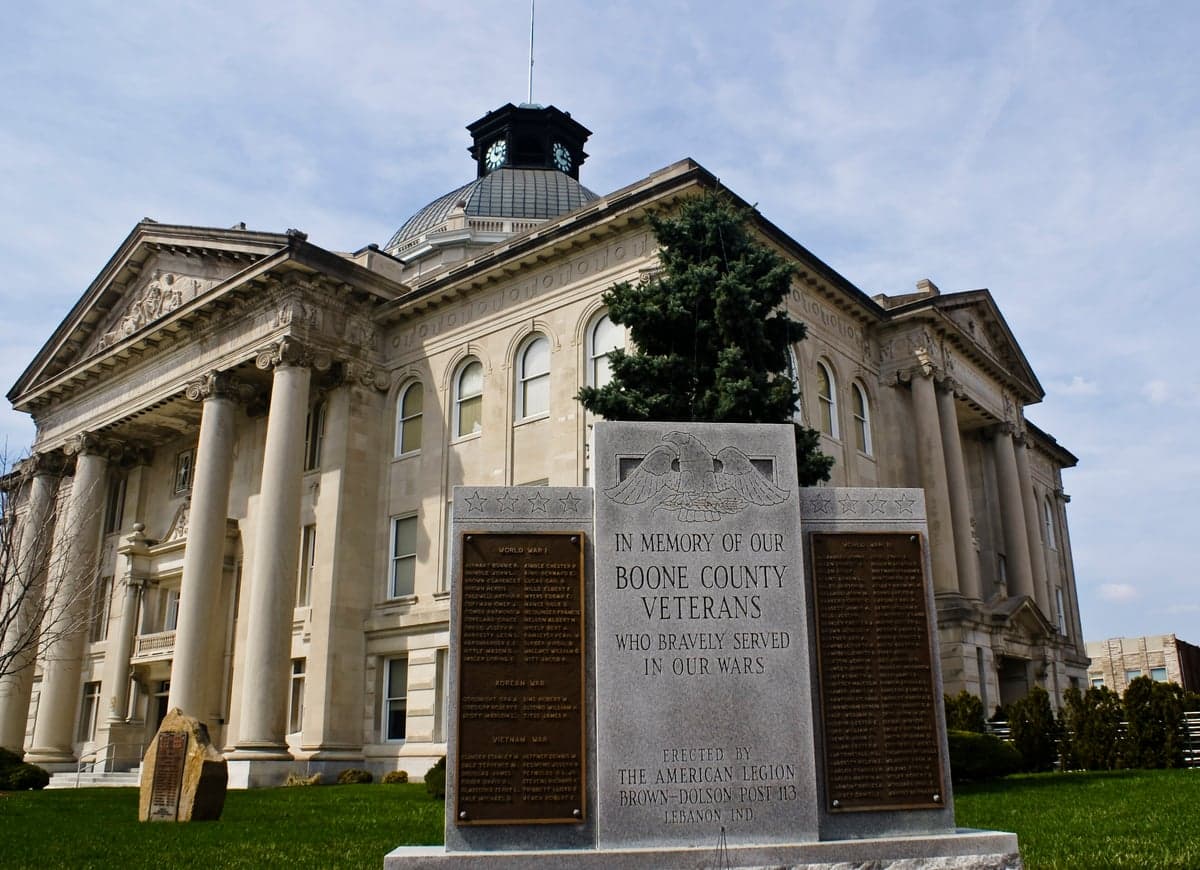
Photo: Wikipedia
Political ClimatePolitical Climate in Boone County
Showing district-level results — no local-only data available.
Local Political AnalysisPolitical Analysis of Boone County
Boone County, Indiana, is a reliably Republican stronghold with a Cook PVI of R+15, making it significantly more conservative than the state of Indiana as a whole, which sits at R+9. This isn't just a matter of party registration; it's baked into the county's voting patterns, where Republican candidates routinely win by double-digit margins in most precincts. However, the county is not a monolith, and the political reality on the ground is more nuanced than a single number suggests, especially when you look at the differences between its towns and the steady influx of people from more liberal areas.
How it compares
The R+15 rating means Boone County is about six points more Republican-leaning than the state average. In practice, this translates to a political environment where conservative candidates and policies are the default. For example, in the 2024 presidential election, the county voted for Donald Trump by a margin of roughly 65% to 32%, a wider spread than the statewide result. The contrast is most visible when comparing Boone County to neighboring Marion County (Indianapolis), which leans Democratic. The county's growth is largely driven by people moving from Marion County, which is slowly introducing a more moderate or even liberal element, particularly in the southern part of the county. The town of Zionsville, for instance, is the most politically moderate area in Boone County, with precincts that have voted for Democratic candidates in recent local races, reflecting its more affluent, educated, and transplant-heavy population. In contrast, Lebanon, the county seat, and Thorntown remain deeply conservative, with Republican candidates routinely winning by 70% or more. The swing precincts are almost exclusively in the southern, fast-growing areas near the Hamilton County line, where new subdivisions are bringing in voters who don't share the county's traditional rural conservatism.
What this means for residents
For conservative residents, Boone County is a comfortable place where their values are reflected in local governance, school board decisions, and community norms. They can expect low taxes, limited government interference, and a general cultural alignment with their beliefs. For liberal or moderate residents, the reality is more complex. While they are not a persecuted minority, they will find that their political views are not the majority. Local elections are often decided in the Republican primary, meaning that the general election is frequently a formality. This can feel disenfranchising for those who don't align with the dominant party. However, the growing population in Zionsville and the southern corridor is slowly shifting the Overton window. You'll see more yard signs for Democratic candidates in those neighborhoods, and local Democratic clubs are more active than they were a decade ago. The key is that the change is incremental, not revolutionary.
Culturally, Boone County still retains a strong sense of small-town, agricultural identity, especially in its northern towns. The annual Boone County 4-H Fair in Lebanon is a major event, and local churches remain central to community life. However, the rapid development is creating a cultural divide between the newer suburbanites and the established rural population. Policy-wise, the county government has focused on managing growth while preserving its conservative fiscal principles, meaning lower property taxes and a resistance to new spending on public transit or large-scale social programs. For anyone moving here, the political climate is a significant factor, but it's one that is slowly evolving as the county's demographics change. The long-term trajectory points toward a gradual moderation, but for the foreseeable future, Boone County will remain a reliably red part of a red state.

State Political ClimatePolitical Climate in Indiana
State Political AnalysisPolitical Environment in the State
Indiana is a reliably Republican state with a Cook PVI of R+9, meaning it votes about nine points more Republican than the national average in presidential elections. The state hasn't backed a Democrat for president since 2008, when Barack Obama narrowly carried it, and that was largely a one-off driven by the financial crisis and strong turnout in the industrial northwest. Over the last 10-20 years, the trajectory has been steadily rightward, driven by the exurban growth around Indianapolis and the continued dominance of rural and small-town voters. The dominant coalition is a mix of fiscal conservatives, social conservatives, and a significant working-class base that has shifted from the old Democratic machine of the Rust Belt to the GOP.
Urban vs. rural divide
The political map of Indiana is a classic study in contrast. The state's two major urban centers, Indianapolis (Marion County) and Fort Wayne (Allen County), are the primary Democratic strongholds, though neither is as deep blue as cities in neighboring Illinois or Michigan. Indianapolis has trended more Democratic over the past decade as the suburbs have grown and the city itself has become more diverse, but it still has a moderate, business-friendly Democratic establishment. Gary and the industrial northwest corner of the state (Lake County) are the other major Democratic anchor, a legacy of unionized steel mills and manufacturing. The rest of the state is overwhelmingly Republican. The suburban ring around Indianapolis—places like Hamilton County (Carmel, Fishers, Noblesville) and Hendricks County—are some of the most reliably Republican suburbs in the entire Midwest. Evansville in the southwest and Terre Haute in the west are more purple but lean Republican in most statewide races. The rural counties, especially in the south and east, are deeply red, often voting 70-80% Republican. The divide isn't just about population density; it's cultural. The urban areas are more diverse, younger, and more secular, while the rural and suburban areas are older, whiter, and more religiously affiliated, particularly with evangelical Protestantism.
Policy environment
Indiana's policy environment is consistently conservative. The state has a flat income tax rate of 3.05% (as of 2025, with a scheduled phase-down to 2.9% by 2027), no inheritance tax, and a relatively low corporate tax rate. Property taxes are capped at 1% of assessed value for owner-occupied homes, which is a major selling point for homeowners. The state is a "right-to-work" state, meaning workers cannot be required to join a union or pay dues as a condition of employment. Education policy has been a major focus: Indiana has a robust school voucher program (the Choice Scholarship Program) that is among the most expansive in the country, and charter schools are widely available. The state has also passed laws restricting abortion (a near-total ban with limited exceptions) and has a permitless carry law for handguns (constitutional carry). Election laws are moderately restrictive: voter ID is required, early voting is available but not as expansive as in some states, and there are no same-day voter registration provisions.
Recent policy direction
The last few years have seen Indiana push further right on several fronts. In 2022, the state passed a near-total abortion ban (Senate Enrolled Act 1), which was upheld by the state Supreme Court in 2023. On gun rights, the state adopted permitless carry in 2022, allowing any law-abiding adult to carry a handgun without a license. In education, the state expanded its school voucher program to include nearly all families, regardless of income, and passed a law requiring schools to notify parents of any changes in a student's health or well-being (the "Parental Bill of Rights"). On the tax front, the state accelerated its income tax rate cuts and eliminated the business personal property tax for many small businesses. On the other hand, the state has not moved aggressively on some culture war issues that have dominated other red states. There has been no major push to restrict transgender healthcare for minors (though a ban was proposed in 2023 and may resurface), and the state has not passed a "Don't Say Gay" law targeting classroom discussion. The state's approach to medical marijuana and cannabis reform remains extremely restrictive; there is no legal medical or recreational cannabis, and possession of even small amounts can lead to jail time. This is a notable outlier compared to neighboring Michigan, Illinois, and Ohio, all of which have legalized in some form.
Civil unrest & political movements
Indiana has not seen the kind of large-scale, sustained civil unrest seen in some other states. The 2020 George Floyd protests in Indianapolis were significant but not as destructive as in Portland or Seattle. The state has a strong, organized conservative movement, particularly around gun rights (the Indiana Gun Owners group is influential) and anti-abortion activism. On the left, the Indiana Democratic Party is relatively weak and has struggled to maintain a statewide presence, though local activism in Indianapolis and Bloomington is active. Immigration politics are less heated than in border states, but there have been local controversies over sanctuary city policies. In 2019, the state passed a law requiring local law enforcement to cooperate with federal immigration authorities, effectively banning sanctuary cities. There have been no major secession or nullification movements. Election integrity has been a topic of discussion, but the state has not seen the kind of high-profile controversies seen in Georgia or Arizona. The 2020 and 2022 elections were conducted without major incident, and the state's voter ID law is broadly accepted.
Projection
Over the next 5-10 years, Indiana is likely to remain solidly Republican, but the margin may narrow slightly as the Indianapolis suburbs continue to diversify and as some younger voters move in from more liberal states. The state's population growth is modest and concentrated in the Indianapolis metro area, which will slowly shift the political center of gravity. However, the rural and small-town areas that dominate the state legislature are not shrinking as fast as in some other Midwestern states, so the legislature will likely remain very conservative. The biggest wild card is the state's continued refusal to legalize cannabis in any form. As more neighboring states legalize, pressure will build, but the current legislative leadership is strongly opposed. A new resident moving to Indiana in 2026 should expect a state that is reliably conservative on taxes, guns, and abortion, but not as aggressively culture-war-focused as some other red states. The state's politics are more pragmatic and business-oriented than ideological, which is a double-edged sword: it means less chaos, but also less rapid change.
For a new resident, the bottom line is this: Indiana is a safe, stable, and affordable state with a conservative tilt that is unlikely to change dramatically in the next decade. If you are a conservative, you will find a state that largely aligns with your values on taxes, guns, and education. If you are a liberal, you will find a state where your vote in statewide elections will not be competitive, but where local politics in Indianapolis, Bloomington, or Fort Wayne can still be meaningful. The state's political climate is not as intense or polarized as in some other parts of the country, which can be a relief for those who just want to live their lives without constant political drama. Just be aware that on certain issues—especially cannabis and abortion—the state is firmly in the conservative camp, and that is not likely to change soon.
* Values derived from national, state, county, city and local statistics and may differ in a specific area. Last updated: 2026-06-29T15:03:04.000Z
Narrative content on this page is AI-generated and may contain mistakes. Verify any details that matter before acting on them.
ReloMaps may earn a commission from affiliate links at no extra cost to you.

