Photo: Wikipedia
Demographics of Boone County
Affluence Level in Boone County
An upper-middle-class area. Household wealth, education levels, and homeownership run ahead of national benchmarks.
People of Boone County
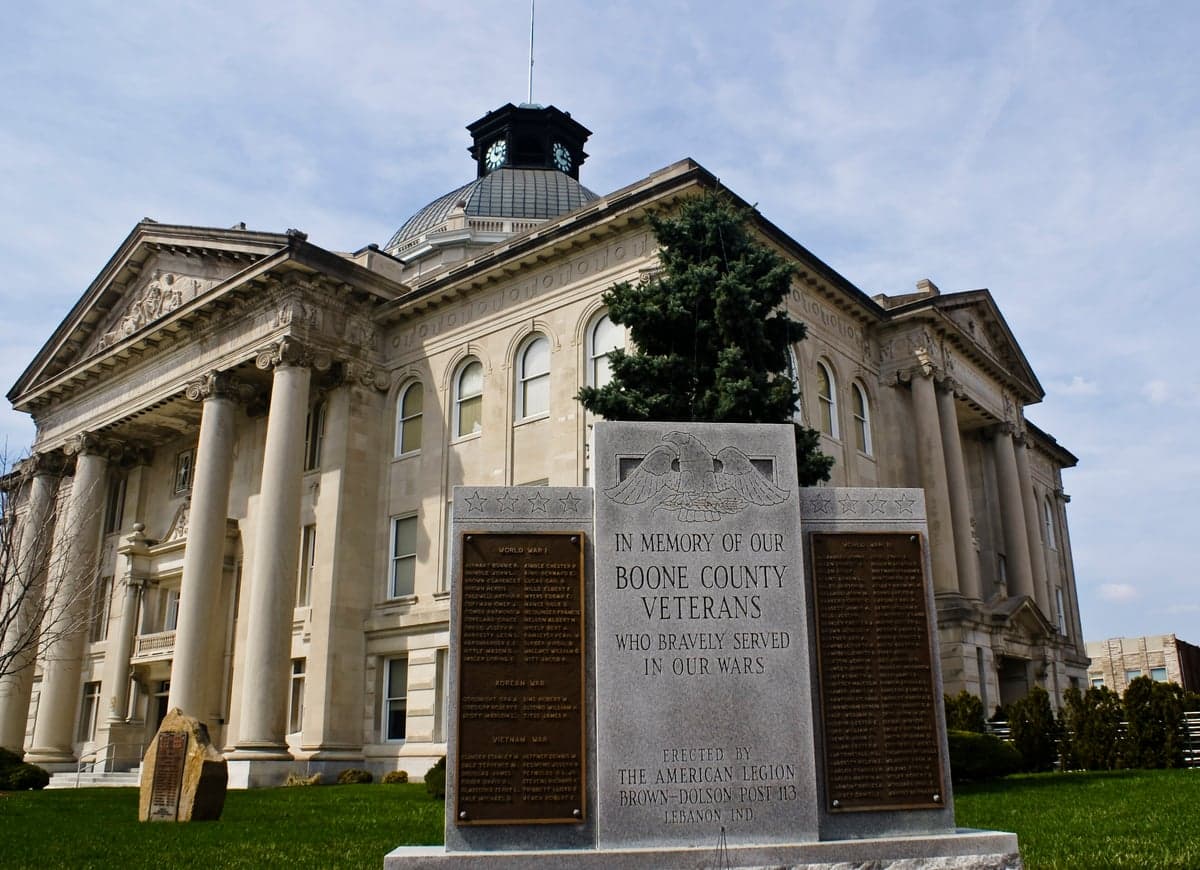
Boone County, Indiana, today is a fast-growing, predominantly white, and highly educated suburban county with a population of 72,827, where 87.2% of residents identify as white and over half hold a college degree. Its character is defined by a blend of historic small towns—like Lebanon, Zionsville, and Whitestown—and sprawling new subdivisions, creating a place that feels both rooted in Midwestern tradition and pulled toward Indianapolis’s expanding northern edge. The county’s foreign-born population is low at just 2.0%, and its largest minority groups are Hispanic (4.1%) and Indian-subcontinent residents (1.8%), reflecting a modest but notable shift from its historically homogenous makeup. For families and individuals seeking good schools, low crime, and a conservative-leaning community with easy access to a major city, Boone County represents a classic Indiana success story of steady, managed growth.
Settlement & growth (pre-1960)
Before American settlement, the area that is now Boone County was inhabited by the Miami and Delaware (Lenape) nations, who used the region for hunting and seasonal camps. The land was ceded to the U.S. government through a series of treaties in the early 19th century, most notably the 1818 Treaty of St. Mary’s, which opened central Indiana to white settlement. The county was formally organized in 1830, carved from the northern portion of Hendricks County, and named after frontiersman Daniel Boone—a symbolic nod to the pioneer spirit that would define its early decades.
The first wave of settlers were primarily Scots-Irish and English farmers from Kentucky, Ohio, and the Upland South, who arrived in the 1830s and 1840s seeking cheap, fertile land. They established the county’s earliest towns: Lebanon (the county seat, platted in 1831), Zionsville (1852), and Thorntown (1830). These communities grew slowly, anchored by agriculture—corn, wheat, and livestock—and later by small-scale manufacturing tied to the railroad lines that reached the county in the 1850s. The population remained overwhelmingly native-born white, with few foreign-born residents even by 1900.
A second, smaller wave came in the late 19th and early 20th centuries, when German and Irish immigrants arrived to work on the railroads and in the county’s emerging grain mills and tile factories. They settled in Lebanon and Jamestown, where small Catholic parishes were established, but they never formed large ethnic enclaves. By 1920, Boone County’s population had reached roughly 24,000, and it would remain nearly static for the next 40 years, as young people left for Indianapolis and other industrial cities. The county’s black population was negligible throughout this period, a pattern that held until the late 20th century.
Modern era (post-1965)
The post-1965 era brought two transformative forces to Boone County: suburbanization and the 1965 Hart-Cellar Immigration Act, though the latter’s impact was delayed and modest here. The county’s modern growth began in earnest in the 1990s, as Indianapolis’s northern suburbs—Carmel, Fishers, Noblesville—filled up and development spilled into Boone County. Zionsville became the epicenter of this wave, transforming from a quiet village into an affluent bedroom community with top-rated schools and a historic downtown. Whitestown, once a tiny railroad town, exploded after 2000, growing from fewer than 500 residents to over 10,000 by 2020, driven by master-planned subdivisions and the expansion of Interstate 65.
Domestic migration—primarily from other parts of Indiana and the Midwest—has been the dominant driver of population growth, which surged from 38,000 in 1990 to over 72,000 today. The county’s racial composition remains overwhelmingly white, but the Hispanic population has grown to 4.1%, concentrated in Lebanon and Whitestown, where many work in construction, warehousing, and the logistics centers that line I-65. The Indian-subcontinent community (1.8%) is a newer presence, largely composed of professionals in tech, healthcare, and engineering who commute to jobs in Indianapolis or work at the large corporate campuses in nearby Carmel and Westfield. They have settled primarily in Zionsville and the newer subdivisions of Whitestown, drawn by the school systems and relatively affordable housing compared to Hamilton County. The East/Southeast Asian population (1.5%) is smaller and more dispersed, with families in Lebanon and Zionsville working in similar professional fields. The Black population (2.4%) remains small and is concentrated in Lebanon and the county’s more affordable rural pockets.
Suburbanization has reshaped the county’s identity. Where Boone County was once a collection of independent farm towns, it is now functionally part of the Indianapolis metropolitan area, with most residents commuting south for work. The county’s politics have remained reliably conservative—it has voted Republican in every presidential election since 1968—and its culture reflects that: strong support for local schools, low taxes, and a preference for limited government. The tension between long-time residents in Thorntown and Advance and newcomers in the subdivisions is a quiet but persistent theme, though it has not produced the kind of political friction seen in more diverse suburban counties.
The future
Boone County’s population is projected to continue growing, likely reaching 90,000–100,000 by 2040, driven by continued domestic migration from other parts of Indiana and the Midwest. The county is becoming slightly more diverse, but the pace is slow: the Hispanic and Indian-subcontinent populations are growing, while the white share is declining gradually from its current 87.2%. New development is concentrating in Whitestown and the southern edge of Zionsville, where large tracts of farmland are being converted into subdivisions, while Lebanon is seeing more modest infill growth and some industrial expansion around the new LEAP Lebanon Innovation District, a technology and manufacturing hub that could attract more Asian and Indian professionals.
The county’s cultural identity is evolving from a purely rural, agricultural community into a hybrid: a place where historic small towns coexist with new subdivisions, and where conservative values remain dominant but are increasingly shaped by educated, professional newcomers rather than farming families. The foreign-born population will likely rise above 3% in the next decade, but Boone County will remain far less diverse than the national average or even neighboring Hamilton County. For a family moving in now, the county offers a stable, safe, and growing environment with strong schools and a clear sense of place—but one where the pace of change is measured, and the character remains unmistakably Midwestern and white.
Boone County is becoming a more prosperous, more educated, and slightly more diverse version of its former self, but it remains a place where the dominant story is still one of domestic migration and suburban expansion rather than global immigration. For the conservative-leaning family or individual seeking a community that balances growth with tradition, it offers a compelling option: good schools, low crime, and a population that, while changing, still looks and votes much like it did a generation ago.

* Values derived from national, state, county, city and local statistics and may differ in a specific area. Last updated: 2026-06-29T15:03:04.000Z
Narrative content on this page is AI-generated and may contain mistakes. Verify any details that matter before acting on them.
ReloMaps may earn a commission from affiliate links at no extra cost to you.

