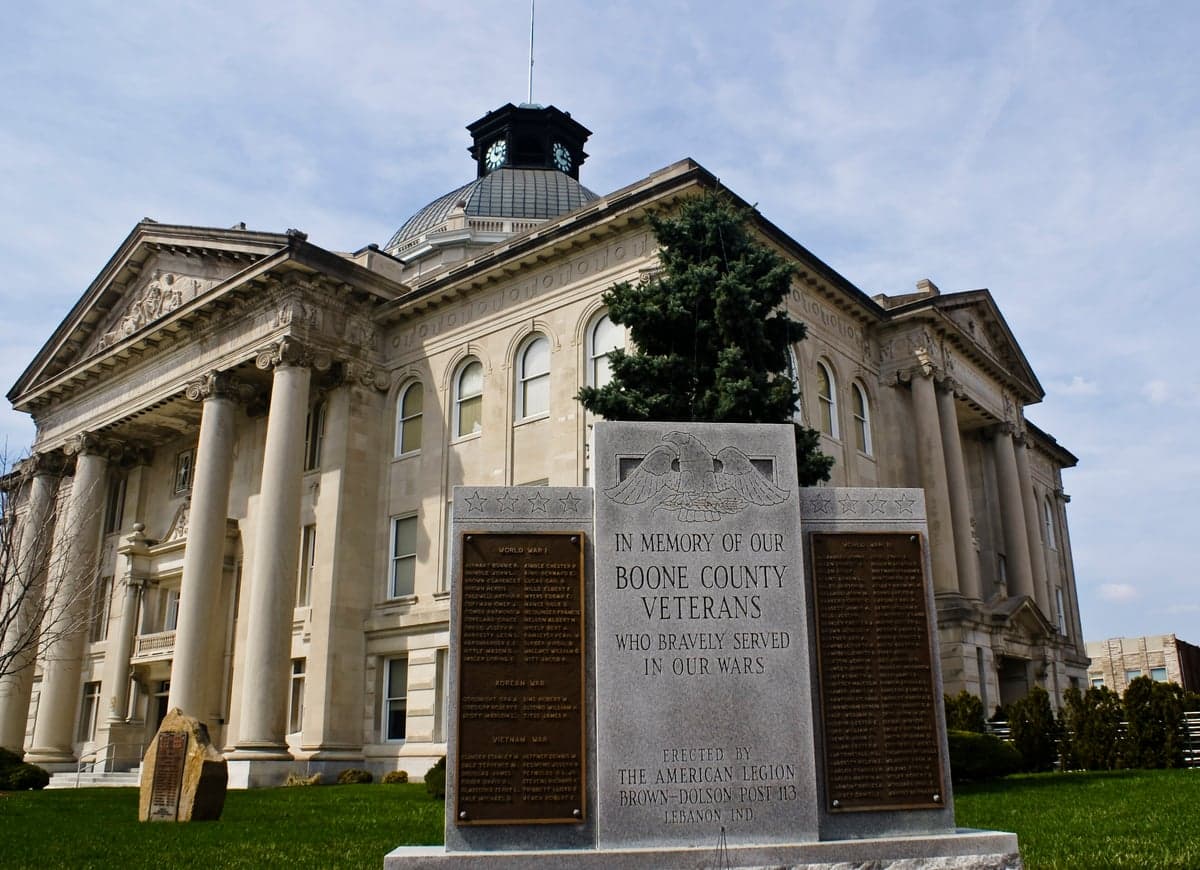
Photo: Wikipedia
Personal Sovereignty in Boone County
Viable for self-reliance. Generally workable, though some barriers may limit total independence.
What does Personal Sovereignty tell us?
Personal Sovereignty measures your capacity for self-reliance and independence with minimal government friction. Higher scores mean fewer barriers between you and the way you want to live... but it assumes you have the space you need and good neighbors.
What does this tell us?
Personal Sovereignty measures your capacity for self-reliance and independence with minimal government friction. Higher scores mean fewer barriers between you and the way you want to live... but it assumes you have the space you need and good neighbors.
State Policy
Energy independence: Importer (35% of energy produced in-state)
Personal Liberty
Homesteading

Personal Liberty Analysis
Boone County, Indiana, offers a notably high degree of personal sovereignty, grounded in Indiana’s strong preemption laws and a local culture that values self-reliance. The county’s regulatory environment is light-touch compared to urban centers like Indianapolis or Bloomington, with local officials in towns like Lebanon, Zionsville, and Whitestown generally favoring limited government intervention. For a relocation reader prioritizing autonomy, Boone County presents a landscape where state-level protections for gun rights, property use, and parental authority create a foundation for independent living, though specific zoning and tax policies vary across its municipalities.
Tax burden and regulatory posture in Boone County
Indiana’s overall tax burden is among the lowest in the nation, and Boone County benefits from this state-level posture. The state’s flat income tax rate of 3.15% (as of 2025) and a sales tax cap of 7% keep the direct tax load light. Property taxes in Boone County are moderate, with an effective rate around 0.85% of assessed value, though this varies by township — for example, Eagle Township near Zionsville sees slightly higher rates due to local school and infrastructure levies. The county’s regulatory posture is generally permissive: there is no county-wide zoning overlay, leaving land-use decisions to individual townships and municipalities. This means that in unincorporated areas like parts of Jackson Township or Center Township, property owners face fewer restrictions on building, fencing, or running a home-based business than they would inside the town limits of Lebanon or Whitestown. Indiana’s right-to-work status and lack of statewide paid family leave mandates further reduce regulatory friction for entrepreneurs and self-employed individuals.
Self-defense and gun law specifics in Boone County
Indiana is a constitutional carry state, meaning no permit is required to carry a handgun openly or concealed for anyone 18 or older who can legally possess a firearm. Boone County fully aligns with this state law, and local sheriffs in Lebanon and Zionsville have historically been supportive of Second Amendment rights. The county has no local ordinances that restrict firearm possession beyond state law, and there are no waiting periods or magazine capacity limits. Stand-your-ground protections apply statewide, with no duty to retreat in any place where a person has a right to be. For those seeking to purchase firearms, gun shops are plentiful in Lebanon and along the I-65 corridor in Whitestown. The county’s gun-friendly culture is reinforced by the presence of shooting ranges and hunting clubs in rural areas like Thorntown and Jamestown, where firearm use is a routine part of outdoor life.
Self-reliance and homesteading viability in Boone County
Boone County offers strong potential for homesteading and off-grid living, particularly in its unincorporated townships. Lot sizes in rural areas like Sugar Creek Township and Worth Township can be as large as 5 to 20 acres, with minimal subdivision restrictions. Zoning in these areas generally permits livestock, gardens, and accessory structures like barns or greenhouses without special permits. Off-grid feasibility is high: Indiana has no state law prohibiting rainwater collection, and many rural properties rely on private wells and septic systems. Solar panel installation is unrestricted in unincorporated areas, though homeowners in Zionsville’s town limits must comply with aesthetic guidelines. The county’s agricultural heritage means that soil quality and water access are generally good, and local feed stores and farm supply businesses are common in Lebanon and Thorntown. For those seeking to reduce reliance on municipal utilities, the county’s rural townships provide a permissive environment for self-sufficient living.
Personal liberties in Boone County: parental rights, medical autonomy, speech, and property
Indiana law provides strong protections for parental rights, including the right to direct a child’s education, medical care, and religious upbringing. Boone County’s school districts — including Lebanon Community Schools and Zionsville Community Schools — generally respect parental input, though the degree of administrative flexibility varies by district. Medical autonomy is supported by Indiana’s broad conscientious objection laws for healthcare providers and the absence of state vaccine mandates for adults. Free speech protections are robust, with no local ordinances restricting political expression or assembly beyond state law. Property rights are reinforced by Indiana’s strong eminent domain protections, which require just compensation and a public purpose for any taking. In practice, Boone County’s local governments rarely exercise eminent domain, and property owners in towns like Whitestown and Jamestown report few disputes with local authorities over land use.
Overall, Boone County ranks among the more sovereignty-friendly areas in Indiana, particularly for those who value gun rights, low taxes, and the ability to live self-sufficiently on rural land. Compared to the more restrictive environments of Marion County (Indianapolis) or Monroe County (Bloomington), Boone County offers a lighter regulatory touch and a culture that respects individual decision-making. For a reader seeking a balance between access to urban amenities and a high degree of personal autonomy, Boone County — especially its unincorporated townships and smaller towns like Thorntown and Jamestown — provides a compelling option.

* Values derived from national, state, county, city and local statistics and may differ in a specific area. Last updated: 2026-06-29T15:03:04.000Z
Narrative content on this page is AI-generated and may contain mistakes. Verify any details that matter before acting on them.
ReloMaps may earn a commission from affiliate links at no extra cost to you.

