Demographics of St Clair County
Affluence Level in St Clair County
A below-average socioeconomic profile. Incomes, home values, and educational attainment trail the U.S., with higher poverty and unemployment.
People of St Clair County
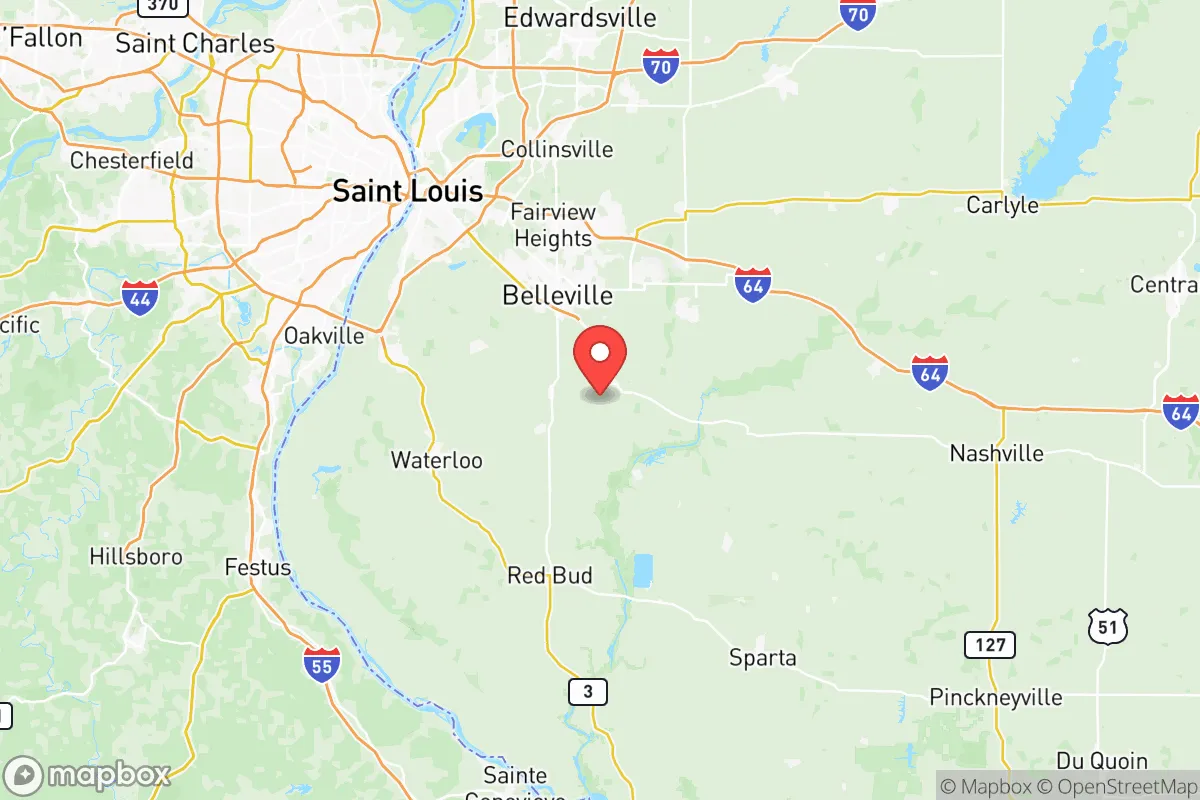
St. Clair County, Illinois, is home to 254,777 residents, a population shaped by its historic role as a Mississippi River crossroads and its position within the Metro East region opposite St. Louis. The county is notably diverse, with a population that is 59.5% White, 27.8% Black, 4.9% Hispanic, and 1.1% East/Southeast Asian, yet it remains one of the least foreign-born counties in the nation at just 1.4%. This demographic profile reflects deep-rooted communities of German and French settlers, a significant African American population with ties to the Great Migration, and a modest but growing suburban and exurban presence. The county's character is defined by a mix of post-industrial river towns, expanding suburbs, and rural farmland, creating a distinct identity separate from the urban core of St. Louis just across the river.
Settlement & growth (pre-1960)
Long before European settlement, the region was home to the Cahokia and Michigamea tribes of the Illinois Confederation, with the powerful Mississippian culture centered at Cahokia Mounds just east of present-day Collinsville. French explorers and fur traders arrived in the late 1600s, establishing the first permanent European settlement in the area at Cahokia in 1699, followed by Prairie du Pont and the village of St. Philippe. These early French settlements, part of the Illinois Country, were agricultural communities built around the fur trade and river commerce, leaving a lasting Catholic and French cultural imprint that can still be seen in place names and local festivals.
After the Louisiana Purchase in 1803, American settlers from Kentucky, Tennessee, and Virginia poured into the region, drawn by fertile bottomland and access to the Mississippi River. Belleville, founded in 1814, quickly became the county seat and a hub for German immigrants who began arriving in significant numbers after the 1830s. These German settlers, many fleeing political unrest and economic hardship, established strong farming communities in and around Belleville, Mascoutah, and Lebanon, and their influence is still evident in the region's Lutheran churches, breweries, and cultural societies. By the mid-19th century, Irish immigrants also arrived to work on the railroads and canals, settling in East St. Louis and other industrial river towns.
The post-Civil War era brought dramatic change as East St. Louis emerged as a major industrial and railroad center. The city's stockyards, meatpacking plants, and factories attracted waves of European immigrants, including Poles, Italians, and Slovaks, who formed dense ethnic neighborhoods. Simultaneously, the Great Migration from the American South began in earnest after 1910, with African Americans from Mississippi, Arkansas, and Tennessee moving to East St. Louis and surrounding communities for industrial jobs. This migration accelerated during World War I and World War II, transforming the county's racial composition and establishing a strong Black working-class presence that remains central to the region's identity. The 1917 East St. Louis race riots, one of the deadliest racial conflicts in American history, marked a violent chapter in this demographic shift, but the African American population continued to grow through the mid-20th century.
Modern era (post-1965)
The post-1965 era brought suburbanization and deindustrialization, reshaping St. Clair County's population patterns. The collapse of heavy industry in East St. Louis after the 1970s led to massive population loss, with the city falling from over 82,000 residents in 1950 to roughly 18,000 today. Many African American families moved outward to Belleville, Fairview Heights, and O'Fallon, creating a more dispersed Black suburban population. Meanwhile, White flight from East St. Louis and older inner-ring suburbs accelerated, with many families relocating to newer developments in Shiloh, Swansea, and the growing exurbs along Interstate 64.
Unlike many metropolitan counties, St. Clair County has seen very limited international immigration since the 1965 Hart-Cellar Act. The foreign-born population remains just 1.4%, far below the national average of roughly 14%. The small Hispanic population of 4.9% is concentrated in Belleville and East St. Louis, with many families working in agriculture, construction, and service industries. The East/Southeast Asian community, at 1.1%, is primarily found in Belleville and O'Fallon, often connected to Scott Air Force Base and the region's healthcare sector. The Indian subcontinent population is even smaller at 0.4%, with families typically employed in professional fields such as medicine and engineering. The county has not developed the large ethnic enclaves seen in other parts of the Chicago or St. Louis metro areas.
Domestic migration has been the primary driver of demographic change since 2000. Scott Air Force Base, located near O'Fallon and Shiloh, has brought a steady stream of military and civilian personnel from across the country, contributing to a more transient and diverse population in those communities. The base's economic impact has spurred residential growth in O'Fallon, which has become the county's fastest-growing city, attracting families seeking good schools and suburban amenities. Belleville has experienced a modest revival, with younger professionals and empty-nesters moving into historic neighborhoods near the downtown square.
The future
St. Clair County's population is projected to remain relatively stable or experience slight decline over the next decade, mirroring trends across downstate Illinois. The county is becoming slightly more diverse, with the White share gradually decreasing as the Hispanic and Asian populations grow from a small base, though these groups will likely remain single-digit percentages. The African American population is expected to continue its suburban dispersal, with O'Fallon and Fairview Heights seeing increased Black homeownership and community development. The county's cultural identity is evolving from its industrial past toward a more service-oriented, suburban character, anchored by healthcare, education, and military-related employment.
The biggest demographic wildcard is Scott Air Force Base, which directly employs over 13,000 military and civilian personnel and supports thousands more jobs. Any future base realignment or expansion would dramatically alter population trends in O'Fallon, Shiloh, and Mascoutah. Without significant international immigration or a reversal of Illinois' outmigration trends, the county will likely continue to age slowly, with younger residents moving to St. Louis or other metro areas for career opportunities. The county's historic French and German heritage remains a point of pride, celebrated in local festivals and preserved in communities like Cahokia and Belleville, but the region is gradually becoming more homogenized as older ethnic neighborhoods fade.
For someone moving to St. Clair County today, the region offers affordable housing, relatively low crime in the growing suburbs, and easy access to St. Louis employment and amenities. The county is becoming a more typical Midwestern suburban landscape, with less of the distinct ethnic character that defined its industrial heyday. New residents will find a community that values its history but is quietly transitioning toward a future shaped by military families, healthcare workers, and commuters rather than factory workers and immigrants. The county's modest diversity and low foreign-born population mean it remains a predominantly native-born, English-speaking environment, which may appeal to those seeking a more traditional American suburban experience.

* Values derived from national, state, county, city and local statistics and may differ in a specific area. Last updated: 2026-07-19T21:21:53.000Z
Narrative content on this page is AI-generated and may contain mistakes. Verify any details that matter before acting on them.
ReloMaps may earn a commission from affiliate links at no extra cost to you.

