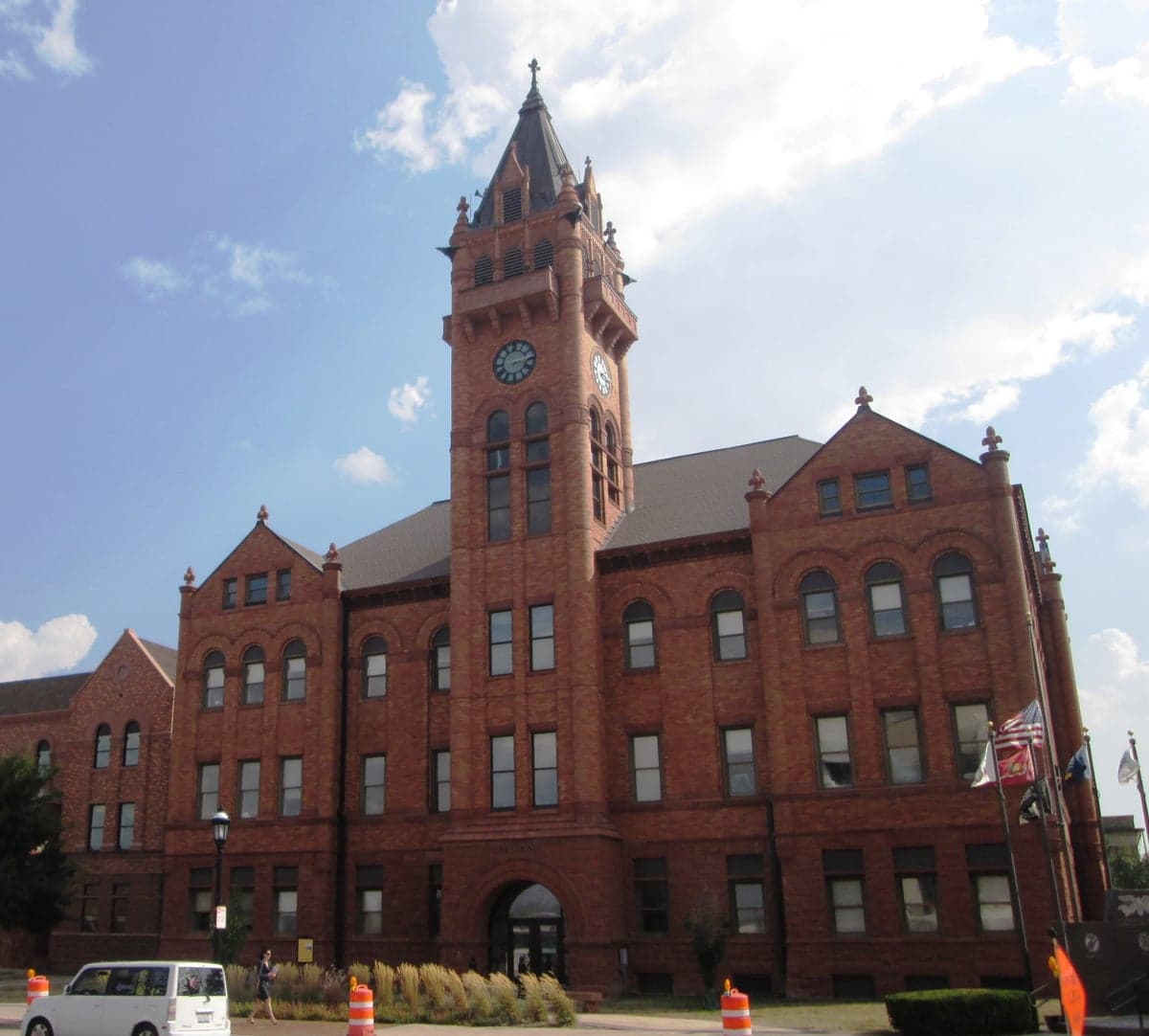
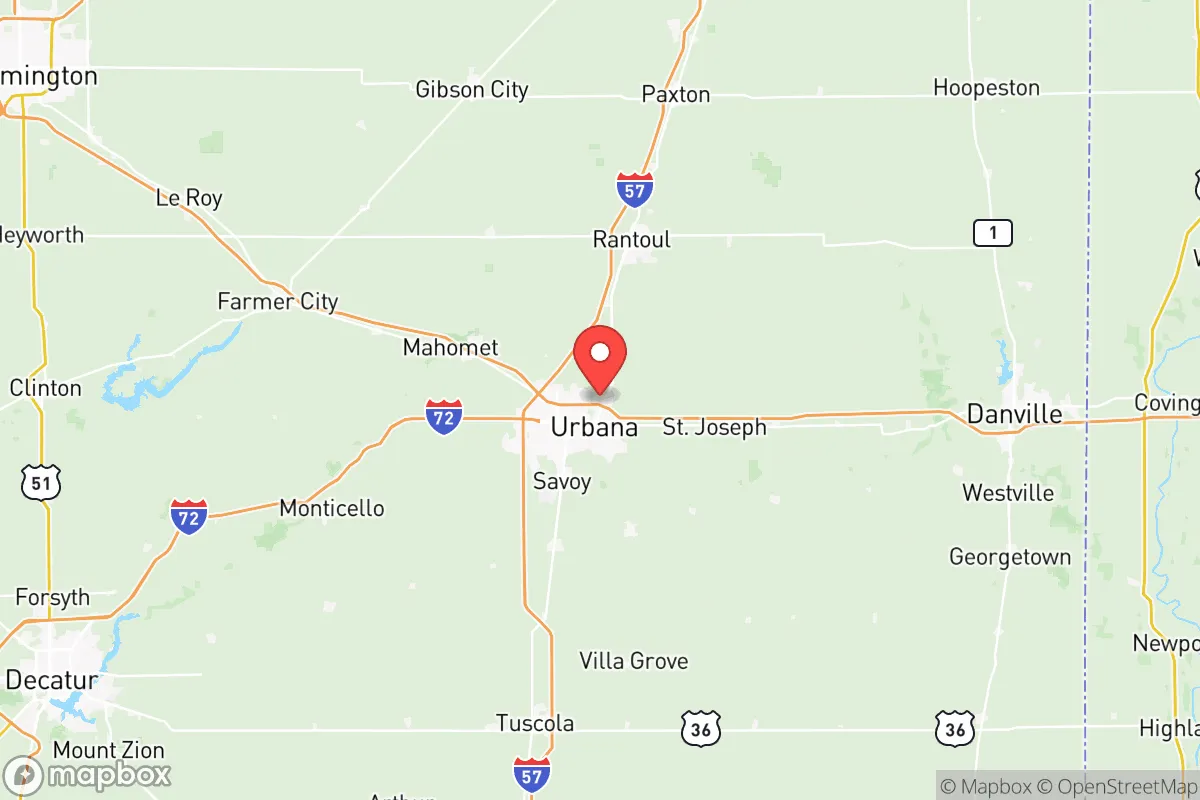
Photo: Wikipedia
Political ClimatePolitical Climate in Champaign County
Showing district-level results — no local-only data available.
Local Political AnalysisPolitical Analysis of Champaign County
Champaign County leans clearly Democratic with a Cook PVI of D+5, though it's a bit less blue than Illinois overall (D+7) because of the conservative farming communities surrounding the University of Illinois bubble. The county has been shifting leftward for over a decade, driven mainly by population growth in Champaign and Urbana, but that trend has slowed since 2020 as the cost of living pushes some younger residents outward and rural areas hold firm. Locals will tell you the real story isn't just the countywide number—it's the stark divide between the liberal twin cities and the deep-red towns of Rantoul, Mahomet, and Tolono.
How it compares
The D+5 vs. D+7 margin means Champaign County is reliably Democratic but with a stronger Republican minority than the state average. In 2024, Champaign and Urbana precincts voted around 75-80% Democratic, while rural villages like Rantoul, Mahomet, and Thomasboro hovered around 55-65% Republican. The true swing territory is in the unincorporated areas along I-74 south of St. Joseph and parts of Bondville, where precincts can flip depending on the candidate. Statewide, Illinois' D+7 is propped up by Chicago's massive margins; Champaign County's D+5 instead reflects a more balanced mix of a liberal university town and conservative farmland. Over time, the gap has narrowed slightly as inflation and housing prices in Champaign-Urbana push some moderate voters toward Republican candidates at the local level, even while presidential races stay safely blue.
What this means for residents
For liberals, Champaign County offers a reliably progressive environment on social issues like LGBTQ rights, environmental policy, and public transit funding—Champaign and Urbana both have non-discrimination ordinances that go beyond state law. Conservatives here are used to being a vocal minority, with active GOP clubs in Rantoul and Mahomet that hold well-attended fish fries and coordinate school board slates. The flip side is gridlock: the county board often splits 7-4 or 6-5 along party lines on big spending items like the planned Champaign County Courthouse renovation, which has been stalled since 2022 over cost concerns. For families in Champaign, property taxes run about 2.3% of assessed value, among the highest in the state, while rural residents in Savoy and Bondville face similar rates but see less direct service because their townships handle most infrastructure themselves.
Cultural and policy distinctions
The clearest local difference from the rest of Illinois is the county's fierce independence on housing and land use. While Chicago mandates affordable housing quotas, Champaign County relies on voluntary agreements with developers like the University of Illinois Research Park, which has added 1,200 tech jobs since 2018 without county subsidies. Gun policy also splits the county: Champaign and Urbana have passed ordinances requiring background checks at gun shows held on public property, but surrounding towns like Rantoul and Thomasboro refuse to enforce them, creating a patchwork locals navigate carefully. If you're moving here, the bottom line is that your experience of the political climate will depend heavily on which side of I-57 you call home—the blue bubble or the red farmland.

State Political ClimatePolitical Climate in Illinois
State Political AnalysisPolitical Environment in the State
Illinois is a solidly Democratic state with a Cook PVI of D+7, meaning it votes about seven points more Democratic than the national average in presidential elections. Over the last 10-20 years, the state has shifted further blue at the statewide level, driven overwhelmingly by the Chicago metro area, while downstate and rural counties have swung sharply in the opposite direction, creating one of the starkest urban-rural divides in the country. A relocator should understand that Illinois isn't a purple state—it's a blue state with a large, deep red minority that feels increasingly powerless in state government.
Urban vs. rural divide
The political map of Illinois is a tale of two worlds. Cook County, home to Chicago, is a Democratic fortress that alone accounts for roughly 40% of the state's vote. The city itself is reliably blue, but the inner ring suburbs like Evanston, Oak Park, and Skokie are even more progressive, while outer suburban counties that once leaned Republican—DuPage, Lake, Kane, McHenry—have been trending Democratic since the Trump era. DuPage County, a former GOP stronghold, voted for Biden in 2020 and has not looked back. Meanwhile, downstate Illinois is overwhelmingly Republican and getting redder. Counties like Williamson, Saline, and Jefferson routinely vote +40 to +60 points Republican. The geographic split is so pronounced that a resident in Marion or Effingham lives in a different political universe than a resident of Chicago's Logan Square neighborhood. The state's legislative maps, drawn by Democrats after the 2020 census, have locked in a supermajority in Springfield, meaning rural conservative voices have remarkably little sway over state policy, even though they cover most of the state's landmass.
Policy environment
Illinois has the highest effective property tax burden in the nation, with rates averaging around 2.1% of home value, and a flat state income tax of 4.95% that was temporarily progressive for one year (2021) before voters rejected a graduated rate amendment. The state also carries the worst pension liability in the country—roughly $140 billion unfunded—driven by decades of underfunding and generous union contracts. On the regulatory front, Illinois is business-friendly in name only for many sectors; the state has strict environmental rules, a $15 minimum wage indexing to inflation, and a robust labor union presence. Education policy is solidly progressive: Illinois has a funding formula that heavily redistributes property tax revenue from wealthier districts to poorer ones, and Chicago Public Schools is under mayoral control with a powerful teachers union. On healthcare, the state expanded Medicaid aggressively and has some of the strongest abortion protections in the Midwest, codified in the Reproductive Health Act of 2019. Election laws are liberal: no-excuse mail voting, automatic voter registration, and a patchwork of same-day registration and early voting that makes it very easy to vote in Chicago and the suburbs, though rural areas often have fewer early voting sites in practice.
Recent policy direction
The last five years have seen Illinois move decisively leftward across a range of issues. Governor JB Pritzker signed a comprehensive gun ban in January 2023 (HB 5471), prohibiting the sale of many semi-automatic rifles and high-capacity magazines, and requiring existing owners to register them with the state police, a law currently challenged in court. Parental rights in education have been curtailed; the state passed a law in 2022 requiring public schools to include LGBTQ+ history in curricula, and a 2024 law prohibits book bans in public libraries as a condition of state funding. On speech and privacy, Illinois has the Biometric Information Privacy Act (BIPA), one of the strictest privacy laws in the country, which has led to massive class-action lawsuits against tech companies and employers. Medical and bodily autonomy is firmly protected: the state is a sanctuary for abortion seekers from neighboring states, and gender-affirming care for minors is explicitly protected under state law, drawing legal challenges. Property rights are relatively constrained; in addition to high taxes, the state has strict landlord-tenant regulations, and Cook County has rent control preemption (though statewide preemption prevents it). Tax-wise, there is no appetite to lower rates; the state relies on its property tax system. Voting access has been steadily expanded, with automatic voter registration at DMVs and same-day registration available statewide, though rural counties often have fewer polling places per capita.
Civil unrest & political movements
Illinois has been a flashpoint for political movements on both sides. The 2020 George Floyd protests in Chicago were among the largest in the country, with significant property damage and looting in the Loop and on the Magnificent Mile. Since then, the city has seen a sharp uptick in organized left-wing activism around policing, housing, and education, particularly from groups like Good Kids Mad City and the Chicago Teachers Union. On the right, the "Illinois is not Chicago" movement has gained traction, with several downstate counties passing non-binding resolutions supporting secession from Illinois, though none have legal teeth. The Second Amendment preservation movement is strong in rural areas; dozens of counties have declared themselves "sanctuary counties" for gun rights, vowing not to enforce the state's assault weapons ban. Immigration politics are active: Chicago is a sanctuary city with a strong pro-immigrant advocacy network, and the state has seen an influx of migrants bused from Texas since 2022, straining shelters and causing political friction within the city itself. Election integrity is a live issue; Republicans have challenged the state's vote-by-mail expansion and the security of drop boxes, though no widespread fraud has been proven. Flashpoints a new resident would notice: heavy state police presence in Chicago during protests, the partisan navigation of license plate readers and surveillance in the city, and the visible divide between "Trump 2024" flags in rural Illinois and "We Believe" yard signs in blue suburbs.
Projection
Over the next 5-10 years, Illinois is likely to become bluer at the state level, not redder. Demographically, the Chicago metro area is gaining in diversity and retaining its liberal tilt, while the white, aging, downstate population is shrinking. Net out-migration continues to be a major factor—Illinois lost roughly 200,000 residents between 2020-2024—but the people leaving are disproportionately from rural areas and the outer suburbs, not from the Democratic strongholds. The state's political trajectory will be defined by fiscal strain: pension costs will crowd out spending on everything else, and no party has a plan to address it without massive cuts or tax increases. A new resident moving in now should expect more of the same: progressive governance in Springfield, high property taxes that won't fall, and a two-tiered quality of life where Chicago and its suburbs get the lion's share of state investment, while downstate roads, schools, and hospitals continue to struggle. The state's Democratic dominance means Republican residents will have no realistic path to influence state policy for at least a decade, unless a scandal or economic crisis reshuffles the political deck.
For a conservative-leaning relocator, the bottom line is this: Illinois offers world-class amenities in Chicago and its suburbs—culture, job density, and infrastructure—but it comes with a political price tag of high taxes, limited gun rights, and a state government that is openly hostile to conservative values. A liberal relocator will find the state welcoming, with robust protections for abortion, LGBTQ+ rights, and union labor, but will still have to contend with the nation's worst pension crisis and highest property taxes. If you move here, you'll be living in a state where your vote for state-level offices is effectively irrelevant if you're conservative, but where your local town or county politics may still align with your values, especially if you choose a red suburb like Naperville (now purple), a rural county like Washington, or a downstate city like Marion or Quincy. Pick your county carefully, and understand that in Illinois, your ZIP code determines far more than your party registration ever will.
* Values derived from national, state, county, city and local statistics and may differ in a specific area. Last updated: 2026-07-02T02:52:44.000Z
Narrative content on this page is AI-generated and may contain mistakes. Verify any details that matter before acting on them.
ReloMaps may earn a commission from affiliate links at no extra cost to you.

