
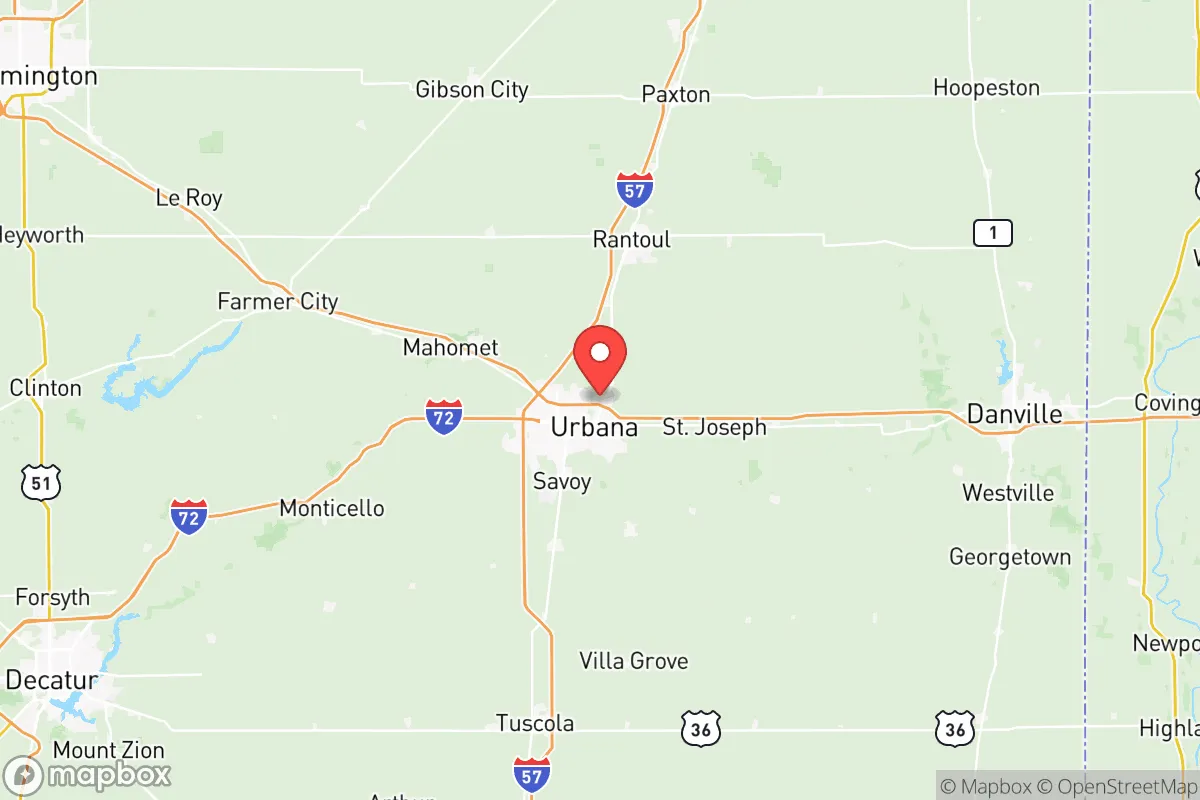
Photo: Wikipedia
Personal Sovereignty in Champaign County
Viable for self-reliance. Generally workable, though some barriers may limit total independence.
What does Personal Sovereignty tell us?
Personal Sovereignty measures your capacity for self-reliance and independence with minimal government friction. Higher scores mean fewer barriers between you and the way you want to live... but it assumes you have the space you need and good neighbors.
What does this tell us?
Personal Sovereignty measures your capacity for self-reliance and independence with minimal government friction. Higher scores mean fewer barriers between you and the way you want to live... but it assumes you have the space you need and good neighbors.
State Policy
Energy independence: Importer (45% of energy produced in-state)
Personal Liberty
Homesteading

Personal Liberty Analysis
Champaign County offers a more substantial latitude for personal autonomy than what is common in Illinois' urban core, largely due to its rural-urban political mix and the state's preemptive legal structure. While Illinois imposes statewide mandates on firearms, taxation, and property regulation that limit local discretion, Champaign County's leaders tend to take a less aggressive approach to enforcement compared to Cook County or collar counties. The result is a living environment where a single person or family can exercise meaningful control over daily choices—within the boundaries of state law—by selecting between the county's distinct communities, from the unincorporated rural stretches around Mahomet and Sidney to the more regulated but still relatively free city of Champaign.
What the local tax burden and regulatory posture mean for residents
Property taxes in Champaign County are notable, with an effective rate averaging approximately 2.2% of assessed value, among the higher rates in the nation. This burden stems from Illinois' heavy reliance on property taxes to fund schools and local services. However, the county's overall property tax structure is still significantly lower than Cook County's roughly 2.5% average, and the local government has not pursued the supplemental municipal taxes common in the Chicago suburbs. State income tax is a flat 4.95%, which is moderate by national standards, and Champaign County imposes no local sales tax surcharge beyond the state's 6.25% base plus county-level add-ons that bring the total to roughly 8.75% in Urbana and 9% in Champaign. Regulatory posture is mixed: the county operates with a relatively straightforward permitting process for home additions and accessory dwellings in unincorporated areas, but the City of Champaign enforces stricter zoning codes, particularly regarding short-term rentals and home-based businesses. For a conservative-leaning resident, the tax load is a real cost of living here but is offset by the absence of the aggressive municipal regulation seen in places like Evanston or Oak Park. The county's approach to business licensing is generally light-touch, with no occupational privilege tax, and the local health department does not impose its own food preparation regulations beyond state minimums for small-scale producers.
Self-defense rights and gun law specifics across Champaign County
Firearm ownership in Champaign County operates under Illinois' framework, including the Firearm Owners Identification (FOID) card system and a state-level concealed carry license (CCL) requirement. Open carry is banned statewide, and concealed carry is permitted only with a CCL, which requires 16 hours of training. However, the county's sheriff's office is known for a comparatively straightforward CCL issuance process, with typical wait times of 60–90 days, and local law enforcement generally does not conduct proactive enforcement against law-abiding gun owners. The City of Champaign has not enacted any local ordinances regarding firearm storage or ammunition sales that exceed state law, and Urbana takes a similarly restrained stance. For practical self-defense, the unincorporated areas of the county, particularly around Sidney and St. Joseph, offer a de facto permissive environment where property owners commonly keep firearms for home defense with minimal local interference. The county lacks the municipal assault weapon bans found in Chicago or Cook County, as the state's preemption law under the Firearm Concealed Carry Act generally prohibits local governments from passing their own restrictions on firearms beyond state law. While Champaign County is not a "Second Amendment sanctuary" jurisdiction, the local sheriff's office has publicly stated it will not enforce any future state-level "red flag" orders beyond the minimum legal requirement, a position that appeals to residents prioritizing self-defense sovereignty.
Self-reliance and homesteading viability: lot sizes, zoning, and off-grid feasibility
Homesteading and off-grid living are most viable in the unincorporated townships outside Champaign and Urbana. Mahomet and Tolono offer substantial residential lots—often 1 to 5 acres—at prices ranging from $20,000 to $60,000 per acre, a fraction of the cost near Chicago or even Bloomington-Normal. Zoning in Champaign County's unincorporated areas generally permits small-scale agriculture, including livestock such as chickens, goats, and one horse per acre, without a special use permit. The county's building code does allow for alternative energy systems, including solar panels, but utility-scale battery storage requires a building permit and must meet National Electric Code standards. Off-grid feasibility is moderate: the county does not require connection to municipal water or sewer on parcels over 1 acre, but state health department rules mandate a private well and septic system permit, which costs $500–$1,500 in permitting and inspection fees. Rainwater collection is legal but limited to non-potable uses like irrigation, and composting toilets are permitted if certified by the state. The City of Champaign, by contrast, requires connection to municipal utilities on parcels smaller than 1 acre and prohibits composting toilets entirely. For a family seeking true self-reliance, the stretch of farmland between Sidney and St. Joseph is ideal: large parcels (10–40 acres) with minimal zoning oversight, where residents can keep multiple livestock species and operate home-based businesses like welding or woodworking without business licenses beyond a simple county registration.
Personal liberties: parental rights, medical autonomy, speech, and property
Parental rights in Champaign County are shaped by Illinois' progressive education policies, but local school boards have some discretion. The county's five school districts (Champaign, Urbana, Mahomet-Seymour, St. Joseph-Ogden, and Tolono) vary significantly: Mahomet-Seymour schools have a reputation for more traditional curriculum and minimal opt-out friction for parental requests regarding sensitive topics, while Urbana's school district more strongly aligns with state guidelines on comprehensive sex education and social-emotional learning. Medical autonomy is limited by state law: Illinois mandates that health insurance cover contraceptives and abortion, and the state has "shield" laws protecting providers and patients from out-of-state legal action. In Champaign County, residents find a pragmatic middle ground—the local hospital (OSF Heart of Mary) offers standard medical services without ideological pressure, and the county health department has not imposed vaccine mandates beyond state requirements for school attendance. Freedom of speech is strongly protected under Illinois' liberal state constitution, and Champaign County has a lively history of public discourse; the local University of Illinois campus occasionally fosters political speech controversies, but the broader county does not engage in viewpoint-based restrictions. Property rights are well-defined: the county follows state law regarding eminent domain, and private property seizures for economic development are extremely rare. The county assessor's office is responsive to homestead exemption applications, which can reduce the taxable value of a primary residence by up to $6,000. Homeowners also enjoy the right to fence their property without permits in unincorporated areas, provided the fence does not exceed 6 feet in height.
Compared to other areas of Illinois, Champaign County offers a moderate-to-high level of personal sovereignty, particularly for residents who choose rural townships over the city cores. The state's baseline taxes and gun laws are fixed, but the county's enforcement culture leans practical, and the land costs and zoning flexibility in places like Mahomet, Sidney, and Tolono create genuine opportunities for homesteading and self-reliance that are simply unavailable in the state's heavily regulated urban centers. For a conservative-leaning individual or family weighing personal freedom against the practicalities of Illinois living, Champaign County represents a viable balance—far more independent than the Chicago metro, yet not as restrictive as one might expect for a county anchored by a major university town.

* Values derived from national, state, county, city and local statistics and may differ in a specific area. Last updated: 2026-07-02T02:52:44.000Z
Narrative content on this page is AI-generated and may contain mistakes. Verify any details that matter before acting on them.
ReloMaps may earn a commission from affiliate links at no extra cost to you.

