Photo: Wikipedia
Demographics of Hudson, NY
Affluence Level in Hudson, NY
A middle-class area roughly in line with national averages across income, home values, education, and employment.
People of Hudson, NY
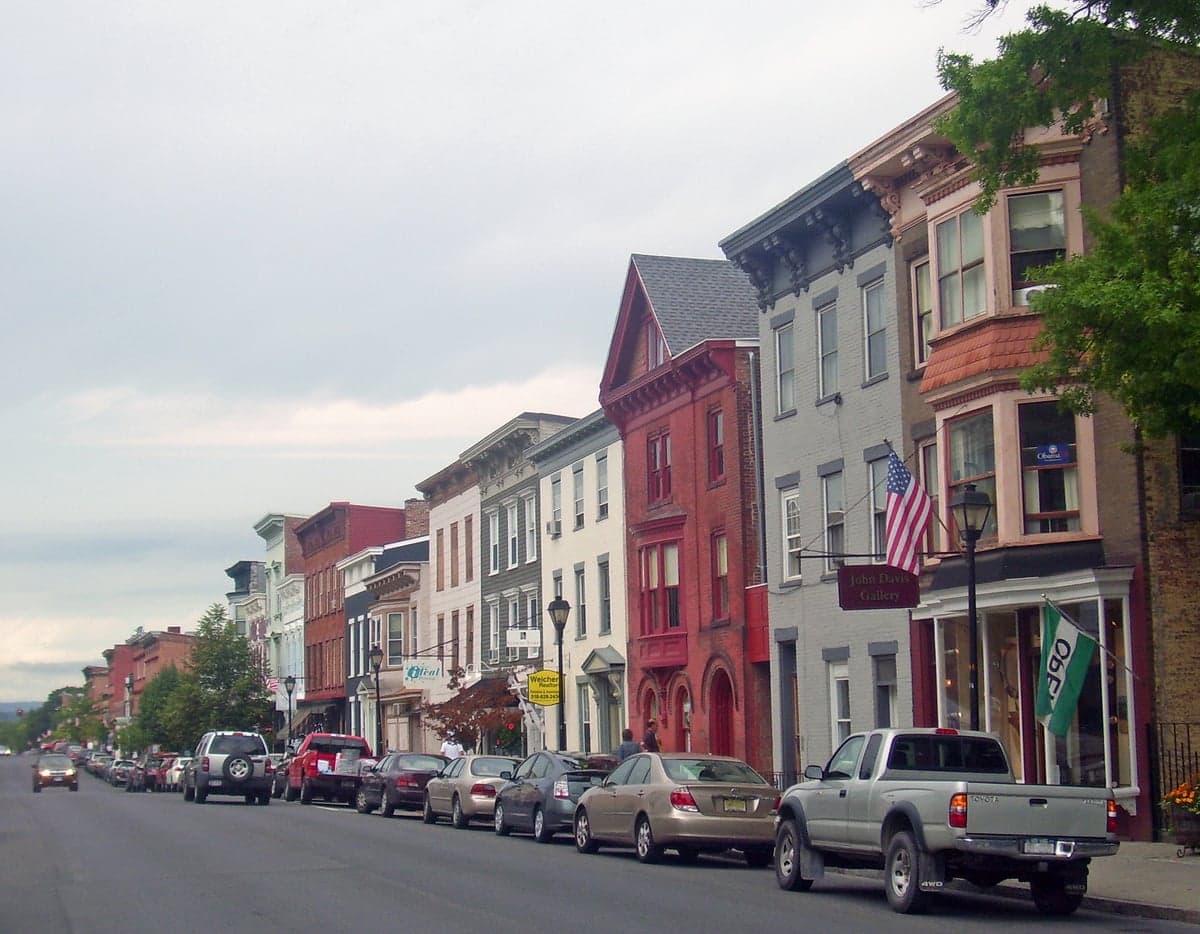
The people of Hudson, New York, today form a compact, culturally dense community of roughly 5,900 residents, marked by a distinctive blend of long-established Black and white working-class families, a growing Indian-subcontinent population, and a smaller but visible East/Southeast Asian presence. The city’s character is notably urban for its size, with a walkable historic core, a strong arts-and-antiques economy, and a population that is 39.0% college-educated—well above the national average for a city this small. Hudson’s identity is shaped by its role as a Hudson Valley destination for second-home owners and weekenders, creating a palpable tension between longtime locals and newer, often wealthier arrivals.
How the city was settled and grew
Hudson was founded in 1783 by a group of New England whaling merchants from Nantucket and Providence, who saw the deep-water port on the Hudson River as an ideal base for the whaling and shipping industries. The original settlers laid out a grid of streets on a steep hillside above the river, and the city quickly became one of the busiest whaling ports in the United States during the early 19th century. The whaling boom drew a mix of European immigrants—primarily Irish and German laborers—who settled in the lower wards near the waterfront, an area now known as the Waterfront District, where many of the original 18th- and 19th-century brick buildings still stand. By the mid-1800s, Hudson’s economy shifted to manufacturing (textiles, ironworks, and later cement), attracting Italian and Eastern European immigrants who clustered in the Union Street corridor and the hilltop neighborhoods around Warren Street. The city’s Black population, which has deep roots in the region dating to the colonial era, grew significantly during the Great Migration (1910–1970) as African Americans moved north for industrial jobs; they concentrated in the Second Ward, a historically Black neighborhood centered on State Street and Columbia Street, which remains a cultural anchor for the city’s Black community today.
Modern era (post-1965)
The post-1965 period brought dramatic demographic shifts. The 1965 Hart-Cellar Act opened immigration from Asia and Africa, and Hudson began receiving a small but steady stream of new residents. The most notable modern change has been the growth of the Indian-subcontinent population, which now stands at 9.1% of the city’s residents—a share that is roughly three times the national average and the highest of any small city in the Hudson Valley. This community, largely composed of professionals in healthcare, technology, and small business, has concentrated in the Promenade Hill area and the newer residential blocks east of Fairview Avenue, where larger single-family homes are available. The East/Southeast Asian population (3.2%) is smaller and more dispersed, with families living throughout the city but with a slight concentration near the Columbia Memorial Health campus, where many are employed. The Black population (11.6%) has remained stable but has seen some out-migration to suburban towns like Greenport and Kinderhook as housing prices in Hudson have risen sharply since 2010. The Hispanic population (7.6%) is a mix of Puerto Rican, Dominican, and Mexican families, many of whom arrived in the 1990s and 2000s for service-industry jobs; they are most visible in the South Bay neighborhood and along Route 9G south of the city. The white population (65.3%) has become increasingly bifurcated between longtime working-class families (many of Italian and Irish descent) and affluent newcomers from New York City and Brooklyn who have renovated historic homes in the Warren Street Historic District, driving up property values and reshaping the city’s retail and cultural scene.
The future
Hudson’s population is likely to continue growing slowly—perhaps reaching 6,500–7,000 by 2040—driven by continued in-migration from the New York City metro area and by natural increase among the Indian-subcontinent and Hispanic communities, both of which have younger age profiles than the white population. The city is becoming more diverse in absolute terms, but the pattern is one of increasing economic stratification: affluent white newcomers occupy the historic core, while lower-income Black and Hispanic families are being pushed to the periphery or to adjacent towns. The Indian-subcontinent population is expected to grow further as professionals are drawn to jobs at Columbia Memorial Health and in Albany’s tech sector, and they are likely to continue concentrating in the Fairview Avenue corridor and newer subdivisions east of the city. The East/Southeast Asian population may grow modestly but will likely remain a small share. The biggest unknown is housing affordability: if prices continue to rise faster than incomes, Hudson could see a net loss of its Black and working-class white populations, making the city more demographically polarized—wealthy and diverse at the top, with a shrinking middle and lower class.
For someone moving to Hudson now, the city offers a rare combination of small-town scale, historic architecture, and genuine diversity—but that diversity is increasingly stratified by income and neighborhood. The city is becoming a place where your street address signals not just where you live, but your era of arrival and your economic standing. Newcomers should expect a community that is culturally rich, politically engaged, and visibly changing, with all the opportunities and tensions that come with rapid demographic turnover.

* Values derived from national, state, county, city and local statistics and may differ in a specific area. Last updated: 2026-09-05T03:09:01.000Z
Narrative content on this page is AI-generated and may contain mistakes. Verify any details that matter before acting on them.
ReloMaps may earn a commission from affiliate links at no extra cost to you.

