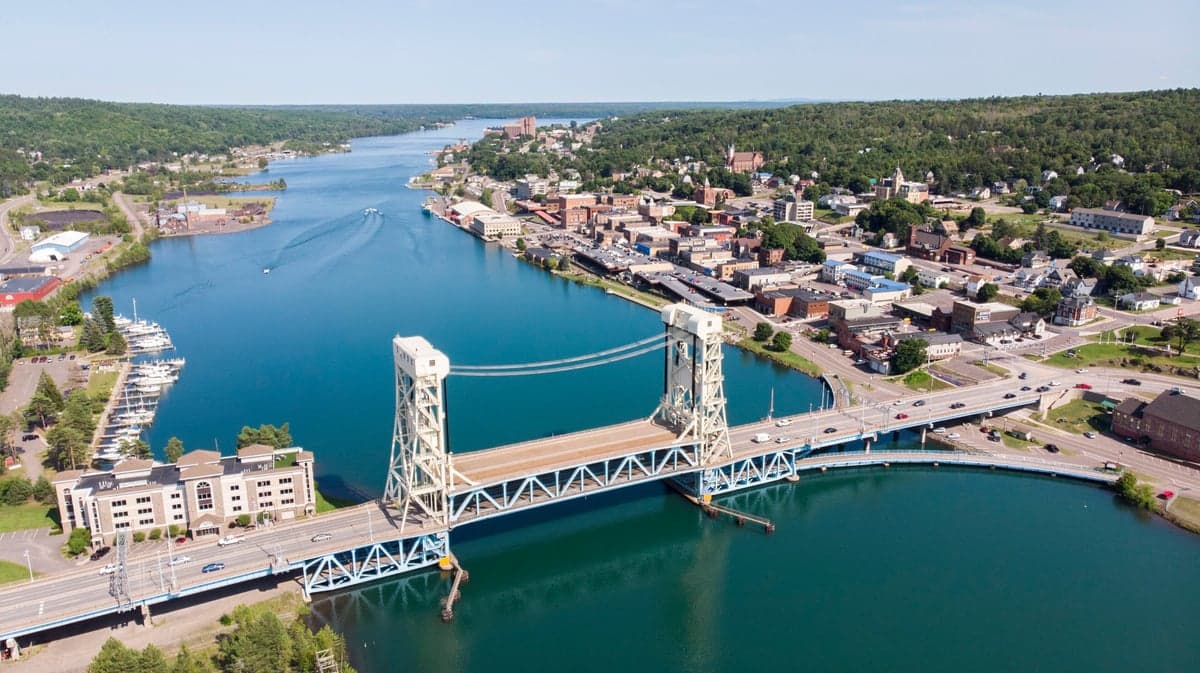
Photo: Wikipedia
Political ClimatePolitical Climate in Houghton, MI
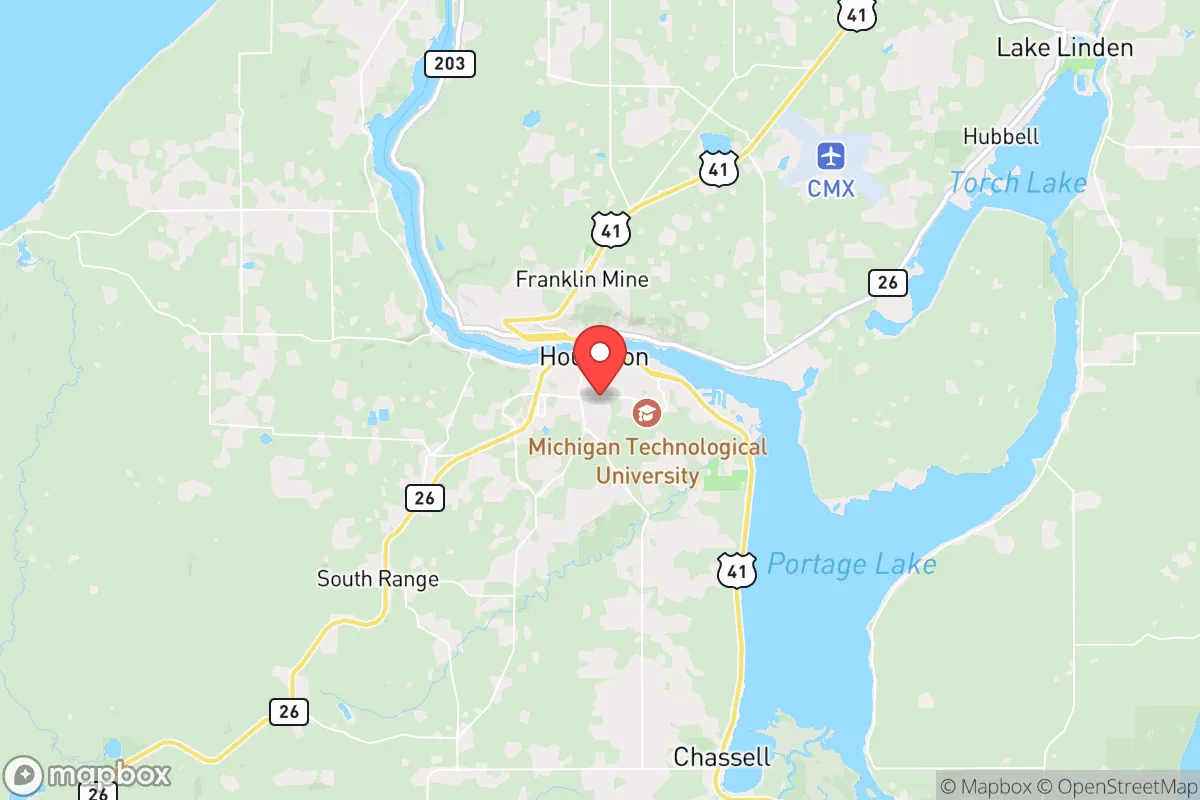
District shown is the primary district for this city’s centroid. Cities may span multiple districts.
Local Political AnalysisPolitical Analysis of Houghton, MI
Houghton, Michigan, sits in a reliably conservative pocket of the Upper Peninsula, with a Cook Partisan Voting Index (PVI) of R+11—a stark contrast to the state of Michigan as a whole, which is rated EVEN. This means the area votes about 11 points more Republican than the national average, while the state itself is a pure toss-up. The political lean here isn't a new trend; it's been a steady, deeply rooted reality for decades, driven by a mix of rural values, a strong outdoor-recreation culture, and a local economy tied to mining and Michigan Technological University. You won't see the dramatic swings you get in downstate swing counties—Houghton is reliably red, but with a notable blue streak running through the university community.
How it compares
Compared to the rest of Michigan, Houghton is an outlier. The state's EVEN rating reflects the fierce competition between Detroit's Democratic strongholds and the Republican-leaning western and northern Lower Peninsula. Houghton's R+11 is more in line with deeply red counties like Missaukee or Osceola, but with a twist: the presence of Michigan Tech means the city of Houghton itself often votes more moderately or even leans left, while the surrounding townships—like Hancock, Chassell, and Calumet—are solidly conservative. Drive 30 minutes south to Ontonagon or west to Ironwood, and you'll find similar conservative leanings, though with even lower population density. The contrast is sharpest when you compare Houghton to Ann Arbor or Grand Rapids; those cities have their own political flavors, but Houghton's mix of rural conservatism and academic liberalism is unique in the state.
What this means for residents
For conservative residents, Houghton is a comfortable place where their views are the norm in county-level elections and local governance. You'll find plenty of support for gun rights, limited government, and traditional values at the township and county board level. For liberal residents, especially those affiliated with Michigan Tech, the city itself offers a bubble of progressive thought—there are active environmental groups, a local Democratic club, and a visible LGBTQ+ community. However, the broader county can feel isolating if you're on the left; you won't see many "Biden 2024" yard signs outside the city limits. The practical reality is that both sides coexist with a fair amount of tolerance, largely because the economy and lifestyle—winter sports, fishing, and a quiet pace—unite people more than politics divides them. You won't find the heated partisan battles you see in Lansing or Detroit; here, it's more about whether the snowplow came on time.
Culturally, Houghton stands out for its fierce localism. The area's isolation—it's a 7-hour drive from Detroit—fosters a "we take care of our own" mentality that transcends party lines. Policy-wise, this means local issues like road funding, internet access, and snow removal dominate over national debates. The university brings a steady influx of out-of-state students and faculty, which keeps the political mix dynamic, but the long-term trajectory points to a continued conservative tilt as the region's population ages and younger graduates often leave for jobs elsewhere. If you're moving here, expect a place where your vote matters more in local races than in presidential ones, and where the biggest political argument might be over the best place to park a snowmobile.

State Political ClimatePolitical Climate in Michigan
State Political AnalysisPolitical Environment in the State
Michigan is the ultimate swing state, with a Cook PVI of EVEN that perfectly captures its knife-edge balance between the two major parties. Over the past 20 years, the state has shifted from a reliably blue stronghold in presidential elections (voting for Democrats from 1992 to 2012) to a true battleground that flipped for Trump in 2016, then flipped back for Biden in 2020 by just 154,000 votes. The dominant coalition is a three-way tug-of-war: the heavily unionized, diverse Detroit metro area pulls the state left; the western side of the Lower Peninsula and the rural Upper Peninsula lean right; and the fast-growing, college-educated suburbs of Grand Rapids and Ann Arbor are the true swing voters who decide every statewide race.
Urban vs. rural divide
The political map of Michigan is a study in stark contrasts. Detroit and its inner-ring suburbs (like Southfield and Dearborn) are the Democratic engine, delivering massive margins that the rest of the state must overcome. Wayne County alone gave Biden 68% of the vote in 2020. In contrast, the rural thumb region (Lapeer, Sanilac, Huron counties) and the western Lower Peninsula (Muskegon, Oceana, Newaygo) vote 60-70% Republican. The real action is in the suburban donut around Detroit — Macomb County flipped from Obama to Trump to Biden, making it the single most watched county in the state. Oakland County, once a Republican stronghold, has become a suburban Democratic bastion as college-educated voters have shifted left. Meanwhile, Grand Rapids (Kent County) is the state's conservative counterweight, though its growing Hispanic and young professional populations are slowly nudging it toward purple. The Upper Peninsula votes Republican by about 55-60%, but its small population means it rarely decides statewide races.
Policy environment
Michigan's policy landscape is a mixed bag that reflects its swing-state status. The state has a flat income tax rate of 4.25%, which was reduced from 4.35% in 2023 through a trigger law tied to state revenue growth. Sales tax is 6%, and property taxes are governed by the Headlee Amendment and Proposal A, which cap annual increases at the rate of inflation or 5%, whichever is less — a major selling point for homeowners. The regulatory posture is moderate: Michigan is a right-to-work state as of 2024, after the Democratic legislature repealed the 2012 right-to-work law, but a subsequent ballot drive is attempting to reinstate it. Education policy is decentralized, with over 500 school districts and a robust charter school sector (Michigan has one of the highest charter enrollment rates in the nation). Healthcare is dominated by the Healthy Michigan Plan (Medicaid expansion under the ACA), which covers about 1.2 million residents. Election laws are relatively accessible: no-excuse absentee voting was approved by voters in 2018, and same-day voter registration is available. However, voter ID is required at the polls (with a signed affidavit as an alternative).
Recent policy direction
The 2023-2024 legislative session, controlled by Democrats for the first time in 40 years, produced a flurry of significant changes. On gun and self-defense law, Michigan passed universal background checks and safe storage requirements, and repealed the state's preemption law that had prevented local governments from enacting their own gun ordinances. Parental and education rights saw the repeal of the 1931 law banning abortion (the state's pre-Roe ban), and the passage of a comprehensive LGBTQ+ nondiscrimination law (the Elliott-Larsen Civil Rights Act expansion). On speech and privacy, the state has no broad privacy law yet, but a Michigan Privacy Act is under active debate. Medical and bodily autonomy was dramatically reshaped: Proposal 3, passed by voters in 2022, enshrined abortion rights in the state constitution up to fetal viability. Property rights remain strong under the Headlee Amendment, though Democrats have discussed allowing local governments to levy new taxes without a vote. Taxation saw the retirement tax phased out for most seniors (effective 2026), and the Earned Income Tax Credit was expanded from 6% to 30% of the federal credit. Voting and ballot access expanded with the 2022 passage of Proposal 2, which established nine days of early voting, drop boxes, and automatic voter registration. For a conservative relocator, the net direction is clearly leftward on social issues, but the state's fiscal posture remains relatively restrained.
Civil unrest & political movements
Michigan has been a flashpoint for political activism on both sides. The 2020 Whitmer kidnapping plot and the armed protests at the state capitol over COVID-19 restrictions put Michigan at the center of national political tensions. The Wolverine Watchmen militia group was implicated in the plot, and several members were convicted. On the left, the Michigan Democratic Party has been energized by the 2022 ballot initiatives on abortion and voting rights, which saw massive grassroots organizing. Immigration politics are relatively quiet compared to border states, but Dearborn and Hamtramck have become centers of pro-Palestinian activism, with large Arab American populations. Sanctuary policies are not statewide, but several cities (Ann Arbor, Detroit, Kalamazoo) have declared themselves sanctuary cities. Election integrity controversies have been persistent: the 2020 election saw Trump's campaign file multiple lawsuits in Michigan, all of which were dismissed, and a GOP-led state Senate investigation found no widespread fraud. However, the 2024 election cycle saw continued partisan battles over absentee ballot processing and the role of the Secretary of State. A new resident would notice the ubiquitous political yard signs in swing suburbs like Rochester Hills and Novi, and the occasional protest at the state capitol in Lansing.
Projection
Over the next 5-10 years, Michigan is likely to remain a competitive swing state, but the demographic trends favor Democrats. The Detroit metro area is slowly depopulating (Wayne County lost 5% of its population from 2010-2020), while the Grand Rapids and Traverse City areas are growing due to in-migration from other states. The college-educated suburban vote in Oakland, Washtenaw, and Kent counties is trending left, while rural areas are solidifying their Republican lean. The Hispanic population in western Michigan (especially around Holland and Grand Rapids) is growing and could become a swing constituency. The 2024 redistricting created more competitive congressional seats, which will keep the state in play. For a conservative relocator, the state's political trajectory is a slow leftward drift on social issues, but the fiscal conservatism of the Headlee Amendment and the flat tax provide a floor. The wildcard is the 2026 gubernatorial race, which will test whether Democrats can hold the gains they made in 2022. Expect Michigan to remain a purple state with a slight blue tint in statewide races, but with enough local variation that a conservative can find a comfortable community in the western suburbs or rural areas.
For a new resident, the bottom line is that Michigan offers a genuine swing-state experience where your vote actually matters. If you're conservative, you'll find strong communities in places like Grand Rapids, Midland, and the Upper Peninsula, but you'll need to accept that statewide policy will swing left on social issues. If you're liberal, the Detroit suburbs and Ann Arbor offer a deep blue haven, but you'll face a state government that is perpetually divided. The practical takeaway: choose your county carefully, because local politics in Michigan are far more polarized than the statewide EVEN rating suggests. The state's flat tax, strong property rights, and school choice are genuine draws for conservatives, while the constitutional abortion protections and expanded voting access appeal to liberals. Michigan is not a state that will ever feel politically comfortable for either side — and that's exactly what makes it interesting.
* Values derived from national, state, county, city and local statistics and may differ in a specific area. Last updated: 2026-06-16T09:27:26.000Z
Narrative content on this page is AI-generated and may contain mistakes. Verify any details that matter before acting on them.
ReloMaps may earn a commission from affiliate links at no extra cost to you.

