Photo: Wikipedia
Demographics of Houghton, MI
Affluence Level in Houghton, MI
A middle-class area roughly in line with national averages across income, home values, education, and employment.
People of Houghton, MI
The people of Houghton, Michigan today form a compact, highly educated community of 8,341 residents, distinguished by a foreign-born population of 13.0%—more than double the national average for a city its size—and a college attainment rate of 65.7%, driven by Michigan Technological University. The city is predominantly White (78.5%), but its ethnic landscape is notably layered: Indian-subcontinent residents make up 4.7% of the population, East/Southeast Asian communities account for 4.2%, Black residents 2.8%, and Hispanic residents 3.5%. This is a place where a historic Finnish and Cornish mining identity now coexists with a globally recruited academic workforce, creating a town that feels both deeply rooted and unusually international for the Upper Peninsula.
How the city was settled and grew
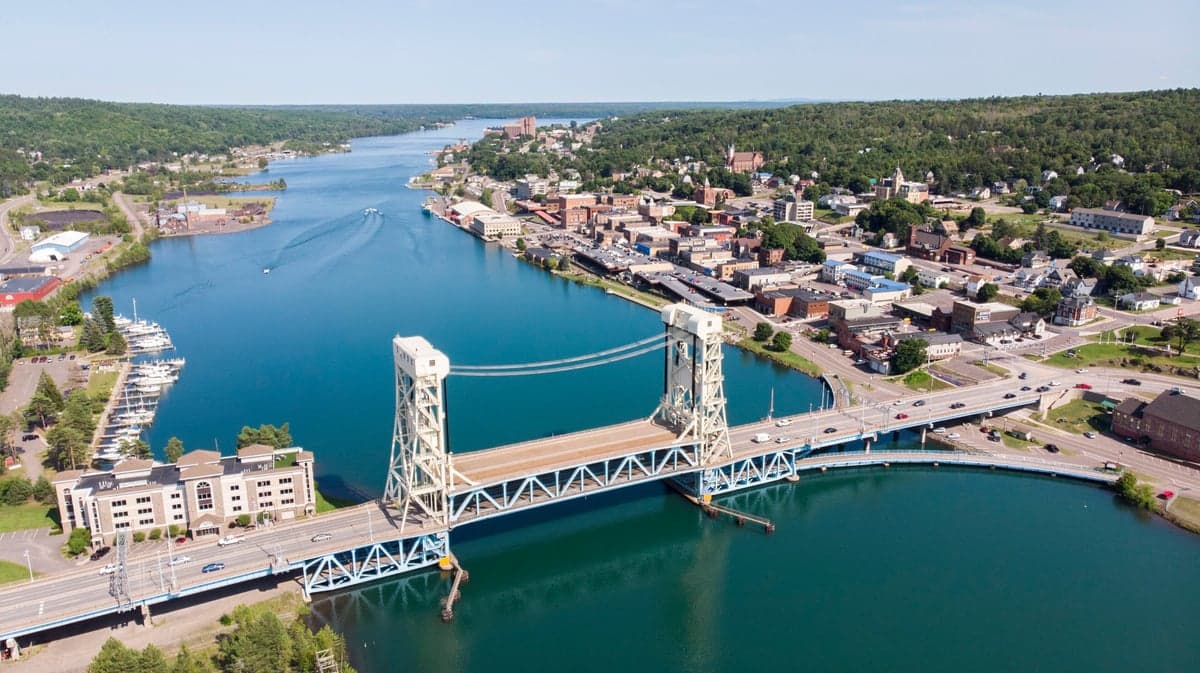
Houghton’s population story begins with the copper boom of the 1840s. The discovery of massive native copper deposits drew the first major wave of settlers—Cornish miners (known as "Cousin Jacks") who brought hard-rock mining expertise, followed by Irish laborers who built the early shafts and rail lines. By the 1870s, Finnish immigrants began arriving in large numbers, fleeing land shortages and Russian oppression; they became the backbone of the Quincy Mine and other operations. These groups settled in distinct neighborhoods: the "Finn Town" district (roughly centered around today’s Montezuma Street and the Portage Lake waterfront) became the heart of Finnish-language churches, saunas, and cooperative stores, while Cornish and Irish families concentrated in the "Pewabic" area along the hillside above the canal. The founding of the Michigan College of Mines (now Michigan Tech) in 1885 added a small but influential layer of faculty and students, though the city’s character remained overwhelmingly working-class and immigrant through the 1920s. The 1913-14 Copper Country Strike, a violent labor conflict, reshaped the population as many strikers left and companies recruited southern European immigrants—Italians, Croatians, and Slovenians—who settled in the "Dollar Bay" and "South Range" fringe areas just outside the city limits. By 1930, Houghton was roughly 40% Finnish, 20% Cornish, and 15% southern European, with a small but established Black community centered near the railroad depot.
Modern era (post-1965)
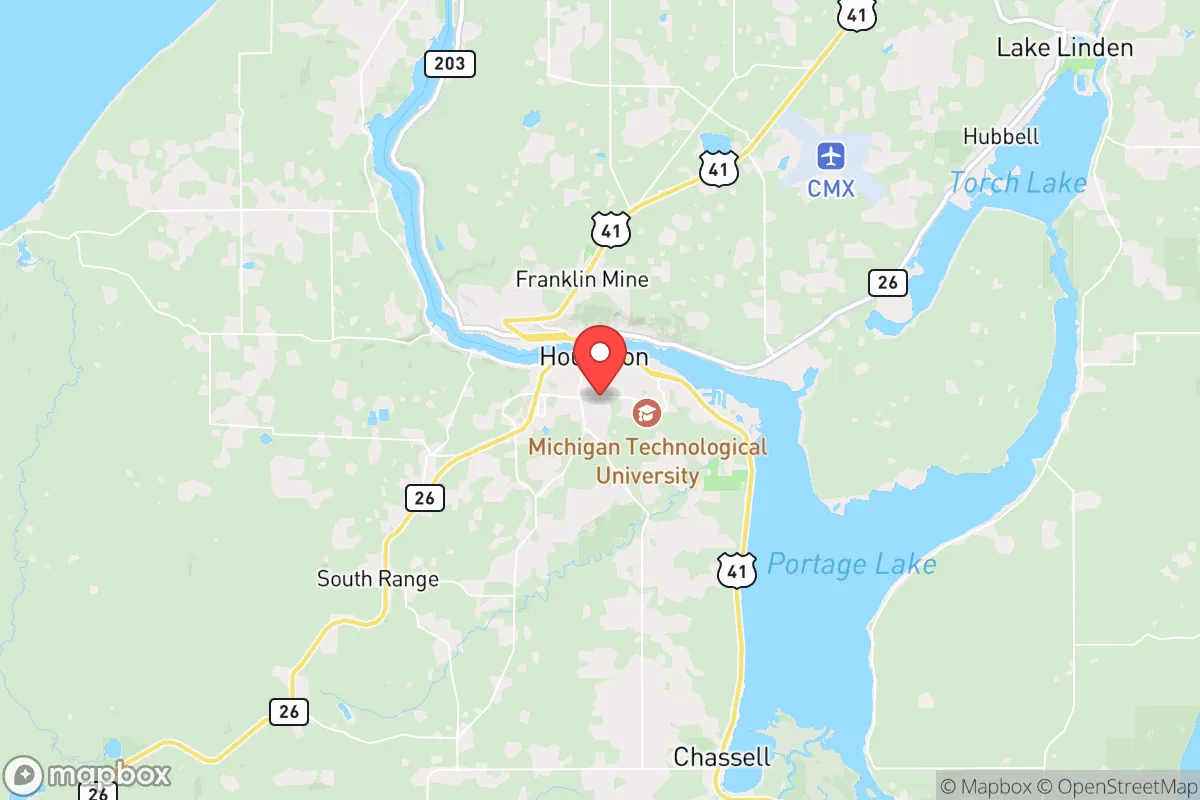
The 1965 Hart-Celler Act and the simultaneous expansion of Michigan Technological University fundamentally remade Houghton’s population. The university began actively recruiting graduate students and faculty from India, China, and South Korea, creating the city’s first significant Asian and Indian-subcontinent communities. These new arrivals did not settle in the old ethnic enclaves but instead concentrated in the "Tech Highlands" area—the cluster of apartment complexes and condominiums along Sharon Avenue and the northern edge of campus—and in the "College Avenue corridor", where international grocery stores and restaurants began appearing in the 1990s. Domestic migration also shifted: the decline of copper mining after the 1968 closure of the Quincy Mine sent many Finnish and Cornish families to the suburbs of Detroit or to the West Coast, while retirees and remote workers began buying up historic homes in the "East Houghton" neighborhood (the residential streets east of US-41). The Hispanic population grew modestly from the 1980s onward, largely through service-industry workers and a small number of agricultural laborers in the surrounding Keweenaw Peninsula, settling in the "Portage Lakefront" area near the bridge to Hancock. By 2020, the Indian-subcontinent population had reached 4.7% and the East/Southeast Asian population 4.2%, making Houghton one of the most ethnically diverse cities in the Upper Peninsula—though still overwhelmingly White and heavily shaped by the university’s academic calendar.
The future
Houghton’s population is trending toward greater ethnic diversity, driven almost entirely by Michigan Tech’s continued international recruitment. The Indian-subcontinent and East/Southeast Asian shares are likely to grow further as the university expands its engineering and computer science programs; the city’s foreign-born percentage (13.0%) could approach 18-20% by 2035 if current enrollment trends hold. However, the White population is aging and slowly declining, as younger native-born residents often leave for job markets in Minneapolis, Chicago, or the East Coast after graduation. The Hispanic and Black populations are expected to remain small but stable, with some growth in service-sector and healthcare roles. Geographically, new international residents are dispersing beyond the Tech Highlands into the "Houghton Heights" subdivision (newer single-family homes west of the airport) and into the "Lakeshore Drive" area, where townhouses and rental duplexes are being built. The cultural identity of the city is evolving from a historic Finnish-Cornish mining town into a bilingual, globally connected college town—Finnish heritage remains visible in the architecture and the annual Heikinpäivä festival, but the daily life of the city is increasingly shaped by Indian, Chinese, and Korean students and faculty.
For someone moving in now, Houghton offers a rare combination: a tight-knit, historically rooted community with a genuinely international academic population, low crime, and a cost of living well below the national average. The demographic trajectory is clear—more diverse, more educated, and more tied to the university’s global reach—but the city’s small size and remote location mean that change comes slowly, and the old mining neighborhoods still set the tone. It is a place where a Finnish sauna sits next to an Indian grocery store, and that mix is likely to deepen in the decade ahead.

* Values derived from national, state, county, city and local statistics and may differ in a specific area. Last updated: 2026-06-16T09:27:26.000Z
Narrative content on this page is AI-generated and may contain mistakes. Verify any details that matter before acting on them.
ReloMaps may earn a commission from affiliate links at no extra cost to you.

