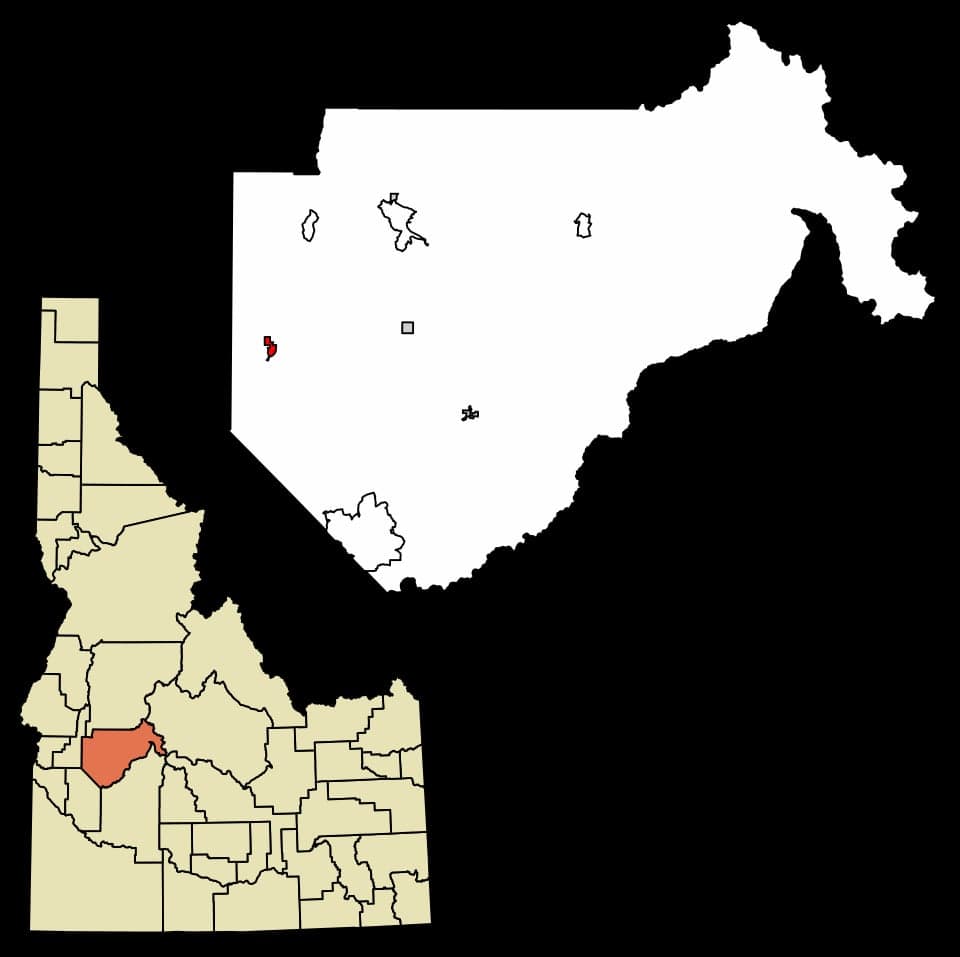
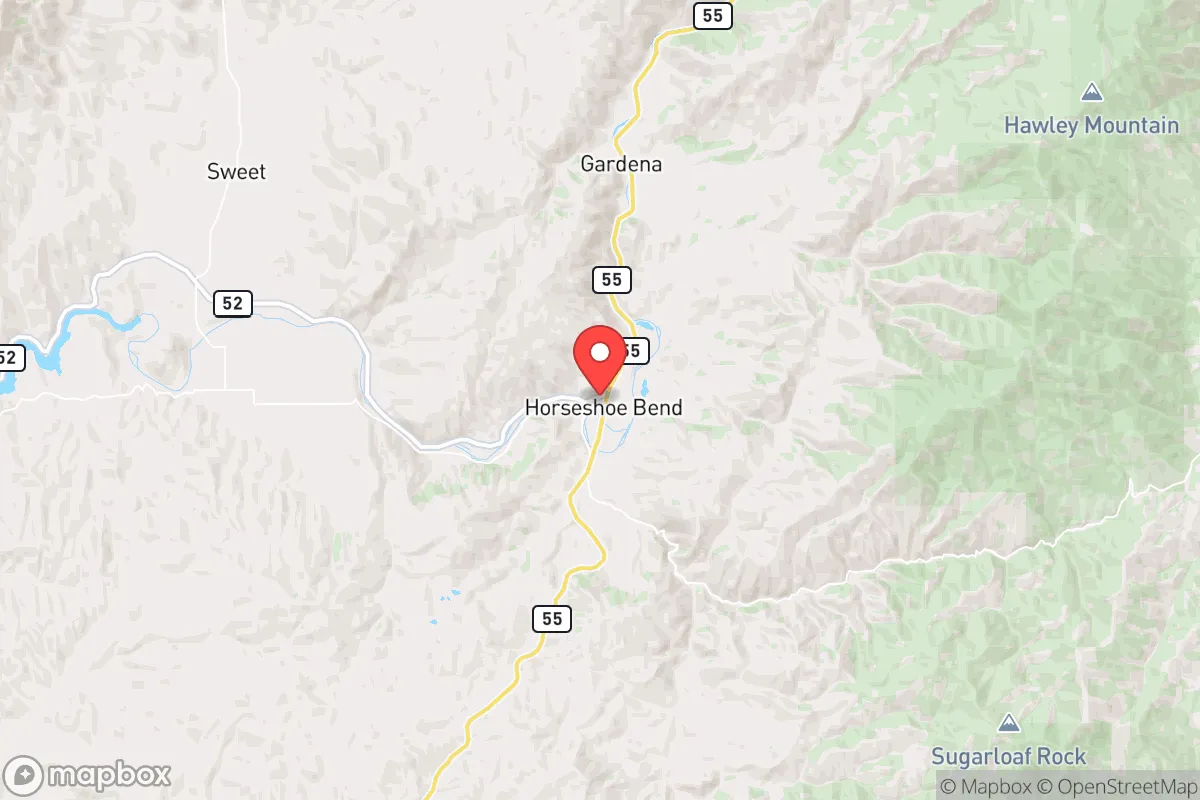
Photo: Wikipedia
Political ClimatePolitical Climate in Horseshoe Bend, ID
District shown is the primary district for this city’s centroid. Cities may span multiple districts.
Local Political AnalysisPolitical Analysis of Horseshoe Bend, ID
Horseshoe Bend, Idaho, is about as reliably Republican as any small town in the state, with a Cook PVI of R+22 that puts it four points to the right of Idaho’s already deep-red R+18 statewide rating. That gap isn’t just a number—it reflects a community that has been consistently conservative for decades, with little sign of the kind of political drift you see in Boise or even parts of Ada County. If you’re looking for a place where the local elections are decided in the primary and the general is a formality, this is it.
How it compares
Idaho as a whole is solidly Republican, but Horseshoe Bend sits in a pocket of even deeper red. The town is in Boise County, which voted over 75% for Donald Trump in 2020, compared to Idaho’s statewide 63%. Nearby cities like Boise (about 45 minutes south) and McCall (about an hour north) have more visible liberal or moderate pockets—Boise’s urban core leans Democratic, and McCall’s resort economy attracts a mix of political views. But Horseshoe Bend is more like the rural towns of Emmett or Cascade: fewer transplants, less tourism-driven change, and a population that’s overwhelmingly native Idahoan. The contrast is stark if you drive 20 minutes south to Garden City, where you’ll see more Harris-Walz yard signs and a younger, more diverse electorate. In Horseshoe Bend, the political conversation is still dominated by property rights, gun access, and opposition to federal land management—issues that resonate deeply in a town surrounded by national forest.
What this means for residents
For conservative residents, the political climate is comfortable and predictable. Local government, school board meetings, and county commission decisions tend to align with traditional Republican values—low taxes, minimal regulation, and a strong emphasis on Second Amendment rights. You won’t find much debate over mask mandates or zoning restrictions here. For liberal or moderate residents, the reality is more isolating. There’s no active Democratic party presence in Boise County, and social circles can feel closed off if your views don’t match the majority. That said, the town is small enough (population around 800) that most people get along day-to-day regardless of politics—neighborly help with a broken-down truck or a shared hunting spot doesn’t hinge on a voter registration card. The real friction shows up in county-level decisions, like how to handle short-term rentals or whether to push back on state preemption laws.
One cultural distinction worth noting: Horseshoe Bend has a stronger libertarian streak than the state average. Many residents are less concerned with social issues (like abortion or school curriculum) and more focused on federal land use and water rights. This puts them at odds with the more evangelical wing of Idaho’s GOP, which dominates in places like Nampa or Rexburg. The town’s politics are practical, not ideological—people vote Republican because they see it as the party that will leave them alone. That’s a subtle but real difference from the rest of Idaho, where cultural conservatism often drives the vote. Looking ahead, the trajectory is stable. Horseshoe Bend isn’t growing fast enough to attract the kind of demographic shift that’s slowly turning Boise purple. Expect the R+22 lean to hold for at least the next decade, with the only real change being a gradual hardening of the local GOP’s focus on property rights as more out-of-state buyers eye the Payette River corridor.

State Political ClimatePolitical Climate in Idaho
State Political AnalysisPolitical Environment in the State
Idaho is one of the most reliably Republican states in the country, with a Cook Partisan Voting Index of R+18, meaning it votes about 18 points more Republican than the national average. The state hasn’t voted for a Democratic presidential candidate since 1964, and the GOP holds every statewide office, supermajorities in both legislative chambers, and all four congressional seats. Over the past 20 years, the political trajectory has been a steady march rightward, driven by explosive population growth in the conservative Boise suburbs and a simultaneous exodus of moderate Democrats from rural areas, leaving the state’s politics dominated by a coalition of libertarian-leaning ranchers, evangelical Christians, and tech-adjacent newcomers who want smaller government and fewer regulations.
Urban vs. rural divide
The political map of Idaho is a study in contrasts. The Treasure Valley, anchored by Boise, Meridian, and Nampa, is the state’s population center and the engine of its Republican dominance. Ada County (Boise) has become a GOP stronghold, but it’s not monolithic—the city of Boise itself has a noticeable Democratic lean, with precincts near downtown and the North End voting blue in recent cycles. The real action is in the suburbs: Meridian and Eagle are among the fastest-growing cities in the nation, and they vote heavily Republican, often by 20-30 point margins. Drive east to Idaho Falls and Rexburg in the eastern part of the state, and you’ll find some of the most conservative territory in the country, heavily influenced by the LDS Church and a strong anti-government libertarian streak. The rural counties—like Lemhi, Clearwater, and Boundary—are deep red, often voting 70-80% Republican. The only real blue dots are Moscow, home to the University of Idaho, and Blaine County (Sun Valley), a wealthy ski resort area that votes reliably Democratic. The urban-rural split is stark: the cities are growing and diversifying, but the rural areas still control the legislature through a system that gives each county equal representation in the state Senate, meaning rural conservatives have outsized influence on state policy.
Policy environment
Idaho’s policy environment is a textbook example of small-government conservatism. The state has a flat income tax rate of 5.8% (down from 6.5% in 2023), no corporate income tax on pass-through entities, and a sales tax of 6% that exempts groceries. Property taxes are relatively low, but they vary widely by county—Ada County’s rates are higher than rural areas due to rapid appreciation. The regulatory posture is aggressively pro-business: there’s no state-level minimum wage above the federal $7.25, no paid family leave mandate, and a “right-to-work” law that bans union security agreements. Education policy is a flashpoint: the state has one of the lowest per-pupil spending rates in the nation (around $8,000 per student), and the legislature has passed multiple school choice bills, including a 2023 law creating education savings accounts for private school tuition. Healthcare is largely market-driven; the state did not expand Medicaid until 2020 (via ballot initiative), and the legislature has since tried to impose work requirements on the expansion population. Election laws are restrictive: voter ID is required, same-day registration is not allowed, and mail-in voting is limited to absentee ballots with an excuse. The state also has a strict “no-excuse” absentee law that was tightened in 2021 to require a notary or witness signature.
Recent policy direction
The last three years have seen a flurry of legislation that signals where Idaho is headed. On gun and self-defense law, Idaho is a constitutional carry state (no permit needed to carry concealed), and in 2023 the legislature passed a law prohibiting local governments from enforcing federal gun regulations—a direct challenge to the ATF. Parental and education rights have been a major focus: the 2023 “Parents’ Bill of Rights” (HB 92) requires schools to notify parents of any curriculum involving sexuality or gender identity and allows parents to opt their children out. The state also banned transgender girls from participating in girls’ sports (2020) and restricted gender-affirming care for minors (2023). On speech and privacy, Idaho passed a law in 2022 that prohibits “malicious” harassment of public officials, which critics say chills free speech, and a 2024 law requires social media platforms to verify the ages of users under 18. Medical and bodily autonomy is a mixed bag: abortion is banned at all stages of pregnancy (trigger law effective 2022), with exceptions only for rape, incest, and life of the mother. But the state has also legalized medical marijuana in a limited form (CBD oil for severe epilepsy) and has a robust home-birth midwifery community. Property rights are strongly protected: Idaho is a “Dillon’s Rule” state, meaning local governments have only the powers explicitly granted by the state, and the legislature has repeatedly preempted local zoning and land-use regulations. Taxation is trending downward: the 2023 tax cut package reduced the top income tax rate from 6.5% to 5.8% and increased the grocery tax credit. Voting and ballot access have been tightened: in 2021, the legislature passed a law requiring a photo ID to vote and eliminating the use of student IDs from out-of-state colleges.
Civil unrest & political movements
Idaho has a long history of anti-government sentiment, and that’s visible today in the form of organized activist movements on both sides. The Idaho Freedom Foundation, a conservative think tank, has been the driving force behind many of the state’s most aggressive policy moves, including the push to defund public education and the fight against Medicaid expansion. On the far right, the “constitutional sheriffs” movement is active, with several county sheriffs publicly refusing to enforce federal gun laws or land-use regulations. The “People’s Rights” network, founded by Ammon Bundy (of the 2016 Oregon standoff), has a strong presence in rural areas, particularly around Emmett and Sandpoint. On the left, the Idaho Democratic Party is weak but has seen a surge in grassroots activism since the 2022 abortion ban, with groups like “Idaho Women’s March” and “Reclaim Idaho” organizing protests and ballot initiatives. Immigration politics are relatively quiet—Idaho has a low foreign-born population (around 6%), but the legislature passed a law in 2023 requiring local law enforcement to cooperate with ICE. There’s no sanctuary city movement to speak of; the closest is Boise, which has a “welcoming city” ordinance but no formal sanctuary policy. Election integrity controversies have been minimal—Idaho’s voting system is considered secure, and there were no major fraud allegations in 2020 or 2022. The most visible flashpoint for a new resident would be the “Stop the Steal” rallies that occurred in Boise in 2020-2021, which drew hundreds but were largely peaceful.
Projection
Over the next 5-10 years, Idaho’s political trajectory is likely to continue its rightward drift, but with some interesting nuances. The state is growing fast—about 2% per year—and most of that growth is in the Treasure Valley, which is already deeply Republican. The newcomers are largely conservative-leaning families from California, Washington, and Oregon, who are moving for lower taxes and less regulation. This will likely reinforce the GOP’s dominance, but it could also create internal tensions between the “liberty” wing (anti-government, pro-gun, anti-vaccine) and the “establishment” wing (pro-business, pro-development, pro-education funding). The rural counties are losing population, which could eventually shift legislative power toward the suburbs, but the state’s constitutional structure (equal Senate representation per county) will preserve rural influence for at least another decade. The biggest wildcard is the Boise metro area: if it continues to grow and diversify, it could produce a more competitive political environment in Ada County, but that’s a long shot. For a relocator, the bottom line is that Idaho will remain a deeply conservative state for the foreseeable future, with a policy environment that favors low taxes, limited government, and individual liberty—but also one that is increasingly polarized between the libertarian and evangelical wings of the GOP.
For a new resident, the practical takeaway is straightforward: if you’re conservative, you’ll find a state that largely aligns with your values, with a government that is actively working to reduce taxes, protect gun rights, and limit government overreach. If you’re liberal, you’ll be in a clear minority, but you’ll find like-minded communities in Boise, Moscow, and Sun Valley, and the state’s strong property rights and low taxes can still be appealing. The key is to understand that Idaho’s politics are not just about party labels—they’re about a deep-seated cultural commitment to independence and self-reliance, which cuts across both left and right in unexpected ways. Expect a state where your neighbor might have a “Don’t Tread on Me” flag in the front yard and a “Keep Your Laws Off My Body” sign in the back, and where the most heated local debates are about land use, water rights, and how much the government should be involved in your daily life.
* Values derived from national, state, county, city and local statistics and may differ in a specific area. Last updated: 2026-10-28T16:40:36.000Z
Narrative content on this page is AI-generated and may contain mistakes. Verify any details that matter before acting on them.
ReloMaps may earn a commission from affiliate links at no extra cost to you.

