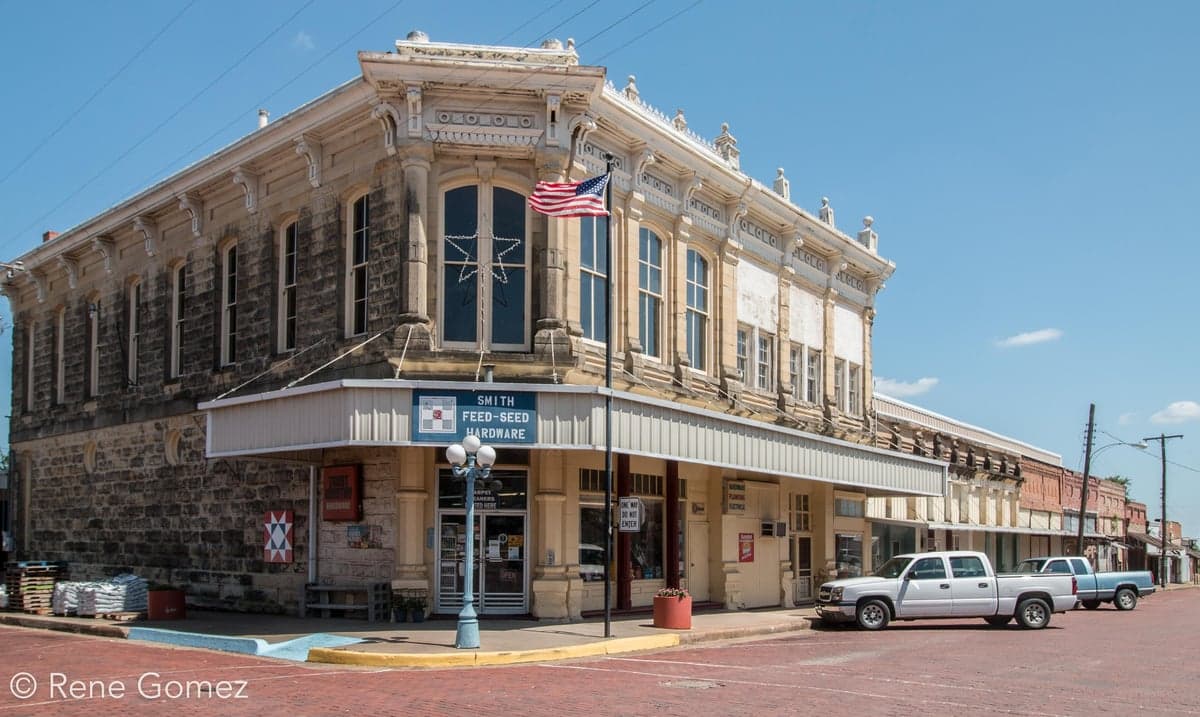
Photo: Wikipedia
Political ClimatePolitical Climate in Honey Grove, TX
District shown is the primary district for this city’s centroid. Cities may span multiple districts.
Inherited from parent county — no local data available.
* Lean and PVI are calculated from the surrounding county’s 2020 and 2024 presidential results, Cook-style — a finer measure here than its congressional district (TX-4).
Political rankings in Texas
- Most Conservative Cities in Texas
- Most Liberal Cities in Texas
- Best Liberal-Leaning Towns in the South
- Safest Liberal-Leaning Towns in the South
- Safest Conservative-Leaning Towns in the South
- Affordable Small Towns for Conservatives
- Most Affordable Liberal-Leaning Small Towns in the U.S.
- Safest Conservative-Leaning Cities in the U.S.
- Most Conservative Counties in Texas
- Most Liberal Counties in Texas
Local Political AnalysisPolitical Analysis of Honey Grove, TX
Honey Grove, Texas, sits deep in reliably conservative territory, with a Cook Partisan Voting Index (PVI) of R+16, meaning the area consistently votes about 16 points more Republican than the national average. This isn't a recent shift; the town has long leaned right, but the margin has widened over the past decade as rural Texas has moved further from the Democratic Party. In the 2024 presidential election, Fannin County, where Honey Grove is the county seat, gave the Republican candidate roughly 80% of the vote, a number that tracks closely with the town's own precinct results. The trajectory here is steady: expect the Republican lean to hold or even deepen, driven by a stable population of retirees, farmers, and commuters who work in the nearby Sherman-Denison metro area or even as far south as McKinney.
How it compares
Compared to the state of Texas as a whole, Honey Grove is significantly more conservative. While Texas itself is a Republican-leaning state, its Cook PVI is unknown (it's often cited around R+5 or R+6 in recent cycles), meaning the state as a whole is only moderately right of center. Honey Grove's R+16 puts it in a different league, more akin to the deep-red rural counties of East Texas than the purple suburbs of Dallas or Houston. For contrast, drive 30 miles south to Bonham, and you'll find a similar conservative bent, but head 45 miles southwest to McKinney, and the politics become more mixed—still Republican, but with a noticeable moderate-liberal minority, especially among younger transplants. The biggest contrast is with the Dallas-Fort Worth metroplex, about 80 miles south, where Democrats can win countywide races in Dallas County. In Honey Grove, a Democratic candidate for county office would be a long shot, and local elections are decided in the Republican primary.
What this means for residents
For conservative residents, this political climate means their values are reflected in local governance: low taxes, limited regulation, and a strong emphasis on Second Amendment rights and religious freedom. The Fannin County Commissioners Court, the local school board, and the city council are all reliably Republican, so policy debates tend to be about how to manage growth or fund roads, not about ideological shifts. For liberal residents, the reality is more isolating. They will find few like-minded neighbors and may feel pressure to keep their political views private, especially in social settings like church or the local coffee shop. There is no active Democratic Party presence in Honey Grove itself, though the Fannin County Democratic Party does hold meetings in Bonham. Practical effects include limited access to progressive services—for example, no Planned Parenthood clinic within 50 miles—and a general expectation that public events, from the annual Honey Grove Bluegrass Festival to city council meetings, will open with a prayer.
Culturally, Honey Grove is a place where the local newspaper, the Honey Grove Signal-Citizen, still runs editorials praising conservative values, and where the biggest political controversy in recent memory was over a proposed wind farm that some residents felt would spoil the rural landscape. The town's identity is deeply tied to its agricultural roots and its history as a stop on the Butterfield Overland Mail route. Policy-wise, this means a strong resistance to any form of gun control, a preference for local control over state mandates, and a general skepticism of federal involvement in land use or education. For anyone moving here, the key takeaway is simple: if you're conservative, you'll feel right at home; if you're liberal, you'll need to be comfortable being in the minority, and you'll likely drive to Sherman or even Dallas for political community and services that match your worldview.

State Political ClimatePolitical Climate in Texas
State Political AnalysisPolitical Environment in the State
Texas has been a reliably Republican state for decades, but the political reality on the ground is far more nuanced than a simple red label. The state’s overall partisan lean is still solidly right-of-center — no Democrat has won a statewide office since 1994 — but the margin has been shrinking. In 2020, Donald Trump carried Texas by about 5.5 points, down from 9 points in 2016 and 16 points in 2012. The dominant coalition remains a mix of rural and suburban conservatives, evangelical Christians, and business-oriented moderates, but explosive growth in the major metros is slowly reshaping the map. For a relocator, the key takeaway is that Texas is a state where conservative policy dominates at the capitol, but where local political culture varies dramatically depending on whether you land in Amarillo or Austin.
Urban vs. rural divide
The political geography of Texas is a tale of three distinct zones. The big urban centers — Houston, Dallas, San Antonio, and especially Austin — are Democratic strongholds. Harris County (Houston) and Dallas County have been reliably blue for years, and Travis County (Austin) is one of the most liberal counties in the South, routinely voting 70%+ Democratic. Meanwhile, the vast rural and exurban expanse — from the Panhandle down through West Texas and into East Texas — is deeply Republican. Lubbock, Midland, and Tyler are among the most conservative cities in the nation. The real battleground is the suburbs. Places like Collin County (north of Dallas), Fort Bend County (southwest of Houston), and Williamson County (north of Austin) have been trending leftward as educated, moderate professionals move in. In 2020, Biden flipped Tarrant County (Fort Worth) — a longtime GOP stronghold — for the first time since 1964. That suburban shift is the single biggest factor driving the state’s gradual purple-ward drift.
Policy environment
Texas operates under a low-tax, low-service model that is deeply ingrained in its political DNA. There is no state income tax — funded instead by a combination of property taxes, sales tax (6.25% state, plus local add-ons), and oil and gas severance taxes. The regulatory posture is famously business-friendly: minimal zoning in many cities, right-to-work laws, and a tort-reform system that caps noneconomic damages in medical malpractice cases. On education, the state funds public schools through a complex Robin Hood system that redistributes property tax revenue from wealthy districts to poor ones, but per-pupil spending remains below the national average. School choice — including vouchers and education savings accounts — is a perennial legislative battle, with rural Republicans often joining Democrats to block it. Healthcare policy is marked by the state’s refusal to expand Medicaid under the ACA, leaving roughly 18% of Texans uninsured, the highest rate in the nation. Election laws have been tightened in recent cycles, with the 2021 SB 1 restricting mail-in voting, expanding poll watcher access, and banning drive-through and 24-hour voting options that Harris County had used in 2020.
Recent policy direction
The last few legislative sessions have pushed Texas sharply to the right on a broad front. On gun and self-defense law, Texas became a permitless carry state in 2021 (HB 1927), allowing most adults to carry a handgun without a license or training. On parental and education rights, the 2023 session saw the creation of a school library content review system and the expansion of the "Parental Bill of Rights" (HB 1605), which requires schools to post curriculum materials online and restricts instruction on sexual orientation and gender identity in elementary grades. On speech and privacy, the state passed a law (HB 20) in 2023 that effectively bans large social media platforms from moderating content based on viewpoint — a direct challenge to Section 230 and currently tied up in court. On medical and bodily autonomy, Texas enacted one of the nation’s strictest abortion bans (SB 8 in 2021, with a near-total ban triggered in 2022) and has restricted gender-affirming care for minors (SB 14, 2023). Property rights remain strong, though the state has been aggressive in using eminent domain for infrastructure projects like the I-35 expansion and the Texas-Mexico border wall. On voting and ballot access, the 2021 SB 1 made it harder to vote by mail and gave partisan poll watchers more latitude, while the 2023 session added new criminal penalties for election officials who send unsolicited mail-in ballot applications.
Civil unrest & political movements
Texas has seen its share of political flashpoints in recent years. The 2020 protests in Austin over the murder of George Floyd were among the largest and most sustained in the country, leading to a city council vote to defund the police by $150 million — a decision that was partially reversed the following year after a spike in violent crime. On the right, the "constitutional sheriff" movement has gained traction in rural counties, with sheriffs in places like Montgomery County publicly refusing to enforce certain state or federal gun laws. Immigration politics remain a constant pressure point. Governor Abbott’s Operation Lone Star, launched in 2021, has deployed thousands of National Guard troops and state troopers to the border, bused migrants to Democratic-led cities like New York and Chicago, and installed razor wire and buoys in the Rio Grande — actions that have triggered multiple federal lawsuits. Secession rhetoric, while not mainstream, has a vocal fringe: the Texas Nationalist Movement, based in Nacogdoches, has pushed for a referendum on independence, though polling consistently shows support below 20%. Election integrity controversies have simmered since 2020, with the state conducting a forensic audit of four counties (including Harris and Dallas) that found no evidence of widespread fraud but did identify administrative errors.
Projection
Over the next 5-10 years, Texas is likely to continue its slow drift toward competitiveness, but it will remain a Republican-leaning state for the foreseeable future. The key demographic driver is in-migration: roughly 1,000 people move to Texas every day, and they are disproportionately young, diverse, and college-educated. Many come from California and the Northeast, and while they are often moderate, they tend to vote Democratic at higher rates than native-born Texans. The suburbs of Dallas-Fort Worth, Houston, and San Antonio will continue to be the political battlegrounds. At the same time, the rural and exurban vote is becoming more conservative and more reliable for the GOP, meaning the state won’t flip blue overnight. The Texas GOP’s recent moves to the right on social issues — particularly abortion and LGBTQ+ rights — may accelerate the suburban shift, as moderate women and college-educated voters become alienated. A new resident moving in now should expect a state where the capitol remains conservative but where local elections in the big metros and inner suburbs become increasingly competitive, and where the political conversation is dominated by the tension between growth and tradition.
For a new resident, the practical takeaway is that your day-to-day political experience in Texas will depend almost entirely on where you live. If you settle in Lubbock or Tyler, you’ll find a deeply conservative community where your politics are assumed. If you land in Austin or El Paso, you’ll be in a blue bubble where progressive values dominate local governance. The suburbs — places like Frisco, Round Rock, or Katy — are where the tension is most visible, with school board meetings and city council races becoming proxy battles for the state’s larger political war. The state’s low taxes and light regulation are real benefits for both conservatives and libertarians, but they come with trade-offs in public services and infrastructure. The best advice: pick your county carefully, because in Texas, local government has more power over your daily life than you might expect.
* Values derived from national, state, county, city and local statistics and may differ in a specific area. Last updated: 2026-11-07T17:02:47.000Z
Narrative content on this page is AI-generated and may contain mistakes. Verify any details that matter before acting on them.
ReloMaps may earn a commission from affiliate links at no extra cost to you.

