
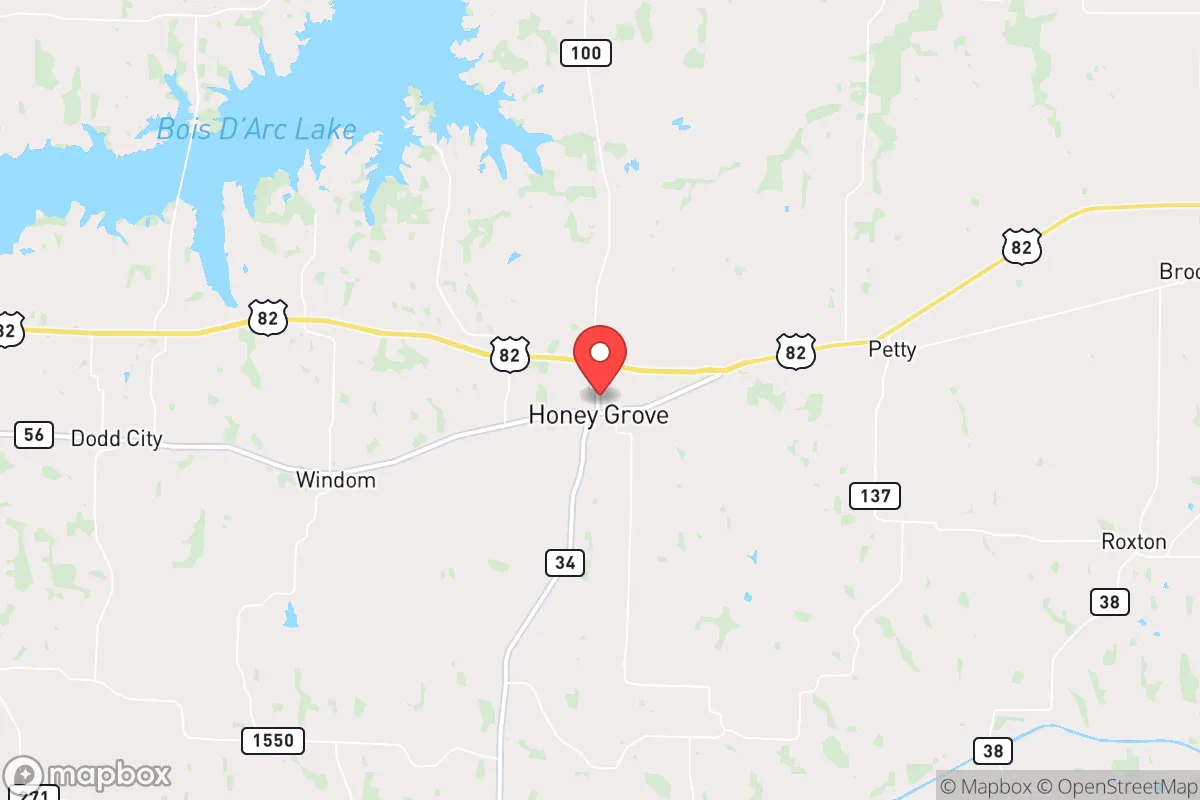
Photo: Wikipedia
Personal Sovereignty in Honey Grove, TX
Strong independent fundamentals that actively favor personal liberty and low regulation.
What does Personal Sovereignty tell us?
Personal Sovereignty measures your capacity for self-reliance and independence with minimal government friction. Higher scores mean fewer barriers between you and the way you want to live... but it assumes you have the space you need and good neighbors.
What does this tell us?
Personal Sovereignty measures your capacity for self-reliance and independence with minimal government friction. Higher scores mean fewer barriers between you and the way you want to live... but it assumes you have the space you need and good neighbors.
State Policy
Energy independence: Net exporter (195% of energy produced in-state)
Personal Liberty
Homesteading

Personal Liberty Analysis
Honey Grove, Texas, offers a personal sovereignty environment shaped by its location in a deeply conservative, rural North Texas county and the state's famously light-touch governance. For individuals and families prioritizing autonomy, the town provides a legal and cultural framework where self-reliance is the default expectation, not an exception. The combination of no state income tax, permissive gun laws, and minimal zoning creates a baseline of personal freedom that is significantly higher than in most urban or coastal areas, though it operates within the broader constraints of Texas state law and Fannin County's local ordinances.
Tax burden and regulatory posture: How the state and county keep government small
Honey Grove's sovereignty appeal begins with Texas's absence of a state personal income tax, which immediately leaves more capital in residents' hands for self-directed investment, whether in property, tools, or savings. The primary tax burden falls on property taxes, which in Fannin County average around 1.5% to 1.7% of assessed value, a rate that is moderate by Texas standards but higher than some other states. However, the county's appraisal district tends to be less aggressive than urban counterparts, and the lack of a state income tax means the total tax load on a typical household is often lower than in states with combined income and property taxes. Regulatory posture at the local level is notably light. Honey Grove operates with a minimal zoning code that does not heavily restrict residential uses, agricultural activities, or home-based businesses. There are no city-level building codes beyond basic safety compliance with state standards, and the county does not impose the kind of environmental or land-use regulations common in more populated areas. This means a resident can, for example, operate a small welding shop from a backyard shed or keep livestock on a standard residential lot without navigating a thicket of permits. The Texas Department of Licensing and Regulation does require occupational licenses for certain trades, but the overall regulatory footprint in Fannin County is small, allowing individuals to pursue livelihoods and property modifications with minimal government interference.
Self-defense and gun law specifics: What the Second Amendment means in practice
Texas law provides a robust framework for self-defense and firearm ownership, and Honey Grove residents benefit from the full scope of these protections. The state's stand-your-ground law eliminates any duty to retreat before using deadly force in any place where a person is lawfully present, which is a critical legal pillar for personal sovereignty. Furthermore, Texas has permitted constitutional carry (permitless carry) since 2021, meaning any adult who can legally possess a firearm may carry it openly or concealed without a state-issued license. This removes a bureaucratic hurdle and affirms the right to self-defense as a default, not a privilege. For those who still want a License to Carry (LTC) for reciprocity with other states, the process is straightforward and involves a background check and a short training course. Fannin County is a Second Amendment Sanctuary County, meaning local law enforcement has formally declared they will not use resources to enforce federal gun laws they deem unconstitutional. In practice, this creates a cultural and legal environment where firearm ownership is normalized and respected. There are no local ordinances restricting magazine capacity, firearm types, or storage requirements beyond state law. The nearest gun ranges and firearms dealers are within a 15- to 30-minute drive in Bonham or Paris, and private firearm sales between individuals are legal without a background check, further reinforcing the autonomy of gun owners.
Self-reliance and homesteading viability: Lot sizes, zoning, and off-grid feasibility
Honey Grove's rural character makes it a strong candidate for those seeking a self-reliant lifestyle, including homesteading, gardening, and off-grid living. Residential lots within the city limits typically range from 0.25 to 1 acre, while unincorporated Fannin County properties often start at 1 to 5 acres and can go much larger. The city's zoning is permissive enough to allow backyard chickens, goats, and even small livestock on most residential lots, though larger animals like cattle or horses generally require acreage outside city limits. There are no county-level restrictions on rainwater harvesting, and Texas state law actually encourages it by exempting rainwater collection systems from permitting and taxation. Solar panel installation is legal and common, with no homeowner association (HOA) restrictions in most rural subdivisions, though some newer developments may have covenants. Off-grid living is feasible but requires navigating state health codes for septic systems and well water. Fannin County allows private wells, but they must be drilled by a licensed contractor and meet state water quality standards. Composting toilets and alternative waste systems are permitted if they comply with Texas Commission on Environmental Quality (TCEQ) rules, which are less stringent than in many states. The absence of mandatory trash collection in unincorporated areas means residents can manage their own waste, including burning (subject to burn bans during dry periods). For those wanting to grow food, the growing season is roughly 230 days, and the local soil is suitable for gardens, though irrigation is often necessary during summer. Overall, Honey Grove offers a high degree of homesteading viability with minimal bureaucratic hurdles, especially compared to urban or suburban areas with strict land-use codes.
Personal liberties: Parental rights, medical autonomy, speech, and property
Personal liberties in Honey Grove are shaped by Texas state law and the local cultural consensus, which strongly favors individual decision-making in family and medical matters. Parental rights are robust: Texas law affirms that parents have the fundamental right to direct the upbringing, education, and healthcare of their children. This includes the ability to opt children out of public school curricula or activities without penalty, and to homeschool without state oversight beyond a simple notice of intent. The state does not require standardized testing for homeschoolers, and there are no curriculum mandates, giving families full control over educational content. Medical autonomy is similarly broad. Texas does not have a state-level vaccine mandate for adults, and while public schools require certain immunizations for attendance, parents can claim exemptions for medical reasons or conscientious objection (including religious beliefs). The state has also passed laws restricting the enforcement of federal public health mandates, such as vaccine requirements for employment, within its borders. However, it is important to note that Texas has strict laws on abortion and certain gender-affirming care for minors, which some may view as limiting personal medical choice. Freedom of speech and assembly are protected under the Texas Constitution, which mirrors the First Amendment, and local government in Honey Grove does not impose any additional restrictions. Property rights are strongly protected: Texas has no state-level property tax on personal property (like vehicles or business inventory) for individuals, and the state's eminent domain laws require just compensation and a public purpose. Fannin County does not have a countywide noise ordinance, and there are no restrictions on political signs on private property beyond state-mandated size limits during election periods. This creates an environment where residents can express themselves, use their land, and raise their families with minimal government intrusion into daily life.
Compared to other areas in the United States, Honey Grove offers a distinctly high level of personal sovereignty, particularly for those who value self-defense rights, low taxes, and the ability to live self-sufficiently. The regulatory environment is light, the legal framework favors individual autonomy, and the local culture reinforces independence. While it does not offer the extreme libertarian legal structures of, say, parts of Alaska or New Hampshire, it provides a practical, well-established balance of freedom and community that appeals to conservative-leaning individuals and families seeking to maximize personal control over their lives without moving to a remote frontier.

* Values derived from national, state, county, city and local statistics and may differ in a specific area. Last updated: 2026-11-07T17:02:47.000Z
Narrative content on this page is AI-generated and may contain mistakes. Verify any details that matter before acting on them.
ReloMaps may earn a commission from affiliate links at no extra cost to you.

