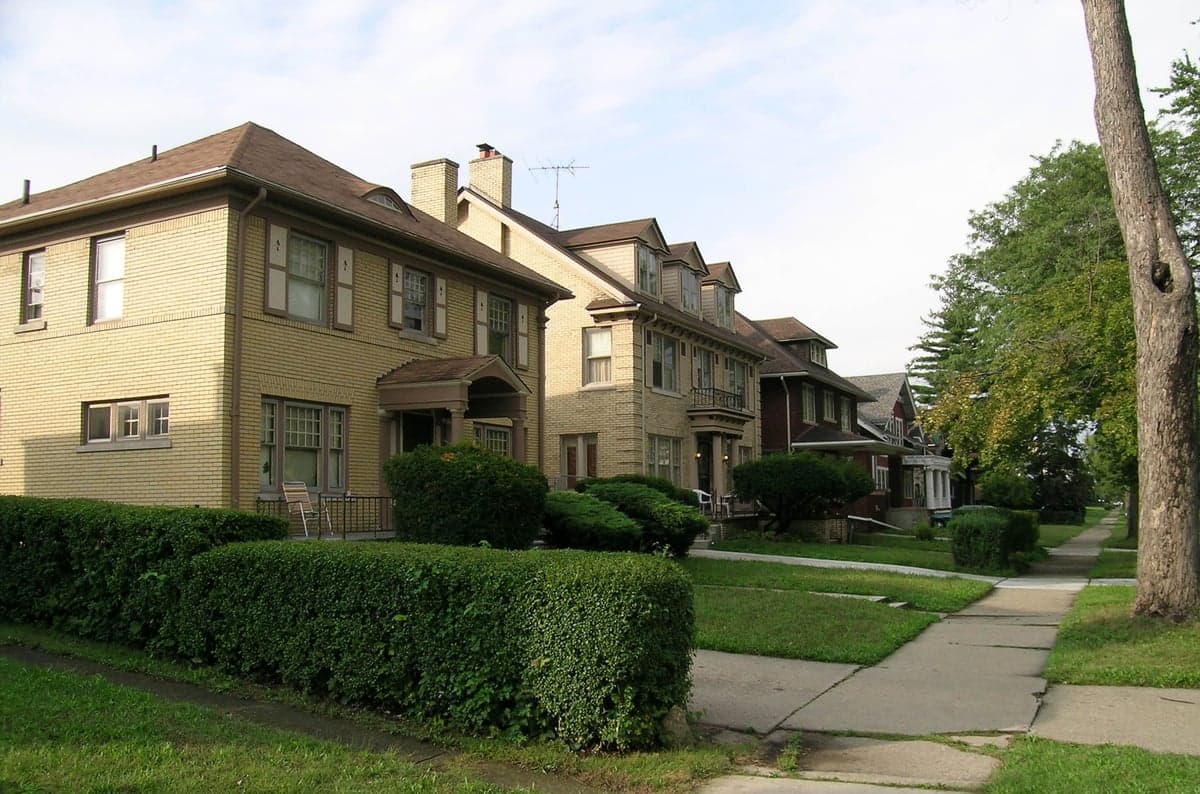
Photo: Wikipedia
Personal Sovereignty in Highland Park, MI
Strong independent fundamentals that actively favor personal liberty and low regulation.
What does Personal Sovereignty tell us?
Personal Sovereignty measures your capacity for self-reliance and independence with minimal government friction. Higher scores mean fewer barriers between you and the way you want to live... but it assumes you have the space you need and good neighbors.
What does this tell us?
Personal Sovereignty measures your capacity for self-reliance and independence with minimal government friction. Higher scores mean fewer barriers between you and the way you want to live... but it assumes you have the space you need and good neighbors.
State Policy
Energy independence: Importer (20% of energy produced in-state)
Personal Liberty
Homesteading

Personal Liberty Analysis
Highland Park, Michigan, presents a complex personal sovereignty environment where state-level preemptions and local urban realities create a mixed picture for autonomy-minded individuals. As a small, landlocked city within Detroit’s footprint, Highland Park operates under Michigan’s relatively permissive state framework for gun rights and property rights, but its dense urban zoning, high property tax rates, and limited municipal services constrain many forms of self-reliance that are more viable in rural or suburban parts of the state. For a relocation researcher evaluating personal freedom, the key trade-off is between low regulatory overhead on personal conduct (e.g., no state income tax on retirement income, constitutional carry) versus high local tax burdens and minimal space for homesteading or off-grid living.
Tax burden and regulatory posture in Highland Park
Michigan’s overall tax climate is moderate, but Highland Park’s local tax structure is notably heavy. The state levies a flat 4.25% individual income tax on wages and business income, though retirement income (Social Security, pensions, and IRA distributions) is exempt from state income tax, a significant benefit for retirees seeking financial autonomy. Property taxes in Highland Park are among the highest in Michigan, with a combined millage rate exceeding 70 mills in some areas (including city, county, school, and special district levies), translating to roughly $7,000+ annually on a $100,000 home. This is substantially above the state median of about 30 mills. The city also imposes a 1% local income tax on residents (and 0.5% on non-residents working in the city), adding to the fiscal burden. Regulatory posture at the state level is business-friendly in many respects—Michigan has right-to-work laws (though repealed for private-sector workers in 2023, public-sector remains), and no statewide rent control or price controls. However, Highland Park’s local zoning code is dense and prescriptive, with minimum lot sizes of 3,000–5,000 square feet in most residential districts, and no allowance for agricultural uses, livestock, or commercial home-based businesses without special permits. The city’s building department enforces the Michigan Residential Code strictly, meaning any structural modifications require permits and inspections. For a sovereignty-minded individual, the tax burden is the primary friction point—high property taxes effectively reduce disposable income and savings capacity, while the regulatory environment is typical for an older industrial suburb but not overly restrictive on personal lifestyle choices like homeschooling or vehicle ownership.
Self-defense and gun law specifics in Highland Park
Michigan is a “shall-issue” state for concealed pistol licenses (CPL), and as of 2024, permitless (constitutional) carry is legal for adults 21 and older who are not prohibited possessors. This means Highland Park residents can carry a concealed firearm without a permit, though a CPL is still required for reciprocity in other states and for purchasing handguns without a waiting period. The city itself has no local gun ordinances beyond state law—Michigan preempts all firearm regulation, so Highland Park cannot ban open carry, restrict magazine capacity, or impose waiting periods beyond the state’s 3-day handgun purchase delay (waived with a CPL). Self-defense law in Michigan follows the “stand your ground” principle: there is no duty to retreat in any place where the individual is lawfully present, including public spaces. Castle doctrine applies to homes and vehicles. However, Highland Park’s high violent crime rate (consistently among the highest in Michigan, with a 2023 violent crime rate of roughly 2,500 per 100,000 residents, compared to the state average of 450) means that self-defense is a practical daily consideration. The city’s police department has been under state oversight and has limited resources, so response times can be slow, making personal firearm ownership a realistic component of personal security. For a conservative-leaning reader, the legal framework is favorable—strong preemption, constitutional carry, and stand your ground—but the high-crime environment demands vigilance and potentially more training than in lower-risk areas.
Self-reliance and homesteading viability in Highland Park
Highland Park’s urban density and zoning code severely limit traditional homesteading and off-grid living. The city’s residential lots average 3,000–5,000 square feet, with most homes built on 30-foot-wide lots. Chickens, bees, and other livestock are prohibited in all residential zones, and gardening is allowed but limited to ornamental or small vegetable plots—no commercial-scale growing. Rainwater harvesting is not regulated by the city, but Michigan state law allows it for non-potable uses (e.g., irrigation) without a permit, though the small lot size makes significant water independence impractical. Solar panels are permitted but subject to building code and HOA-like restrictions in some neighborhoods; net metering is available through DTE Energy, the local utility, but at a reduced rate. Off-grid living (no connection to municipal water, sewer, or electric) is effectively impossible because the city requires all habitable structures to connect to public utilities. The city’s water and sewer systems are aging but functional, and there is no legal pathway to disconnect. For those seeking self-reliance through food production, energy independence, or reduced utility dependence, Highland Park offers almost no viable options. The best alternative is to consider nearby rural areas in Wayne or Washtenaw counties, where lot sizes of 1–5 acres are common and zoning allows small-scale agriculture. Within Highland Park, self-reliance is more about financial independence (low debt, high savings) and community networks than physical homesteading.
Personal liberties in Highland Park: parental rights, medical autonomy, speech, and property
Michigan’s legal framework generally supports personal liberties in several key areas. Parental rights are strong: Michigan has no mandatory vaccination laws for school attendance (only a requirement to have a record of vaccination or a waiver), and homeschooling is legal with minimal regulation—parents need only submit a simple intent to homeschool form and provide instruction in core subjects, with no standardized testing or curriculum approval required. Medical autonomy is mixed: Michigan does not have a statewide mask or vaccine mandate (as of 2026), but local health departments can impose restrictions during declared emergencies. The state has legalized recreational marijuana (since 2018), and adults 21+ can possess up to 2.5 ounces and grow up to 12 plants at home, though Highland Park’s zoning prohibits retail dispensaries within 1,000 feet of schools, limiting access. Free speech is protected under the First Amendment, and Michigan has no state-level hate speech laws that restrict expression beyond federal limits. Property rights are generally respected, but Highland Park’s high property tax rate and the city’s aggressive tax foreclosure process (Wayne County has one of the highest foreclosure rates in the nation) mean that property ownership can be precarious if taxes are not paid promptly. The city also has a rental inspection ordinance that requires landlords to register units and pass periodic inspections, which some property owners view as an infringement on their right to use their property as they see fit. For a conservative-leaning reader, the most favorable liberties are parental rights (homeschooling freedom) and gun rights, while the most constrained are property rights (high taxes, foreclosure risk) and medical autonomy (potential local health mandates).
Overall, Highland Park offers a mixed personal sovereignty profile: strong state-level protections for gun rights, homeschooling, and marijuana cultivation, but a heavy local tax burden, dense zoning that precludes homesteading, and a high-crime environment that makes self-defense a practical necessity. Compared to more rural parts of Michigan (e.g., the Upper Peninsula or northern Lower Peninsula), Highland Park is significantly less conducive to self-reliance and off-grid living. Compared to other urban areas in the state (Detroit, Flint), it is roughly comparable in tax burden and regulatory density, though its smaller size means fewer municipal services and slower police response. For a relocation researcher prioritizing personal freedom and independence, Highland Park is a viable choice only if the individual values state-level legal freedoms over local tax and zoning constraints, and is prepared to navigate a high-tax, high-crime urban environment with limited space for homesteading. The best fit is likely a single individual or couple without children who prioritize gun rights and homeschooling freedom, and who can absorb the property tax burden through higher income or retirement savings.

* Values derived from national, state, county, city and local statistics and may differ in a specific area. Last updated: 2026-10-07T06:17:31.000Z
Narrative content on this page is AI-generated and may contain mistakes. Verify any details that matter before acting on them.
ReloMaps may earn a commission from affiliate links at no extra cost to you.

