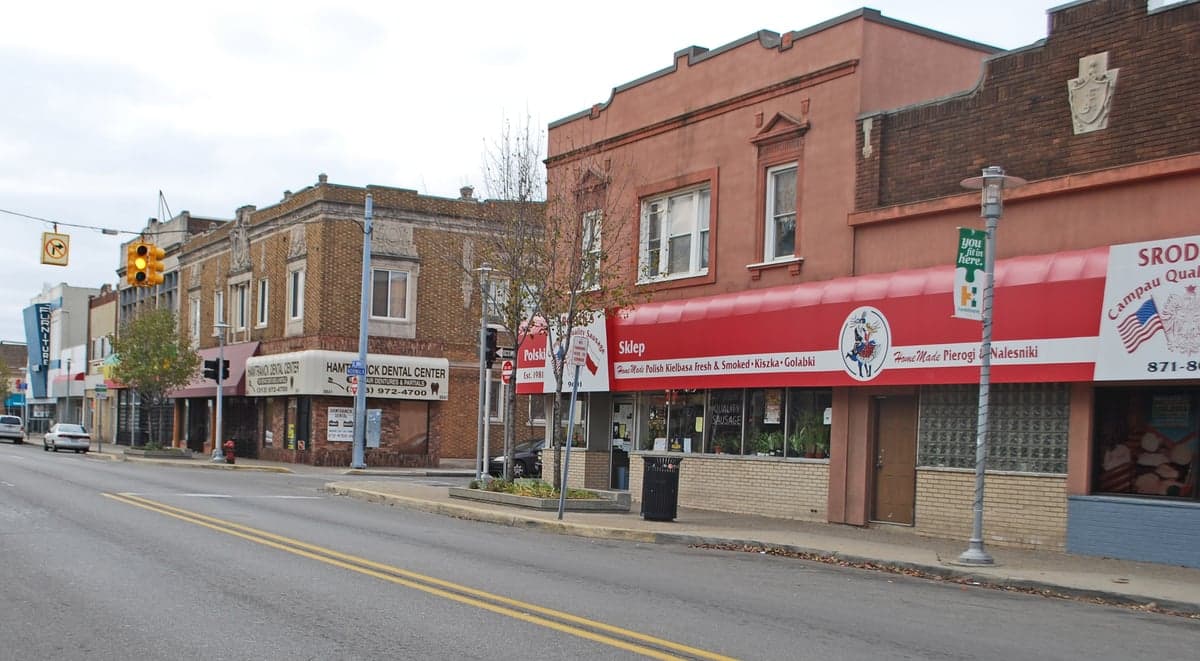
Photo: Wikipedia
Political ClimatePolitical Climate in Hamtramck, MI
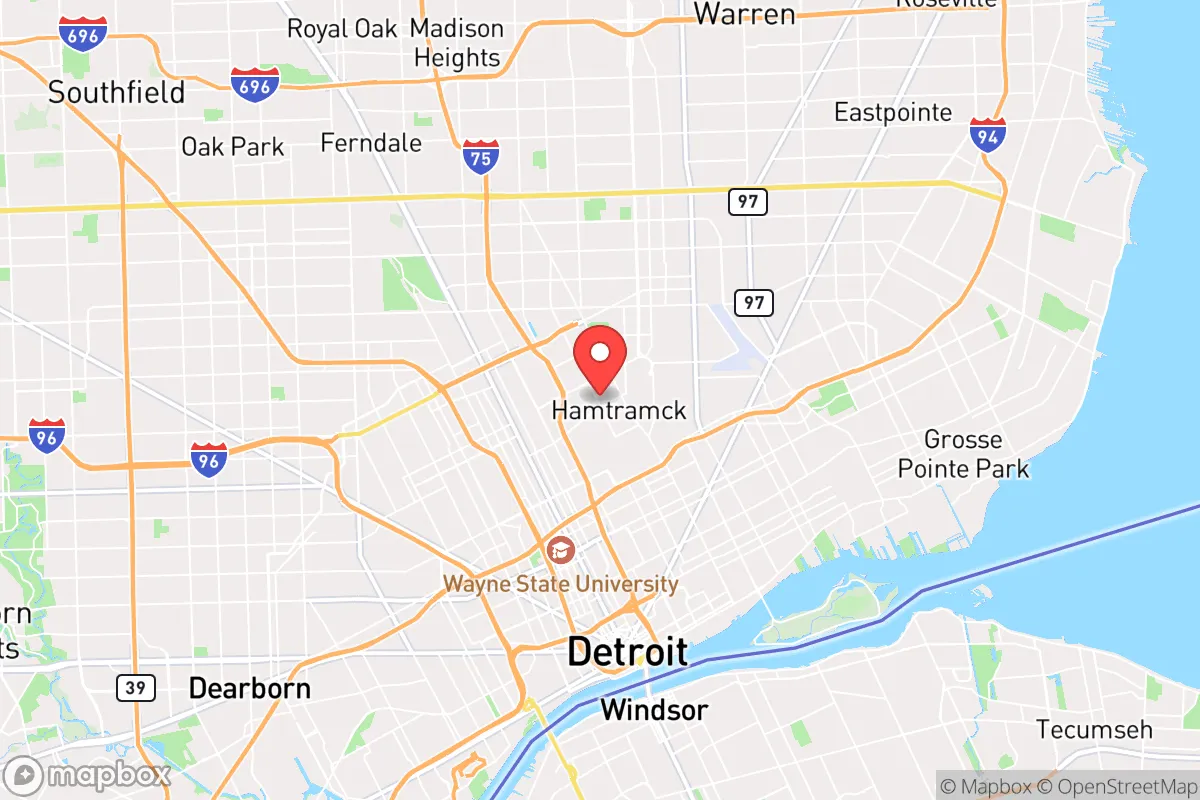
District shown is the primary district for this city’s centroid. Cities may span multiple districts.
Local Political AnalysisPolitical Analysis of Hamtramck, MI
Hamtramck is a deep blue island in a purple state, with a Cook Partisan Voting Index of D+22 compared to Michigan’s overall EVEN rating. That’s a massive 22-point Democratic lean, making it one of the most reliably liberal cities in the state. But the story here isn’t just about party labels—it’s about a unique coalition of immigrant communities, labor unions, and progressive activists that has shifted the city’s politics leftward over the past two decades. In 2024, Hamtramck voted for Kamala Harris by a margin similar to Detroit’s, while surrounding Wayne County as a whole was closer to D+15. The trajectory is toward even stronger Democratic dominance, driven by a growing Bangladeshi and Yemeni population that has become politically organized and influential.
How it compares
Compared to Michigan as a whole, Hamtramck is a political outlier. The state’s EVEN rating reflects a genuine toss-up status—think of places like Macomb County’s Clinton Township or Kent County’s Grand Rapids suburbs, where elections are decided by a few thousand votes. Hamtramck, by contrast, hasn’t been competitive in a general election in decades. The nearest politically similar city is Detroit (D+52), but Hamtramck is far smaller and more ethnically diverse. Drive 10 minutes north to Warren (R+3) or east to St. Clair Shores (R+6), and you’ll find working-class suburbs that lean Republican, especially on cultural issues. The contrast is stark: Hamtramck’s city council is majority Muslim, while Warren’s is majority white and Catholic. This means Hamtramck residents live in a bubble where progressive policies on housing, policing, and social services are the norm, while just across the city line, the political conversation is completely different.
What this means for residents
For liberal residents, Hamtramck is a comfortable place to live politically. The city government has passed rent control measures, funded community policing initiatives, and maintained a sanctuary city policy that limits cooperation with federal immigration enforcement. You’ll see pride flags on Jos. Campau Avenue and hear multiple languages at city council meetings. For conservative residents—and there are some, especially among older Polish-American families who remember the city’s pre-2000s demographics—the experience can be isolating. They often feel out of step with local leadership on issues like school curriculum and public spending. But because Hamtramck is so small (about 28,000 people), most political disagreements are handled face-to-face at the local diner or mosque, not through partisan media. The practical effect is that conservative residents tend to vote in state and federal races but disengage from city politics, which are dominated by the progressive coalition.
One notable cultural distinction is the city’s approach to alcohol sales. Hamtramck has a high concentration of halal restaurants and grocery stores, and several blocks near the mosque have no liquor licenses. This reflects the influence of the Muslim-majority city council, which has restricted new bar permits in residential areas. Meanwhile, the city’s famous Polish bakeries and the annual Paczki Day celebration remain popular, creating a blend of old and new traditions. This isn’t a policy battle—it’s a lived reality where religious and cultural norms shape daily life more than in most Michigan cities. For newcomers, especially from more politically mixed areas like Ann Arbor or Grand Rapids, Hamtramck’s political homogeneity can feel refreshing or stifling, depending on your perspective. But everyone agrees: the city’s politics are a direct reflection of its people, not the other way around.

State Political ClimatePolitical Climate in Michigan
State Political AnalysisPolitical Environment in the State
Michigan is the ultimate swing state, with a Cook PVI of EVEN that perfectly captures its knife-edge balance. Over the last 20 years, the state has lurched from reliably blue (voting for Kerry in 2004, Obama twice) to a Trump pickup in 2016 by 0.2 points, then back to Biden in 2020 by 2.8 points. The dominant coalitions are a shrinking, union-heavy blue wall in the southeast and a growing, exurban and rural red wave everywhere else. The trajectory is a slow rightward drift driven by out-migration from Detroit and in-migration to conservative-leaning western and northern counties, but the state remains too close to call in any given cycle.
Urban vs. rural divide
The political map is a classic Michigan story: Wayne County (Detroit) and Washtenaw County (Ann Arbor) are the Democratic engine, delivering massive margins that offset the rest of the state. In 2020, Wayne County alone gave Biden a 330,000-vote cushion. But the real action is in the exurbs and rural areas. Oakland County, once a Republican stronghold, has flipped suburban and now leans Democratic, while Macomb County (north of Detroit) is the iconic blue-collar swing county that went for Trump twice. Up north, Grand Traverse County (Traverse City) is a rare purple island in a sea of red, with the city itself trending left while the surrounding townships stay conservative. The western side of the state, from Holland to Grand Rapids, is historically Republican but has seen Grand Rapids proper drift left as young professionals and artists move in. The Thumb and Upper Peninsula are deeply red, with Marquette being the only blue dot in the UP. The divide isn't just urban vs. rural—it's also southeast Michigan vs. the rest of the state, with the I-75 corridor acting as a political fault line.
Policy environment
Michigan's policy environment is a mixed bag that reflects its swing-state status. The state has a flat income tax of 4.25%, which was cut from 4.35% in 2023 via a trigger law. Property taxes are moderate, with a 6-mill state education tax and local levies that vary wildly—Oakland County suburbs can hit 50 mills, while rural Alpena is under 30. There is no sales tax on groceries or prescription drugs, but the general sales tax is 6%. Regulatory posture is business-friendly in the right-to-work repeal era—the 2023 repeal of right-to-work (PA 1 of 2023) was a major union win, but the state still has a lower regulatory burden than Illinois or California. Education policy is a flashpoint: the 2023 "Read by Grade Three" law was retained, but the state also expanded LGBTQ+ anti-discrimination protections in schools. Election laws are a battleground: Proposal 2 of 2022 enshrined nine days of early voting, drop boxes, and automatic voter registration, while the 2024 "Secure MI Vote" initiative (which failed) would have tightened ID requirements. Healthcare is dominated by Blue Cross Blue Shield of Michigan, and the state expanded Medicaid under the Affordable Care Act in 2014. Gun laws are moderate: universal background checks and safe storage laws passed in 2023, but there is no permit required for open carry, and the state has a "shall issue" concealed carry system.
Recent policy direction
The last three years have seen a sharp leftward lurch under Governor Gretchen Whitmer and a Democratic trifecta (2023-2024). Key legislation includes: Repeal of right-to-work (PA 1 of 2023), which restored union security agreements; expansion of the Elliott-Larsen Civil Rights Act (2023) to include sexual orientation and gender identity; gun safe storage laws (2023) requiring firearms to be locked if a minor is present; and repeal of the 1931 abortion ban (2023), codified by Proposal 3 of 2022. On the conservative side, the state retained its stand your ground law (no duty to retreat in any place you have a right to be), and the 2024 "Clean Slate" law automatically expunges certain non-violent felonies after 10 years. Property rights saw a win with the 2023 "Right to Farm" act strengthening agricultural protections against nuisance lawsuits. Privacy and surveillance: the state passed a biometric data privacy law (2024) requiring consent for fingerprint and facial recognition collection. Ballot access: the 2022 Proposal 2 changes are being implemented, but the state Supreme Court (4-3 Democratic majority) has blocked most Republican-backed voter ID laws. The overall direction is a Democratic trifecta pushing through a progressive agenda, but the 2024 election saw Republicans flip the state House, meaning gridlock is back.
Civil unrest & political movements
Michigan has been a national flashpoint for political movements. The 2020 Whitmer kidnapping plot (involving militia members from Hastings and Luther) put the state on the map for far-right extremism. The 2020-2021 "Operation Gridlock" protests at the state capitol in Lansing saw armed demonstrators demanding an end to COVID-19 restrictions, which became a template for national protests. On the left, the 2023 "March for Our Lives" in Detroit drew 10,000 after the Michigan State University shooting. Immigration politics are relatively quiet—Michigan is not a border state, but Detroit and Ann Arbor are sanctuary cities, while Macomb County passed a 2024 resolution opposing sanctuary policies. Election integrity remains a live issue: the 2020 "Stop the Steal" movement was strong in Ottawa County and Livingston County, where the GOP county clerk was sued for refusing to certify results. The 2024 "Secure MI Vote" petition drive collected 500,000 signatures but was invalidated by the state Supreme Court. A new resident will notice the ubiquitous political yard signs in swing precincts—in Kent County, you'll see Trump and Whitmer signs on the same block. The Michigan Militia movement is still active in the northern Lower Peninsula, but it's more talk than action post-2020.
Projection
Over the next 5-10 years, Michigan will remain a swing state, but the demographic trends favor a slow rightward shift. The Detroit exodus continues (population down 7% since 2020), while northern Michigan (Grand Traverse, Leelanau, Emmet counties) is seeing an influx of remote workers from Chicago and the East Coast, many of whom are fiscally conservative but socially liberal. The Hispanic population is growing fastest in Holland and Grand Rapids, and these voters lean Democratic but are not a lock—the 2024 election saw a 10-point shift toward Trump among Michigan Latinos. The Arab American community in Dearborn is a wild card: they voted heavily for Biden in 2020 but are disillusioned over Gaza, and could swing the 2028 election. The state House map is being redrawn after the 2020 census, and the independent redistricting commission has created more competitive seats—expect the legislature to flip back and forth every cycle. The 2026 gubernatorial election will be a toss-up, with Whitmer term-limited. A new resident moving in now should expect a state that is perpetually contested, with policy whiplash every two years. The Upper Peninsula will continue to drift red, while Washtenaw County will become even bluer. The practical effect is that your vote will matter more here than in almost any other state.
For a new resident, the bottom line is that Michigan offers a genuine swing-state experience—your vote counts, your local school board race matters, and you'll see both parties competing for your attention. If you're conservative, you'll find strong communities in Macomb County, Ottawa County, and the Thumb, but you'll need to accept that the state government will often be controlled by Democrats. If you're liberal, you'll feel at home in Ann Arbor, Detroit, and Traverse City, but you'll have to live with Republican control of many county commissions and school boards. The key takeaway: Michigan is not a safe bet for either side, and that's exactly what makes it interesting. You'll get a front-row seat to the future of American politics, for better or worse.
* Values derived from national, state, county, city and local statistics and may differ in a specific area. Last updated: 2026-10-15T08:44:52.000Z
Narrative content on this page is AI-generated and may contain mistakes. Verify any details that matter before acting on them.
ReloMaps may earn a commission from affiliate links at no extra cost to you.

