Photo: Wikipedia
Demographics of Hamtramck, MI
Affluence Level in Hamtramck, MI
A low-income area with significant economic hardship. Household wealth and educational attainment are well below national averages.
People of Hamtramck, MI
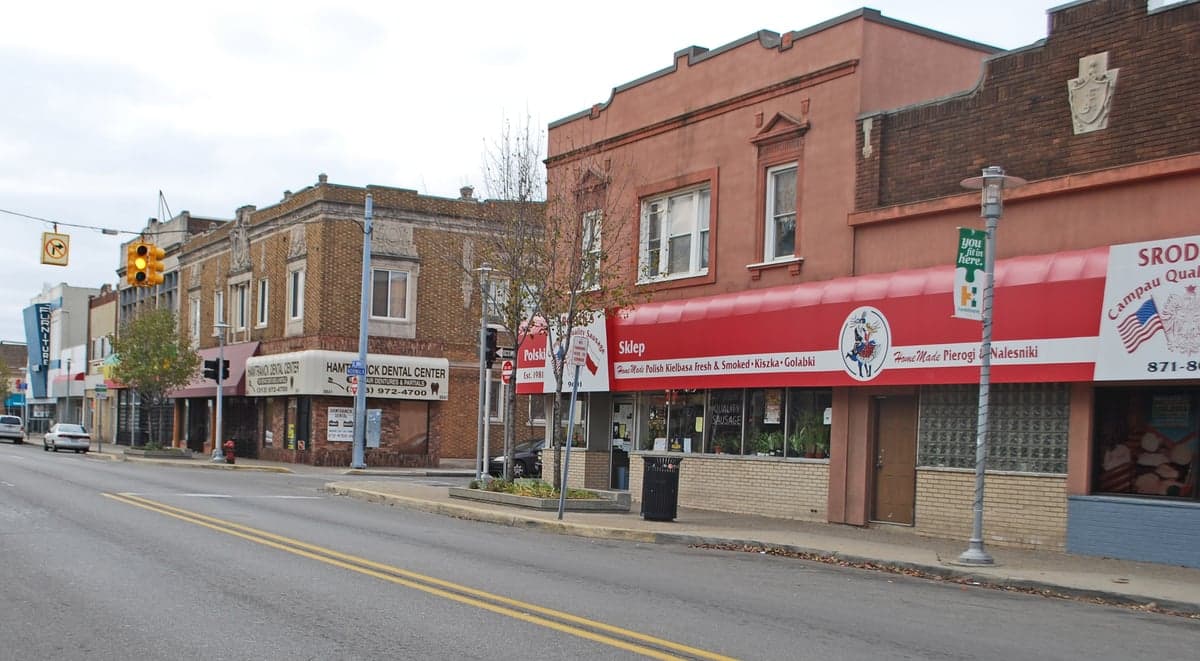
Today, Hamtramck, Michigan, is one of the most densely populated and ethnically diverse cities in the Midwest, home to roughly 27,830 people within just 2.1 square miles. The city’s character is defined by a unique blend of a historic Polish-Catholic core, a large and growing Bangladeshi and Yemeni population, and smaller communities of East/Southeast Asian, Black, and white residents. With 20% of residents foreign-born and a majority-minority population, Hamtramck is a living mosaic where immigrant entrepreneurship and traditional working-class values coexist in a tight-knit, walkable urban setting.
How the city was settled and grew
Hamtramck’s population history begins with German farmers in the 1850s, but the city’s explosive growth came with the rise of the American auto industry. Incorporated as a city in 1922, Hamtramck was quickly transformed by the massive Dodge Main plant (opened 1910), which drew tens of thousands of European immigrants and domestic migrants seeking factory work. The first major wave was Polish, and by the 1930s, Hamtramck was one of the most Polish cities in America, with Polish spoken on the streets and Catholic parishes anchoring daily life. These Polish immigrants settled primarily in the South Hamtramck and Dodge Park neighborhoods, building dense rows of single-family homes and two-flats near the plant. A smaller wave of Ukrainian and Slovak immigrants followed, clustering around the St. Florian and St. Ladislaus church districts. By 1970, the city was over 90% white, overwhelmingly Catholic, and deeply tied to the rhythms of the auto assembly line.
Modern era (post-1965)
The 1965 Hart-Cellar Act and the decline of Detroit’s auto industry reshaped Hamtramck’s population dramatically. As the Dodge Main plant closed in 1980, many Polish and other white families left for the suburbs, opening up affordable housing stock. The first new arrivals were Arab immigrants, primarily Yemeni, who began settling in the Caniff and Joseph Campau corridor in the 1970s and 1980s, opening grocery stores, restaurants, and mosques. By the 1990s, a second major wave arrived from Bangladesh, with families buying homes in the Holbrook and McDougall-Hunt districts (the latter straddling the Detroit border). Today, Indian (subcontinent) residents make up 22.7% of the population—the largest single ethnic group—while East/Southeast Asian communities (3.0%) and Black residents (8.2%) add further layers. The white population, still 56.5% of the total, is now largely older, Polish-descended residents in South Hamtramck, alongside a small influx of younger, non-Polish white professionals drawn by low home prices. The city’s college-educated share is just 18.0%, reflecting its enduring blue-collar character.
The future
Hamtramck’s population is trending toward greater diversity, but the direction is not simply “more diverse”—it is specifically more South Asian and Arab. The Bangladeshi and Yemeni communities continue to grow through both immigration and higher birth rates, while the white population (including the historic Polish base) is aging and shrinking. The city elected its first Muslim-majority city council in 2015 and a Bangladeshi-American mayor in 2021, signaling a political shift that mirrors the demographic one. New arrivals are concentrating in the McDougall-Hunt and Holbrook areas, while South Hamtramck remains the most Polish and white. Gentrification pressures are minimal compared to Detroit’s core, but the city’s proximity to the revitalizing Eastern Market and Detroit Riverfront may attract more young professionals over the next decade. The population is likely to stabilize or grow slightly, with the Indian and Arab shares continuing to rise and the white share continuing to fall.
For someone moving in now, Hamtramck offers an affordable, walkable, and intensely communal environment where immigrant entrepreneurship and a strong sense of neighborhood identity are the norm. It is not a melting pot in the classic sense—ethnic groups maintain distinct neighborhoods and institutions—but it is a place where a newcomer can find a tight-knit block, a low mortgage, and a city that still feels like a small town inside a big city. The next 10-20 years will likely see Hamtramck become even more South Asian and Arab, with its Polish heritage preserved in churches, festivals, and the names on the street signs, but less so in the census numbers.

* Values derived from national, state, county, city and local statistics and may differ in a specific area. Last updated: 2026-10-15T08:44:52.000Z
Narrative content on this page is AI-generated and may contain mistakes. Verify any details that matter before acting on them.
ReloMaps may earn a commission from affiliate links at no extra cost to you.

