Photo: Wikipedia
Political ClimatePolitical Climate in Hammondsport, NY
District shown is the primary district for this city’s centroid. Cities may span multiple districts.
Local Political AnalysisPolitical Analysis of Hammondsport, NY
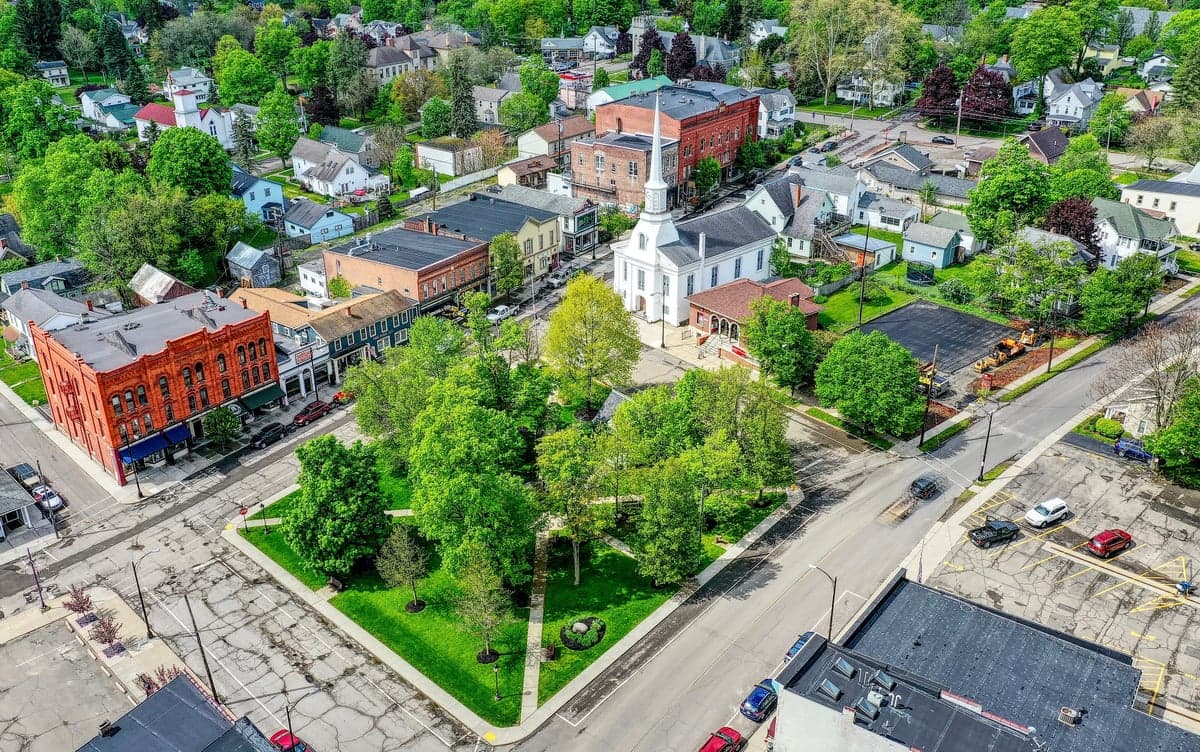
Hammondsport sits in one of the reddest pockets of upstate New York, with a Cook Partisan Voting Index of R+10 — meaning the area votes roughly ten points more Republican than the nation as a whole. That lean runs through the surrounding Steuben County countryside and the Finger Lakes towns along Keuka Lake, and it has deepened over the past two decades as national politics sorted itself out. In practice, this is Trump country: local roadside signs, farm-town gun shops, and church parking lots tell you more about the political mood here than any party headquarters would.
How it compares to New York City
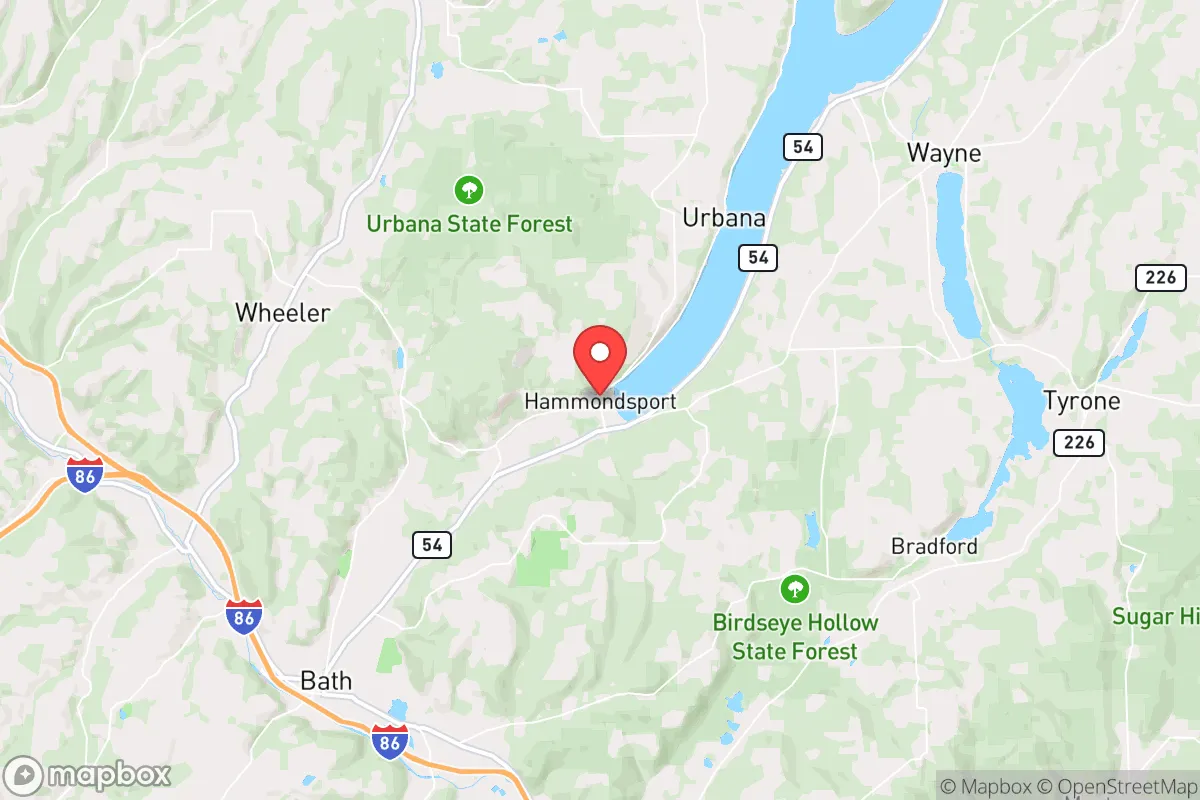
The contrast with New York, NY could hardly be sharper. Manhattan and the city's core vote overwhelmingly Democratic, and the city's politics are shaped by progressive priorities — tenant protections, climate rules, public transit funding, and a large immigrant population. Hammondsport, a village of roughly 700 people in the town of Urbana, is the mirror image: small, older, overwhelmingly white, and deeply skeptical of Albany regulation. Where a Brooklyn voter might see state mandates as progress, a Hammondsport voter often sees them as costs imposed from five hours away. Nearby Corning leans somewhat more moderate thanks to its corporate and college-educated base, and Ithaca to the east is a genuine blue island — but the villages around Keuka Lake, including Hammondsport, Wayne, and Pulteney, stay reliably conservative.
What this means for residents
For conservative residents, the R+10 lean means local government and county offices almost always reflect their views, and state-level fights over gun laws, land-use rules, and school curriculum feel like a distant imposition rather than a local debate. For liberal residents — and there are some, often newcomers drawn by lakefront property or remote work — the reality is quieter: you can live comfortably here, but you'll likely be outvoted locally and may keep political opinions to yourself at the diner. Practically, both sides feel the same pinch from Albany: high property taxes, strict septic and shoreline regulations, and state energy mandates that hit rural homeowners harder than urban renters. The difference is in how they interpret it.
Looking ahead, the trajectory seems stable rather than shifting. Population is aging, young people leave for Rochester and Corning, and the seasonal-home economy brings in outsiders who are often more moderate but rarely vote locally. I'd expect Hammondsport to stay comfortably Republican through the next several cycles, with the real political energy going into land-use and lakefront disputes rather than national races. The cultural divide with New York City isn't going anywhere — it's baked into the geography, the economy, and the way people here think about government's proper reach.

State Political ClimatePolitical Climate in New York
State Political AnalysisPolitical Environment in the State
New York is one of the most reliably Democratic states in the country, and it has moved further in that direction over the past two decades. Democrats control both U.S. Senate seats, the governorship (Kathy Hochul), the Assembly, and — since 2019 — the State Senate, and the party's presidential margin in New York has generally landed between 20 and 30 points since 2004. The coalition is anchored in New York City and its inner suburbs, buffered by upstate college towns like Ithaca and Albany, and increasingly offset by a reddening rural interior and a Long Island suburb that has drifted toward the GOP in recent cycles. If you're relocating from a swing state, the practical reality is that your state-level vote will rarely decide much — but the policy environment it produces will touch your taxes, your kids' schools, and your gun license directly.
Urban vs. rural divide: how the political map actually breaks down
The map is stark. New York City's five boroughs, plus Yonkers and the close-in Westchester and Rockland suburbs, generate the overwhelming bulk of Democratic margins — Manhattan and Brooklyn routinely vote 80%+ Democratic. Buffalo and Rochester, though smaller and more working-class, still lean Democratic, while Syracuse and Albany are dependable blue anchors upstate. The flip side: the rural counties of the Southern Tier, the North Country, and the Catskills are deep red — places like Steuben, Allegany, and Lewis counties vote Republican by 30+ points. The most interesting shift is on Long Island, where Suffolk and Nassau counties have moved toward Republicans in recent cycles, driven by crime, taxes, and the migrant crisis; Suffolk in particular has become a genuine battleground. College towns like Ithaca (Tompkins County) and New Paltz remain progressive outliers surrounded by redder countryside. In practice, a conservative moving to, say, Saratoga County or Dutchess County will find plenty of like-minded neighbors; one moving to Brooklyn will not.
Policy environment: taxes, regulation, schools, and elections
New York has one of the highest combined state and local tax burdens in the country. The top state income tax rate is 10.9% for earners above roughly $25 million (with a "millionaire's tax" surcharge extended through 2027), property taxes in Westchester and Nassau routinely run 2%+ of home value, and the state sales tax sits at 4% before county add-ons. The regulatory posture is interventionist: the Climate Leadership and Community Protection Act (2019) mandates an 85% emissions cut by 2050, the state has aggressive rent-stabilization and tenant-protection laws, and the Department of Environmental Conservation wields broad permitting authority. On education, New York spends more per pupil than almost any state and has strong teachers' unions; the state has moved toward "science of reading" mandates and universal pre-K in NYC. Healthcare is generous — the Essential Plan and expanded Medicaid cover hundreds of thousands — but premiums and provider consolidation are real cost pressures. Election law is among the most accessible in the nation: early voting, no-excuse absentee voting, automatic voter registration at DMVs, and same-day registration proposals that recur annually.
Recent policy direction: what's actually changed
The last several years have been legislatively active, and the direction is clear on most fronts. On guns, the 2022 Bruen response (the "Concealed Carry Improvement Act") tightened permitting, added sensitive-location restrictions, and required training — since partially litigated. On parental and education rights, the state has resisted book-removal efforts and expanded protections for transgender students, while school-choice advocates have pushed (so far unsuccessfully) for a larger charter sector and tax-credit scholarships. On speech and privacy, New York passed a sweeping abortion "shield law" and a data-privacy bill for minors, and the state has been aggressive on social-media regulation for minors. On medical and bodily autonomy, abortion is codified in state law and Medicaid covers it. On property rights, the Housing Compact (2023) tried to override local zoning for transit-oriented density and largely failed in the legislature, though the governor has continued pushing. On voting, the state expanded early voting and mail voting, and a 2024 ballot measure (Prop 1) enshrined broad anti-discrimination protections in the constitution. The through-line: more regulation, more social liberalism, more fiscal pressure.
Civil unrest and political movements
New York has a long history of visible political mobilization. The 2020 George Floyd protests produced large demonstrations in Brooklyn and Manhattan, and the 2023-24 pro-Palestinian encampments at Columbia and NYU drew national attention and heavy police response. On the right, the "parental rights" movement has been vocal on Long Island and in Staten Island, and Second Amendment groups have litigated the state's gun laws repeatedly. Immigration is the sharpest flashpoint: New York City's sanctuary-city status and the 2022-24 influx of asylum seekers (over 200,000 arrivals) strained shelters and budgets and became a central issue in suburban races. Election integrity controversies have been relatively muted — the state's main fights have been over redistricting (the 2022 Court of Appeals struck down the Democratic gerrymander) rather than fraud claims. A new resident will notice the politics most in local school-board meetings, on Long Island's talk-radio dial, and in the visible presence of advocacy groups in Albany.
Projection: what to expect over the next 5-10 years
Demographically, New York is losing population — roughly 100,000+ net domestic out-migrants annually in recent years, disproportionately middle-income and older — while gaining immigrants and retaining young professionals in NYC. That combination likely keeps the state solidly Democratic statewide but could narrow margins in the suburbs and on Long Island, where the GOP has already made inroads. Expect continued fiscal pressure from Medicaid, pensions, and climate mandates, likely producing more "millionaire's tax" extensions and possibly new congestion-pricing-style fees. On social policy, the trajectory is toward more codification of abortion and LGBTQ protections and tighter gun rules, with litigation as the main brake. The realistic bet: New York stays blue, but the red pockets get redder and the suburbs become the real battleground.
For a new resident, the bottom line is that New York's politics are less about who wins statewide (Democrats will) and more about the policy texture you'll live with: high taxes, strong unions, generous social services, tight gun laws, and a live-and-let-live social culture in the cities offset by more traditional values in the rural counties and on Staten Island. If you're conservative, you can find community in Suffolk, Saratoga, or the Southern Tier — but you'll be voting in a minority statewide. If you're liberal, you'll find the policy environment congenial, though you'll pay for it. Either way, the state rewards people who pick their county carefully: the difference between Nassau and Allegany is bigger than the difference between many states.
* Values derived from national, state, county, city and local statistics and may differ in a specific area. Last updated: 2026-11-03T03:23:03.000Z
Narrative content on this page is AI-generated and may contain mistakes. Verify any details that matter before acting on them.
ReloMaps may earn a commission from affiliate links at no extra cost to you.

