Photo: Wikipedia
Demographics of Hammondsport, NY
Affluence Level in Hammondsport, NY
A middle-class area roughly in line with national averages across income, home values, education, and employment.
People of Hammondsport, NY
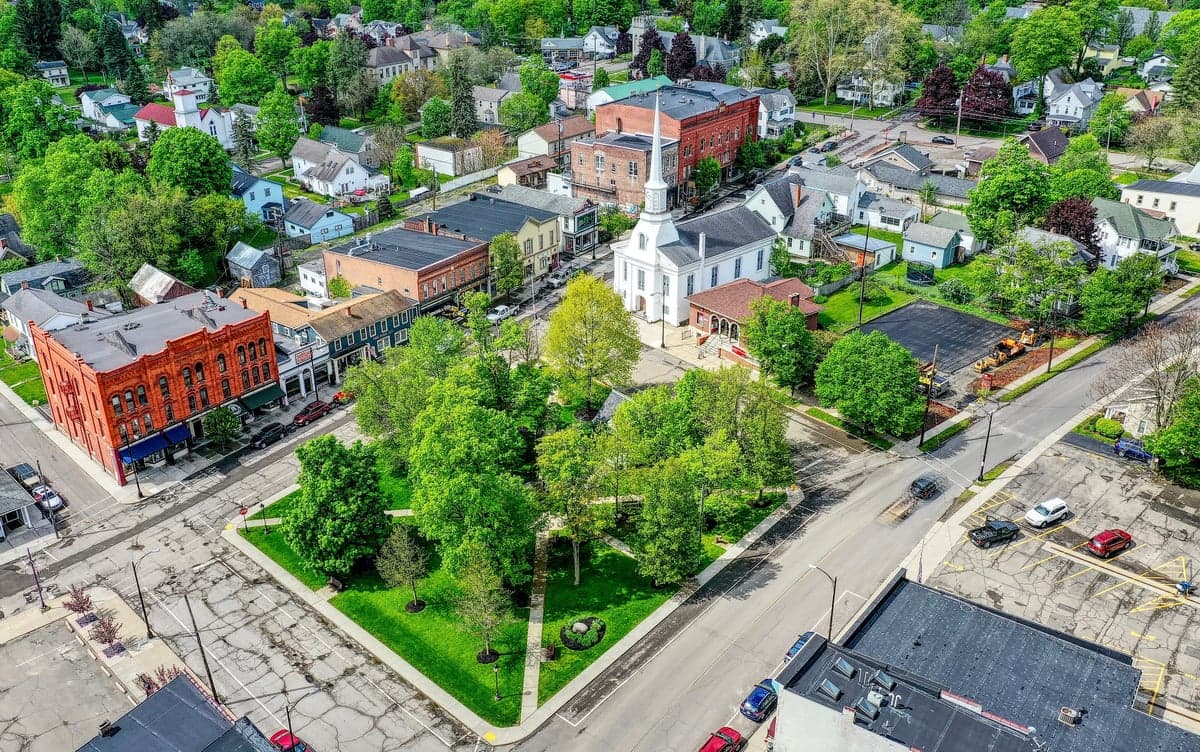
Hammondsport today is a village of 564 residents on the southern tip of Keuka Lake, a community whose identity was shaped less by mass immigration than by a single industry and the families it drew. The population is 94.7% white, with a Black share of 1.1%, a Hispanic share of 0.5%, and an East/Southeast Asian share of 0.4%; the Indian-subcontinent and foreign-born shares both register at 0.0%. Roughly 31.2% of adults hold a college degree, and the village's civic life still orbits the lakefront, the Pleasant Valley wine district, and the historic core along Water Street.
How the village was settled and grew
Hammondsport was laid out in 1796 by Lazarus Hammond of New Jersey, who purchased the land at the foot of Keuka Lake and platted a village around the lakehead. Early settlement drew Yankee families from New England and the Hudson Valley, who farmed the steep hillsides and ran mills and boat landings along the water. The decisive turn came in 1860, when the Pleasant Valley Wine Company was founded just north of the village — the first bonded winery in the United States — followed by the Taylor Wine Company and others. That industry, plus the lake steamboat trade and later the Glenn H. Curtiss aircraft works (Curtiss was born in Hammondsport in 1878), pulled in skilled laborers, coopers, and tradesmen from across the Finger Lakes and from Italian and German immigrant stock in the surrounding towns. These arrivals clustered in the village core around Water Street and Shether Street, in the Pulteney Street and Lake Street blocks near the lakefront, and in the Pleasant Valley district to the north where the wineries and their worker housing stood. By the mid-20th century the village had settled into a stable, largely native-born wine-and-tourism economy of a few hundred families.
Modern era (post-1965)
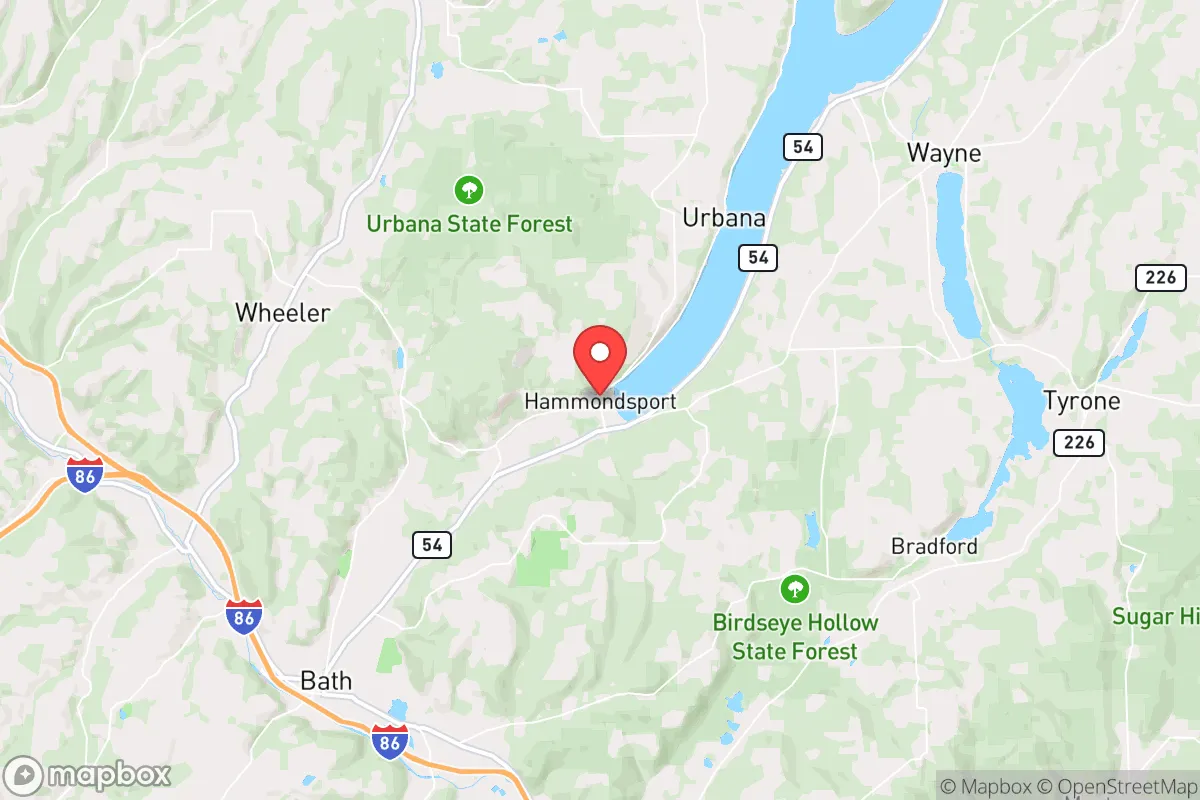
The post-1965 decades brought little of the immigration that reshaped larger American cities. Hammondsport's population drifted downward from its mid-century peak as the wine industry consolidated — Taylor was absorbed into Coca-Cola's wine holdings in the 1970s and later shuttered — and as younger residents left for Corning, Rochester, and beyond. What growth occurred was domestic in-migration: retirees and second-home buyers drawn to Keuka Lake, and commuters tied to Corning Inc. and the region's hospitals. The result is the present profile — a village that is 94.7% white with only trace Black, Hispanic, and East/Southeast Asian populations and no measurable foreign-born residents. The descendants of the old winery and boatyard families remain concentrated in the Water Street historic district and the Pulteney Street neighborhood, while newer seasonal and retiree households have settled along the lakefront and the hillside roads off State Route 54 leading toward Bath and the Pleasant Valley wineries.
The future
Hammondsport's demographic trajectory points toward slow shrinkage and continued homogeneity rather than diversification. With a median age well above the national figure, negligible foreign-born inflow, and a housing stock increasingly absorbed by seasonal and retirement buyers, the village is unlikely to see meaningful growth in its Hispanic, Black, or East/Southeast Asian shares over the next 10–20 years; the Indian-subcontinent population, currently at zero, shows no sign of emerging. The more likely story is a smaller year-round population, a larger share of part-time lake residents, and a cultural identity that leans harder into heritage tourism — the Curtiss museum, the Pleasant Valley wine trail, and the Water Street historic district — as the working families who once staffed the wineries thin out. Any new residents will most likely arrive as remote workers or retirees from downstate New York and Pennsylvania, dispersing along the lakefront rather than concentrating in any single neighborhood.
For someone moving to Hammondsport now, the bottom line is a village that is quiet, homogeneous, and aging — a place where the human history is deep but the demographic future is narrow. Families seeking a tight-knit, low-density lake community with strong civic institutions will find it; those looking for diversity, rapid growth, or a young professional peer group should look toward Corning or Ithaca instead.

* Values derived from national, state, county, city and local statistics and may differ in a specific area. Last updated: 2026-11-03T03:23:03.000Z
Narrative content on this page is AI-generated and may contain mistakes. Verify any details that matter before acting on them.
ReloMaps may earn a commission from affiliate links at no extra cost to you.

