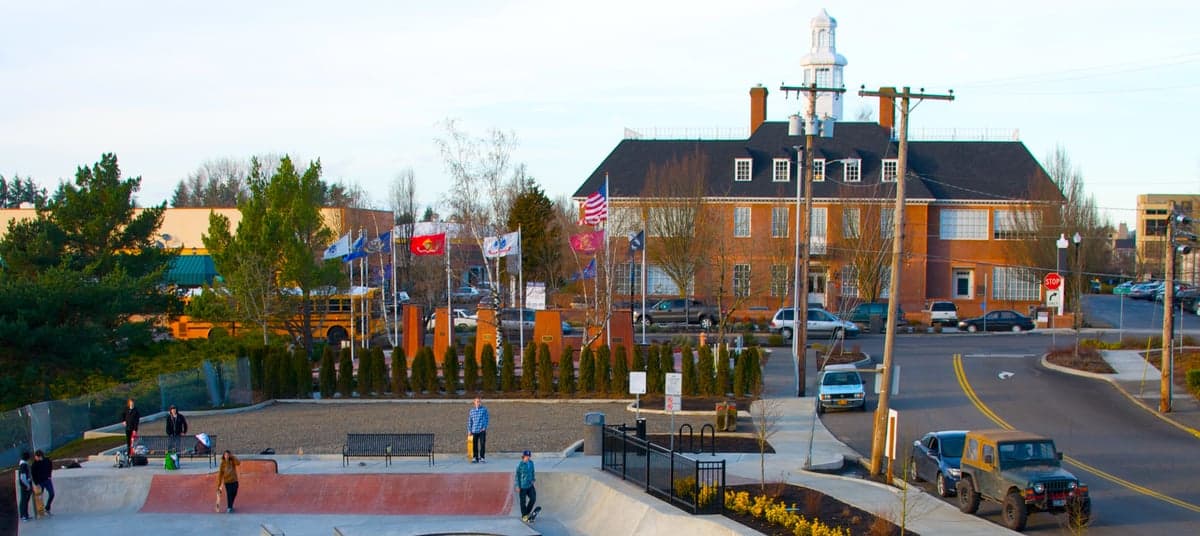
Photo: Wikipedia
Political ClimatePolitical Climate in Gresham, OR
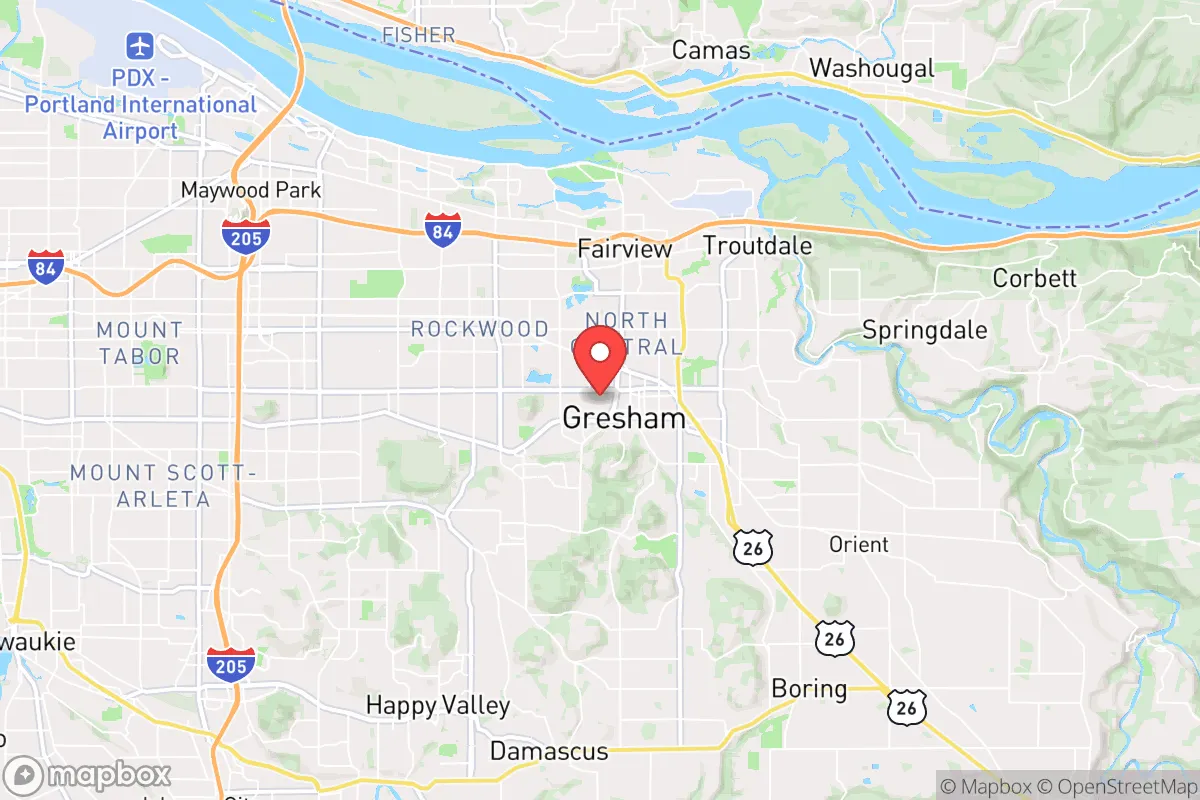
District shown is the primary district for this city’s centroid. Cities may span multiple districts.
Local Political AnalysisPolitical Analysis of Gresham, OR
Gresham leans heavily Democratic, with a Cook Partisan Voting Index (PVI) of D+24, making it one of the most reliably blue cities in Oregon. That’s a full 16 points more Democratic than the state as a whole, which sits at D+8. If you’ve lived here a while, you’ve seen this shift accelerate over the past decade—what was once a more moderate, working-class suburb has become a stronghold for progressive politics, especially among younger families and newer transplants from Portland.
How it compares
Compared to Oregon overall, Gresham is significantly more Democratic. The state’s D+8 PVI already puts it in solidly blue territory, but Gresham’s D+24 rating places it in the same league as Portland’s inner eastside neighborhoods. Drive just a few miles east to Troutdale or Wood Village, and you’ll find similar Democratic leanings, though slightly less intense. Head south toward Sandy or Estacada, and the political landscape flips—those areas lean Republican, often by double digits. Even within Gresham itself, the divide is visible: the older, more rural eastern edge of town (near the Bull Run Watershed) tends to vote more conservatively, while the western half, closer to Portland, is where you’ll find the strongest Democratic turnout. The city’s trajectory has been consistently leftward since the early 2000s, driven by an influx of Portland commuters and a growing population of younger, more diverse residents.
What this means for residents
For liberal residents, Gresham’s political climate means local policies often align with their values—think robust public transit investment (the MAX Blue Line runs right through town), affordable housing initiatives, and a city council that’s generally supportive of climate action and social equity programs. Conservative residents, however, aren’t entirely sidelined. The city’s strong mayor-council system means local elections can still produce moderate or even center-right voices, especially in wards east of 182nd Avenue. You’ll find that many longtime residents—particularly those in the Rockwood and Wilkes East neighborhoods—vote Republican in state and national races but pragmatically support local Democrats on bread-and-butter issues like road maintenance and police funding. The practical effect is a city that feels politically charged at the ballot box but surprisingly cooperative in day-to-day governance. School board meetings and neighborhood association gatherings tend to be more about potholes and park hours than partisan gridlock.
Culturally, Gresham stands apart from Portland in a few key ways. There’s less of the “keep Portland weird” ethos here—you’re more likely to see pickup trucks with American flags than bumper stickers for local political candidates. The city’s large Latino and Pacific Islander communities (about 20% and 5% of the population, respectively) bring a distinct cultural flavor that influences everything from local festivals to city council priorities. Policy-wise, Gresham has been more aggressive than the state average on urban growth boundary expansions and police oversight reforms, reflecting its unique blend of suburban pragmatism and progressive activism. Looking ahead, expect the D+24 lean to hold steady or even deepen as Portland’s housing costs push more left-leaning renters and first-time buyers eastward. But don’t expect Gresham to become a carbon copy of Portland—the city’s roots in timber, manufacturing, and agriculture run deep, and that blue-collar identity keeps its politics grounded in real-world concerns, not just ideological purity.

State Political ClimatePolitical Climate in Oregon
State Political AnalysisPolitical Environment in the State
Oregon is a reliably Democratic state at the presidential level, with a Cook PVI of D+8, but that label hides a deeply fractured political reality. The state hasn’t voted for a Republican presidential candidate since 1984, yet it’s home to some of the most conservative counties in the West, and the legislature is often split between a progressive Portland metro and a restive, rural interior. Over the last 20 years, the Democratic majority has solidified in the Willamette Valley while the eastern and southern parts of the state have grown more alienated, fueling a persistent urban-rural civil war that defines nearly every policy debate.
Urban vs. rural divide
The political map of Oregon is essentially a tale of two states. The Portland metro area — Multnomah, Washington, and Clackamas counties — accounts for roughly 45% of the state’s population and delivers massive Democratic margins. In 2024, Multnomah County voted over 75% for the Democratic presidential candidate, while Clackamas County, once a swing county, has shifted left over the past decade. Meanwhile, the rest of the state is overwhelmingly Republican. Eastern Oregon counties like Malheur, Harney, and Grant routinely vote 70-80% Republican. The Rogue Valley around Medford and Ashland is a microcosm of the divide: Jackson County is purple-to-red, but Ashland itself is a liberal college town. The Bend-Redmond area (Deschutes County) has been the state’s most watched swing region — it voted for Obama in 2008, then flipped to Trump in 2016 and 2020, before trending back toward Democrats in 2024 as California transplants poured in. The Willamette Valley outside Portland — places like Salem, Eugene, and Corvallis — leans blue, but the small towns in between (think Woodburn, Stayton, or Dallas) are often red islands. The result is a state where the governor and legislature are solidly Democratic, but county commissions and sheriffs in 30 of 36 counties are Republican, creating constant friction over land use, gun laws, and pandemic mandates.
Policy environment
Oregon’s policy environment is a study in contrasts. On taxes, the state has no sales tax — a major draw for conservatives — but has one of the highest personal income tax rates in the nation, topping out at 9.9% for top earners. Property taxes are capped by Measure 50 (1997), which limits annual increases to 3%, so longtime homeowners pay far less than newcomers. The regulatory posture is heavily progressive: Oregon has a statewide land-use planning system (Senate Bill 100, 1973) that strictly controls urban growth boundaries, making housing expensive in Portland and Bend. Education policy is dominated by the teachers’ unions; the state ranks near the bottom in high school graduation rates (around 80%) but spends above the national average per pupil. Healthcare is a mixed bag: Oregon expanded Medicaid early under the Affordable Care Act and has a strong public health infrastructure, but rural hospitals are struggling. Election laws are among the most accessible in the country — Oregon was the first state to vote entirely by mail (1998), and automatic voter registration at the DMV is standard. Voter turnout is consistently among the highest in the nation, often above 70% in presidential years.
Recent policy direction
The last five years have seen Oregon lurch left on several fronts, then partially pull back. Measure 110 (2020) decriminalized possession of small amounts of hard drugs like heroin and methamphetamine, but the resulting public drug use crisis in Portland and other cities led to a bipartisan backlash. In 2024, the legislature passed House Bill 4002, which recriminalized possession and created a new system of deflection to treatment — a clear course correction. On gun policy, Oregon passed Measure 114 (2022), which requires a permit to purchase a firearm and bans magazines over 10 rounds. It’s currently tied up in court, but if fully implemented, it would be one of the strictest gun laws in the country. On parental rights, the state passed the Student Success Act (2019), which increased education funding but also expanded ethnic studies and LGBTQ+ inclusive curriculum — a flashpoint for conservative families. Measure 111 (2022) amended the state constitution to declare healthcare a right, though it’s largely symbolic. On property rights, Oregon’s land-use system remains a sore spot for rural landowners, and the 2019 wildfire liability laws made utilities liable for fire damages, driving up insurance costs. On voting, Oregon remains a vote-by-mail stronghold, but the 2023 Senate Bill 579 made it a crime to intimidate election workers, a response to post-2020 tensions. The overall direction is a progressive state that occasionally hits the brakes when the consequences become visible.
Civil unrest & political movements
Oregon has a long history of political activism, from the 2020 Portland protests (which lasted over 100 consecutive nights) to the Malheur National Wildlife Refuge occupation (2016) by armed anti-government activists. The Portland protests were a national flashpoint, with federal agents deployed and widespread property damage. Since then, the movement has cooled, but antifa and far-right groups like the Proud Boys both have a presence in the state. Immigration politics are less heated than in border states, but Oregon is a sanctuary state (1987), meaning local law enforcement cannot ask about immigration status. This has led to friction with federal immigration authorities, especially in rural counties where sheriffs sometimes cooperate with ICE anyway. Election integrity controversies are muted compared to states like Arizona or Georgia — Oregon’s mail-in system is widely trusted, though a 2020 ballot drop box fire in Portland and a 2023 incident involving a stolen ballot box in Clackamas County raised concerns. The Greater Idaho movement — a proposal to move 13 eastern Oregon counties into Idaho — has gained traction, with several counties voting in favor of exploring the idea. It’s mostly symbolic, but it reflects the depth of rural alienation. A new resident in Portland will see homeless encampments and occasional street protests; a new resident in Klamath Falls will see “Let’s Go Brandon” flags and pickup trucks with gun racks. The two Oregons rarely meet.
Projection
Over the next 5-10 years, Oregon’s political trajectory points toward continued Democratic dominance at the state level, but with growing internal friction. The Portland metro will keep growing, driven by in-migration from California and other blue states, which will reinforce the Democratic majority. However, the housing crisis — Portland rents have risen 40% since 2015 — may slow that growth. The Bend area will continue to swing, but as more remote workers and retirees arrive, it will likely trend blue. Rural Oregon will not flip; instead, the Greater Idaho movement may gain more symbolic votes but won’t succeed without a constitutional amendment. The most likely scenario is a state that remains blue but becomes more pragmatic — the backlash to Measure 110 and the passage of HB 4002 suggest a willingness to correct course. A conservative relocator should expect to live in a state where their vote for president won’t matter, but where local elections (sheriff, county commission, school board) are highly competitive and consequential. A liberal relocator should expect a state that is broadly aligned with their values but where the rural-urban divide means constant legislative battles over land use, guns, and education.
For a new resident, the bottom line is this: Oregon is a beautiful, expensive, and politically divided state where your experience depends almost entirely on where you live. If you’re a conservative moving to Portland or Eugene, you’ll be in a deep-blue environment with high taxes and progressive policies on drugs, guns, and homelessness. If you’re a liberal moving to Medford or Pendleton, you’ll be in a red area where your neighbors may be armed and your county commission will fight the state at every turn. The state’s lack of a sales tax and its mail-in voting are genuine perks for both sides, but the income tax and housing costs are real burdens. The best advice: visit the specific town you’re considering, talk to locals, and understand that Oregon’s political reality is not a monolith — it’s a collection of fiercely independent communities that happen to share a border.
* Values derived from national, state, county, city and local statistics and may differ in a specific area. Last updated: 2026-06-14T10:21:58.000Z
Narrative content on this page is AI-generated and may contain mistakes. Verify any details that matter before acting on them.
ReloMaps may earn a commission from affiliate links at no extra cost to you.

