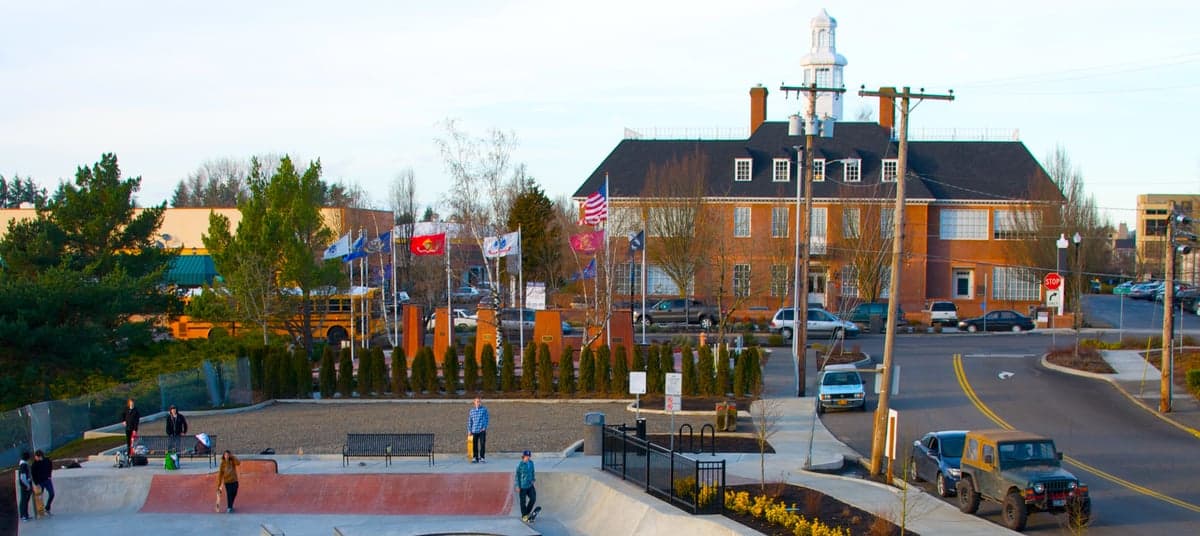
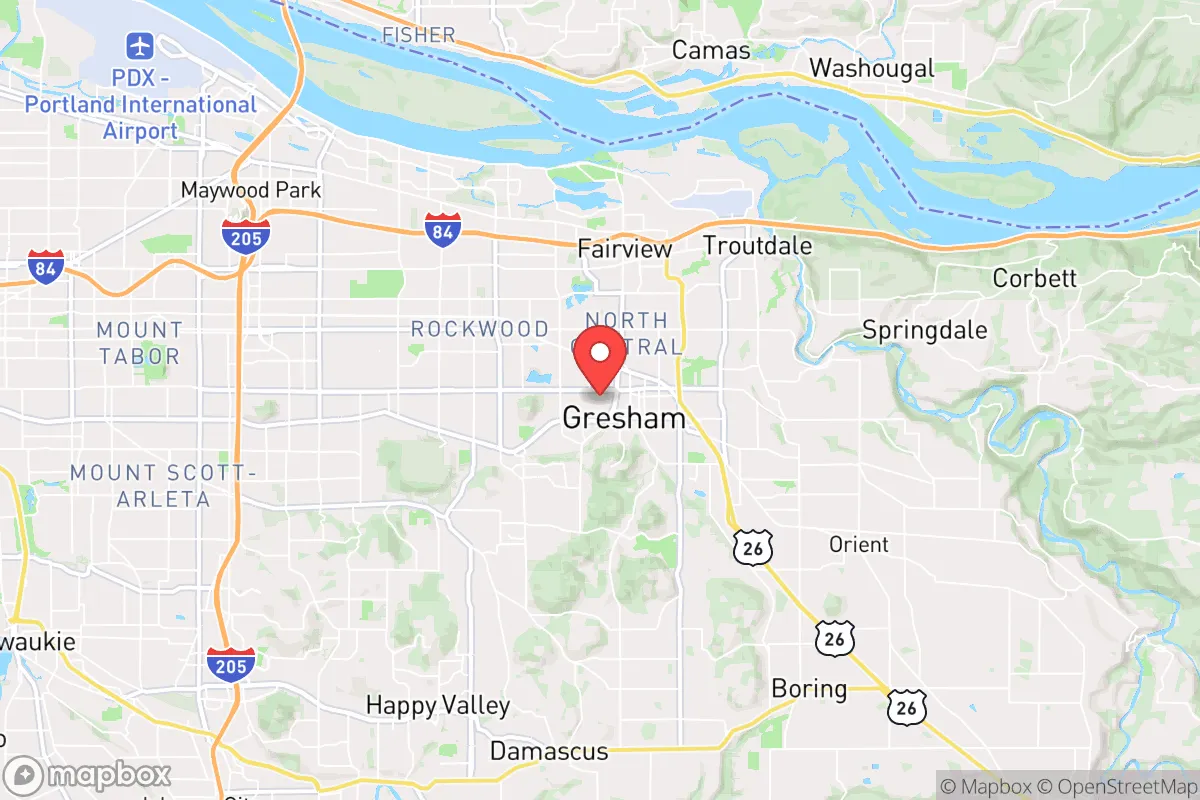
Photo: Wikipedia
Demographics of Gresham, OR
Affluence Level in Gresham, OR
A middle-class area roughly in line with national averages across income, home values, education, and employment.
People of Gresham, OR
The people of Gresham, Oregon today number 112,818, forming a notably diverse and family-oriented suburb east of Portland. The city is characterized by a strong Hispanic community (21.1% of the population), a significant East and Southeast Asian presence (5.2%), and a Black population (4.2%) that is larger than many Portland suburbs. With 23.6% of adults holding a bachelor’s degree or higher, Gresham’s identity is that of a working- and middle-class hub where affordability and space draw a mix of long-standing white families and newer immigrant communities.
How the city was settled and grew
Gresham’s human history begins with the Wasco and Clackamas tribes, who used the area for seasonal fishing and gathering along Johnson Creek. Euro-American settlement started in the 1850s, driven by the Donation Land Claim Act. The city’s original core formed around the Gresham Butte Siding (a railroad stop) and the Rockwood area, where early farmers grew wheat, oats, and fruit. The arrival of the Oregon Railway & Navigation Company in the 1870s turned the tiny crossroads into a shipping point, attracting German and Scandinavian homesteaders who built the first churches and schools in what is now Historic Downtown Gresham. By 1900, the population was almost entirely white, Protestant, and agrarian. The city incorporated in 1905, and growth remained slow through the 1940s, limited to the area around Main Avenue and Powell Boulevard.
Modern era (post-1965)
The 1965 Hart-Cellar Immigration Act and the expansion of Portland’s urban growth boundary reshaped Gresham’s population dramatically. The Rockwood neighborhood became the primary landing point for Hispanic immigrants, especially from Mexico and Central America, who arrived for construction, warehouse, and service jobs in the 1970s and 1980s. By 1990, Rockwood’s Hispanic share had reached 15%, and today it exceeds 35%, with a dense corridor of taquerias, mercados, and Spanish-language churches along 181st Avenue. East and Southeast Asian communities—primarily Vietnamese, Chinese, and Filipino—settled in the North Gresham and Fairview areas, drawn by affordable housing and proximity to Portland’s Jade District. The Black population grew more slowly, concentrated in East Gresham near the Mount Hood Community College campus, where families sought larger lots and lower crime rates than in inner Portland. The white population, which was 85% in 1980, dropped to 61.2% by 2024, as many longtime residents moved to outer suburbs like Sandy or Estacada. The Indian subcontinent population remains tiny at 0.4%, with no distinct neighborhood cluster.
The future
Gresham’s population is becoming more diverse and slightly younger. The Hispanic share is projected to reach 25-28% by 2035, driven by both immigration and higher birth rates, with continued concentration in Rockwood and spreading into South Gresham near the Springwater Corridor. The East and Southeast Asian population is growing more slowly, dispersing from North Gresham into newer subdivisions along the 20th Street corridor. The white share is declining, but not as rapidly as in Portland proper, as some families are drawn by Gresham’s lower home prices (median home value ~$450,000 vs. Portland’s ~$550,000). The city is also seeing a small influx of younger, college-educated renters from Portland, priced out of the inner east side, who are settling in the Downtown Gresham redevelopment area. This group is more liberal and diverse than the older white cohort, but the overall political character of the city remains moderate—Gresham voted for Joe Biden by 12 points in 2020, a narrower margin than Portland’s 40-point spread. The next decade will likely see continued diversification, with Rockwood becoming a majority-minority neighborhood and the city’s cultural identity shifting from a white working-class suburb to a multiethnic, middle-class gateway.
For someone moving to Gresham now, the city offers a genuine cross-section of the Pacific Northwest’s demographic future: a place where Hispanic, Asian, and white communities coexist in distinct neighborhoods, where housing is still attainable, and where the schools and parks reflect a growing diversity. It is not a wealthy enclave or a hipster magnet, but a solid, evolving suburb where the people are the story.

* Values derived from national, state, county, city and local statistics and may differ in a specific area. Last updated: 2026-06-14T10:21:58.000Z
Narrative content on this page is AI-generated and may contain mistakes. Verify any details that matter before acting on them.
ReloMaps may earn a commission from affiliate links at no extra cost to you.

