
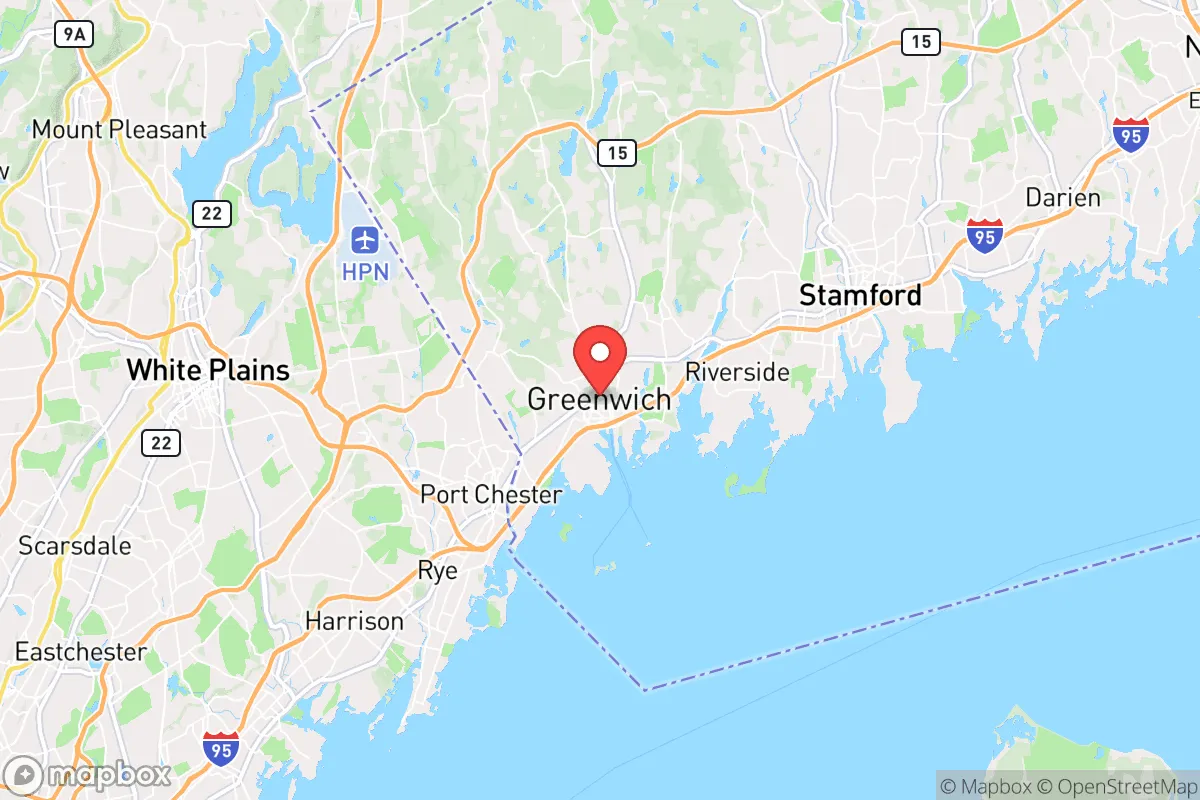
Photo: Wikipedia
Personal Sovereignty in Greenwich, CT
Viable for self-reliance. Generally workable, though some barriers may limit total independence.
What does Personal Sovereignty tell us?
Personal Sovereignty measures your capacity for self-reliance and independence with minimal government friction. Higher scores mean fewer barriers between you and the way you want to live... but it assumes you have the space you need and good neighbors.
What does this tell us?
Personal Sovereignty measures your capacity for self-reliance and independence with minimal government friction. Higher scores mean fewer barriers between you and the way you want to live... but it assumes you have the space you need and good neighbors.
State Policy
Energy independence: Importer (5% of energy produced in-state)
Personal Liberty
Homesteading

Personal Liberty Analysis
Greenwich, Connecticut, offers a constrained but workable autonomy environment for individuals and families, defined primarily by the state’s heavy regulatory footprint and the town’s own restrictive zoning. While the area is known for elite private services and strong property protections, personal sovereignty here comes with trade-offs: high taxes, strict firearm laws, and limited off-grid feasibility. For a relocation audience that values independence, Greenwich is best understood as a place where financial resources can buy a degree of personal freedom, but where state-level policies consistently limit individual self-determination.
Tax burden and regulatory posture: how Connecticut’s policies shape daily life
Connecticut carries one of the highest combined state and local tax burdens in the nation, and Greenwich residents feel that acutely. The state imposes a progressive income tax topping out at 6.99%, a 6.35% sales tax with few exemptions, and property taxes that are among the highest per capita in the country. In Greenwich, the effective property tax rate hovers around 0.6–0.7% of assessed value, but because property values are sky-high—median home prices exceed $1.5 million—annual tax bills routinely run $10,000–$15,000 or more. This fiscal appetite funds exceptional public services: Greenwich schools are perennially top-ranked, and public safety and infrastructure are well-maintained. However, the regulatory posture extends far beyond taxes. Connecticut’s building codes are among the strictest in the Northeast, with mandatory energy standards, costly permitting processes, and lengthy review timelines. Greenwich itself layers on local zoning ordinances that tightly control lot coverage, setbacks, and allowable uses. For someone seeking to modify a home or start a small business, the administrative burden is substantial and non-negotiable. The net effect is that individual financial autonomy is traded for collective service quality and environmental regulation.
Self-defense and gun law specifics: what the state requires for firearms ownership
Connecticut has some of the most restrictive firearm laws in the country, and Greenwich does not deviate. The state requires a pistol permit to purchase any handgun or long gun, which involves fingerprinting, a background check, a state-approved safety course, and a 60–90 day waiting period. Assault weapons and magazines holding more than ten rounds are banned, with existing ones requiring registration. There is no state preemption of local gun laws, so Greenwich could theoretically impose its own restrictions, though it generally enforces state standards. Carrying a firearm for self-defense is legal with a permit, but the permit process is lengthy and can involve local police interviews; Greenwich Police have a reputation for scrutinizing applications thoroughly. Stand Your Ground laws do not exist in Connecticut; the state follows a “duty to retreat” outside the home before using deadly force. For a conservative-leaning individual or family, these limitations represent a substantial reduction in personal sovereignty over self-defense. Local gun culture exists but is quiet, with no shooting ranges within town limits and few gun-friendly events. The practical takeaway: if firearms ownership and carry are high priorities, Greenwich ranks low on the spectrum of personal liberty.
Self-reliance and homesteading viability: zoning, lot sizes, and off-grid feasibility
Homesteading-style self-reliance in Greenwich is severely constrained by both state and local regulations. Typical residential lots range from 0.5 to 2 acres in most neighborhoods, though some estates sit on 5+ acres in the backcountry. However, zoning ordinances prohibit keeping livestock—no chickens, goats, or bees in the vast majority of residential zones—and restrict the size and use of sheds, greenhouses, and accessory structures. Off-grid living is essentially impossible: Connecticut mandates grid-tied electrical connections for any habitable structure, and the town requires septic or sewer hookups with rigorous permitting. Rainwater collection is permitted but heavily regulated; large-scale cisterns require a water diversion permit from the state. Vegetable gardens and fruit trees are allowed, but growing enough to meaningfully supplement a household’s food supply is impractical on standard suburban lots. For those interested in solar panels, net metering is available, but installation requires permits and often homeowner association (HOA) approval in planned communities. Self-reliance in Greenwich is largely limited to financial independence and the ability to purchase high-quality goods and services, not physical subsistence. If your definition of sovereignty includes raising your own food or disconnecting from utilities, Greenwich is not a viable location.
Personal liberties: parental rights, medical autonomy, speech, and property
Personal liberties in Greenwich reflect Connecticut’s progressive state policies, tempered by the town’s relatively affluent and politically moderate environment. On parental rights: the state mandates school vaccination for children unless a medical exemption is obtained; philosophical or religious exemptions are not permitted after 2021 legislation. Homeschooling is legal but requires annual notice, portfolio review, and standardized testing. Medical autonomy is limited by state vaccination mandates for school attendance and a lack of medical freedom exceptions for COVID-19 or other public health orders. Speech rights are fully protected under the First Amendment, though Greenwich has local noise and demonstration ordinances that can be enforced. Property rights are strong in terms of ownership tenure, but land use is heavily controlled: you cannot build what you want, where you want, without government approval. The town’s Planning & Zoning Commission reviews virtually all construction and changes of use, and appeal processes are lengthy. Newer state affordable housing mandates (CT Public Act 21-29) pressure towns like Greenwich to allow multifamily developments in certain zones, which could reduce property owner control over neighborhood character. For a conservative audience, these constraints are significant. However, Greenwich’s general wealth and culture of civic engagement mean that local governance is responsive to resident concerns—public hearings are common, and community input can shape outcomes. In practice, personal liberties are exercised within clear, well-enforced boundaries set by the state and town.
Compared to areas in the South, Midwest, or Mountain West—where state preemption, lower taxes, castle doctrine laws, and fewer zoning restrictions are the norm—Greenwich clearly ranks lower in overall personal sovereignty. For someone whose relocation priorities prioritize self-determination in taxation, self-defense, homesteading, and medical autonomy, the trade-offs required by Greenwich’s high-amenity, high-regulation environment may outweigh the benefits. Yet for those who can accept the constraints and value access to top-tier public services, strong schools, and a vibrant local economy, the area still offers a degree of personal autonomy that is rare in the Northeast—precisely because those services and protections are well-funded and locally accountable. The final judgment depends on which aspect of sovereignty matters most: the freedom from government intervention, or the freedom to enjoy high-quality public goods backed by substantial tax dollars.

* Values derived from national, state, county, city and local statistics and may differ in a specific area. Last updated: 2026-06-20T16:31:03.000Z
Narrative content on this page is AI-generated and may contain mistakes. Verify any details that matter before acting on them.
ReloMaps may earn a commission from affiliate links at no extra cost to you.

