
Photo: Wikipedia
Political ClimatePolitical Climate in Green Valley, AZ
District shown is the primary district for this city’s centroid. Cities may span multiple districts.
Local Political AnalysisPolitical Analysis of Green Valley, AZ
Green Valley, Arizona, sits in a political sweet spot that’s rarer than you’d think in this state: a Cook PVI of EVEN, meaning the area votes almost exactly in line with the national average. That’s a far cry from the rest of Pima County, where Tucson pulls things hard to the left, and it’s a world away from the deep-red ranching towns like Sahuarita’s outskirts or the heavily Republican communities further north in Maricopa County. For a retiree-heavy community of about 45,000, that EVEN rating isn’t an accident—it’s the product of a demographic shift that’s been building for a decade, and it makes Green Valley one of the few genuinely competitive swing zones in southern Arizona.
How it compares
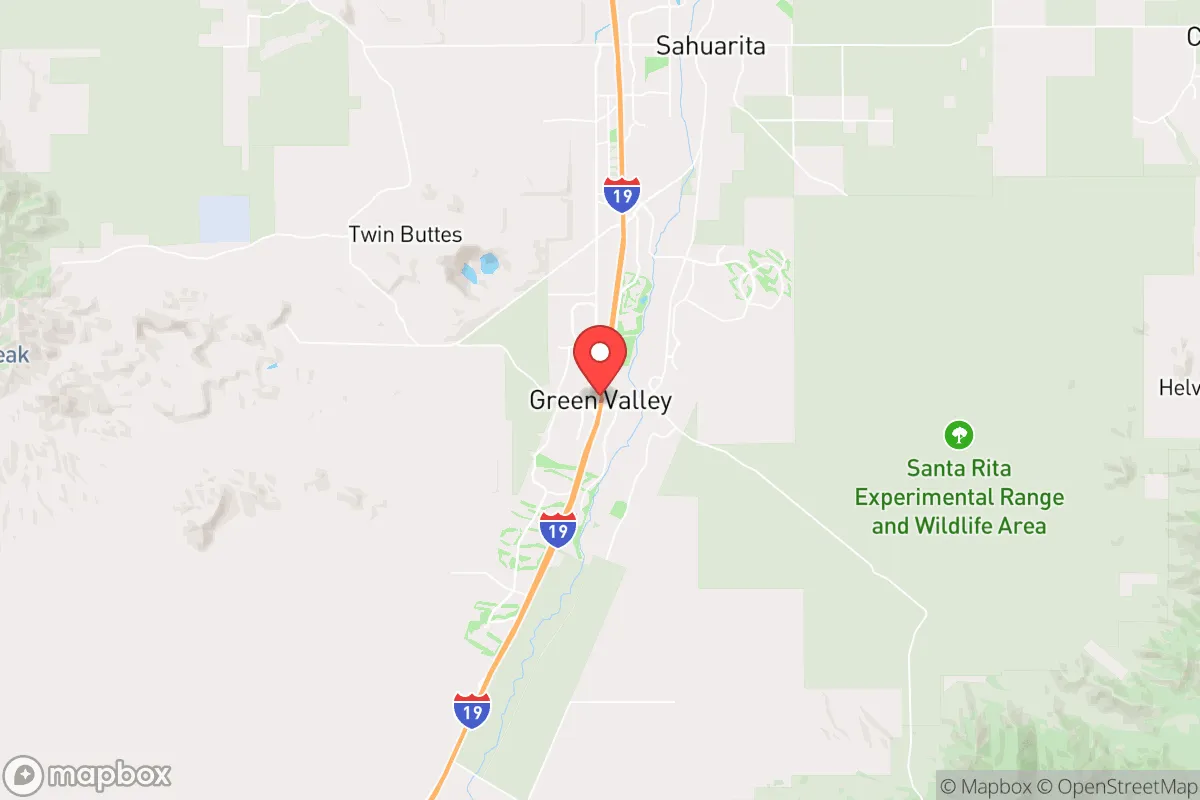
To understand Green Valley, you have to look at the map. The immediate neighbor, Sahuarita, leans more Republican, while Tucson proper—just 25 miles north—is a Democratic stronghold that routinely votes 2-to-1 for statewide Democrats. Green Valley sits between those poles, and its EVEN rating reflects that tug-of-war. In the 2022 gubernatorial race, the area split almost down the middle, with Katie Hobbs and Kari Lake trading precinct-level wins within a few points of each other. That’s not the case in the rest of Pima County, which went for Hobbs by a landslide, nor in Cochise County to the east, which went heavily for Lake. The state of Arizona as a whole also carries an EVEN PVI, but that’s an average of extremes—Phoenix’s urban core, the rural north, and the border counties. Green Valley’s EVEN is more organic, driven by a mix of Midwestern transplants, former snowbirds who stayed, and a growing number of younger service workers priced out of Tucson.
What this means for residents
For conservatives, living in Green Valley means your vote actually counts in a way it doesn’t in most of Pima County. You’re not shouting into the void; local races for the Pima County Board of Supervisors and state legislative seats are genuinely competitive here, so your registration matters. You’ll find plenty of like-minded neighbors at the Green Valley Republican Club, and the local VFW posts are active. For liberals, it means you’re not in a bubble—you’ll have real conversations with people who disagree with you, which is increasingly rare in Arizona. The upside is that local politics tend toward pragmatism: the area’s biggest issues—water rights, Medicare access, and the future of the Santa Cruz River corridor—don’t break neatly along party lines. Both sides have to work together on the county board to fund road maintenance on I-19 and keep the Green Valley-Sahuarita transit system running.
One practical effect of the EVEN lean is that campaign spending is heavy here. Both parties know Green Valley can tip a statewide race, so you’ll see more yard signs, more mailers, and more candidate visits than you would in a safely blue or red district. That can feel exhausting during election season, but it also means your concerns—whether that’s property tax caps or affordable healthcare—actually get addressed in candidate platforms.
Cultural and policy distinctions
Culturally, Green Valley is distinct from the rest of Arizona because it’s a planned retirement community that has evolved into a year-round town. The politics here are less ideological and more issue-driven than in Tucson or Phoenix. You won’t find the same culture-war intensity; instead, the local paper, the Green Valley News, runs more letters about water policy than about national politics. The area has also become a testing ground for nonpartisan local initiatives—like the community’s push for a regional water authority—that would be nonstarters in more polarized parts of the state. Looking ahead, the trajectory is toward a slight Democratic drift as younger families move in for the schools and the relatively affordable housing, but the EVEN rating is likely to hold for another cycle or two. That makes Green Valley, for better or worse, one of the most honest political bellwethers in Arizona—a place where your vote genuinely moves the needle.

State Political ClimatePolitical Climate in Arizona
State Political AnalysisPolitical Environment in the State
Arizona is the closest thing the country has to a true swing state in 2026, with a Cook PVI of EVEN that reflects a brutal, decade-long tug-of-war between two roughly equal coalitions. The state went for Donald Trump by 3.5 points in 2016, flipped to Joe Biden by a razor-thin 0.3 points in 2020, and then swung back to Trump by 5.5 points in 2024 — a wild ride that mirrors the demographic churn and suburban volatility happening on the ground. What you’re really looking at is a state where the old conservative anchor of Maricopa County has become a sprawling, purple battleground, while the rural north and east remain deeply red, and the urban core of Tucson and Phoenix proper lean increasingly blue.
Urban vs. rural divide
The political map of Arizona is essentially a story of three distinct regions fighting for control. The Phoenix metro — anchored by Maricopa County, which casts about 60% of the state’s votes — is the entire ballgame. Maricopa itself is a microcosm of the national divide: the affluent, educated suburbs of Scottsdale, Paradise Valley, and Chandler have drifted left over the last decade, while the sprawling exurbs like Buckeye, Queen Creek, and Surprise have become Republican strongholds. The city of Phoenix proper is solidly Democratic, but the county’s overall lean is decided by the vast middle — places like Gilbert and Mesa, where ticket-splitting is common and local issues like water policy and school funding often outweigh national partisanship.
Outside Maricopa, the map is stark. Tucson and Pima County are the state’s second Democratic anchor, with a strong progressive base around the University of Arizona. But drive an hour in any direction from Tucson and you hit deep red territory: Yavapai County (Prescott), Mohave County (Lake Havasu City), and the sprawling rural counties of the east and north are as conservative as anywhere in the country. The 2024 election saw Trump run up massive margins in these rural counties, but it wasn’t enough to overcome the suburban shift in Maricopa — which is why the state remains a coin flip every cycle.
Policy environment
Arizona’s policy environment is a study in contradictions — a state that is fiscally conservative, culturally moderate, and increasingly libertarian on some fronts while remaining restrictive on others. The income tax is a flat 2.5% after a 2021 Republican tax cut, and there’s no estate tax. Property taxes are low by national standards, and the state has a right-to-work law that keeps unions weak. The regulatory posture is generally business-friendly, particularly for manufacturing and data centers, which have flocked to the Phoenix area.
On education, Arizona was a pioneer of school choice — the Empowerment Scholarship Account program, expanded in 2022, gives every family access to public funds for private or homeschool expenses. Healthcare is a mixed bag: the state expanded Medicaid under the Affordable Care Act, but it also has some of the most restrictive abortion laws in the country, with a near-total ban that was briefly reinstated in 2024 before being repealed. Election laws are a flashpoint — the state has no-excuse mail voting, which Republicans have tried to restrict, but a 2022 law added stricter ID requirements for mail ballots.
Recent policy direction
The last few years have seen Arizona lurch in both directions, often simultaneously. On gun rights, the state is a constitutional carry state — no permit needed to carry concealed — and in 2024 it passed a law allowing firearms on public university campuses. On parental rights, Arizona passed a Parents’ Bill of Rights in 2022, requiring schools to notify parents of curriculum changes and health services. On speech and privacy, the state has been more moderate, with no major book-banning laws but also no strong data privacy protections.
Property rights are a big deal here — Arizona is a strong “right-to-farm” state, and it has fought federal land management aggressively, with state officials pushing to transfer federal lands to state control. On taxation, the 2021 flat tax was a major win for conservatives, but a 2024 ballot measure to expand school funding passed, showing the electorate’s willingness to fund education when asked directly. On voting, the state has been a national battleground: the 2020 election audit in Maricopa County became a national spectacle, and subsequent laws have tightened signature verification and ballot harvesting rules, though mail voting remains popular across both parties.
Civil unrest & political movements
Arizona has been a flashpoint for political movements on both sides. The 2020 election audit — the so-called “Cyber Ninjas” review — was the most visible election integrity controversy in the country, and it energized both the election-denial movement and its opponents. Immigration politics are ever-present: the state passed SB 1070 in 2010, the infamous “show me your papers” law, and while parts were struck down, the issue remains central. Border communities like Nogales and Yuma see constant federal-state friction, and the state has bused migrants to other states as a protest against federal policy.
On the left, the state has seen significant organizing around abortion rights — the 2024 ballot measure that restored abortion access passed with 62% support, a clear signal that the state’s cultural center is more moderate than its legislature. There have also been large protests at the state capitol in Phoenix over education funding and voting rights. The state’s large Latino population, concentrated in Phoenix, Tucson, and Yuma, is a growing political force, though it’s not monolithic — many Latino voters in rural areas lean conservative on social issues.
Projection
Looking ahead five to ten years, Arizona is likely to remain a battleground, but the demographic trends favor a slight Democratic tilt. The state is growing fast — Phoenix, Mesa, and Chandler are among the fastest-growing cities in the country — and the new arrivals are a mix of California transplants (leaning left) and Midwest retirees (leaning right). The Latino population is growing, and while it’s not uniformly Democratic, younger Latino voters are more liberal than their parents. The suburban shift in Maricopa County appears structural, not cyclical — the same educated, college-degree voters who moved left in 2020 stayed left in 2024, even as Trump improved his margins elsewhere.
That said, the rural vote is not going anywhere, and the state’s Republican Party remains competitive, particularly if it can hold the exurbs and turn out its base. The most likely scenario is a state that stays within a few points of the national average for the next decade, with control of the governorship and legislature flipping back and forth. A new resident should expect perpetual political drama — close elections, contested results, and a state government that often swings between divided government and narrow one-party control.
For a new resident, the bottom line is that Arizona rewards political engagement but punishes complacency. If you’re conservative, you’ll find a state with low taxes, strong gun rights, and school choice — but you’ll need to accept that the cities are blue and the state will keep swinging. If you’re liberal, you’ll find a state with a growing progressive base and a strong record on ballot initiatives — but you’ll be living in a state where the legislature is often controlled by the other side. Either way, you’re moving to a place where your vote genuinely matters, and where the political climate is as dynamic and unpredictable as the weather.
* Values derived from national, state, county, city and local statistics and may differ in a specific area. Last updated: 2026-10-13T01:03:45.000Z
Narrative content on this page is AI-generated and may contain mistakes. Verify any details that matter before acting on them.
ReloMaps may earn a commission from affiliate links at no extra cost to you.

