
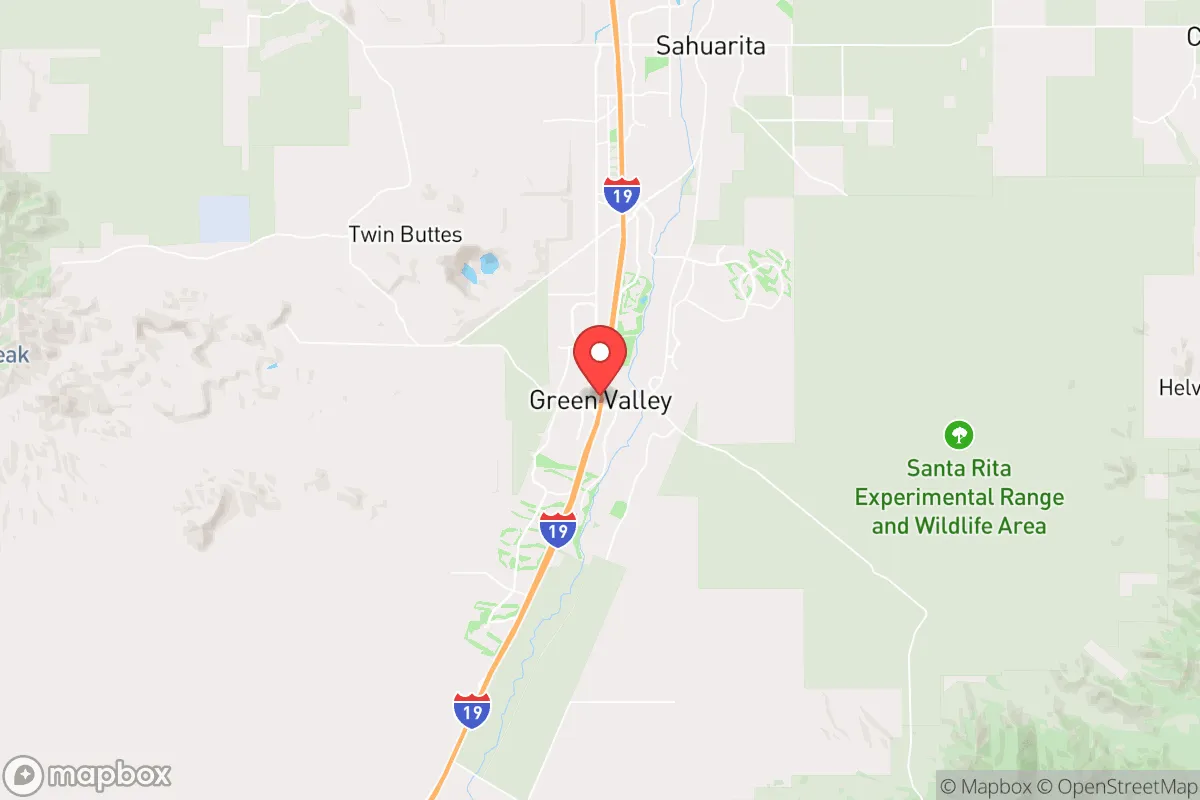
Photo: Wikipedia
Personal Sovereignty in Green Valley, AZ
Viable for self-reliance. Generally workable, though some barriers may limit total independence.
What does Personal Sovereignty tell us?
Personal Sovereignty measures your capacity for self-reliance and independence with minimal government friction. Higher scores mean fewer barriers between you and the way you want to live... but it assumes you have the space you need and good neighbors.
What does this tell us?
Personal Sovereignty measures your capacity for self-reliance and independence with minimal government friction. Higher scores mean fewer barriers between you and the way you want to live... but it assumes you have the space you need and good neighbors.
State Policy
Energy independence: Importer (20% of energy produced in-state)
Personal Liberty
Homesteading

Personal Liberty Analysis
Green Valley, Arizona, offers one of the strongest personal sovereignty environments in the Sun Belt, combining Arizona’s constitutional protections with a uniquely light-touch local regulatory culture. The community’s unincorporated status within Pima County means no city council dictates land use, and the state’s preemption laws keep local ordinances from layering on top of state statutes. For a relocation researcher, the key takeaway is that Green Valley delivers a high degree of individual autonomy with minimal municipal interference, though residents trade some local control for county-level governance.
How the tax burden and regulatory posture compare to nearby metro areas
Arizona’s overall tax climate ranks among the most favorable in the nation, and Green Valley benefits directly from that structure. The state levies a flat income tax rate of 2.5% — down from a progressive system that topped out at 4.5% just a few years ago — and Pima County’s combined sales tax rate sits at 8.7%, which is moderate for the region. Property taxes are the real standout: Arizona’s average effective property tax rate is approximately 0.62% of home value, and Green Valley’s unincorporated status means no additional city property tax layer. A $400,000 home in Green Valley carries an annual property tax bill of roughly $2,480, compared to a comparable home in Tucson proper at around $2,900 or a Phoenix-area home at $3,200.
The regulatory posture is decidedly light-touch. Arizona is a right-to-work state with no state-level minimum wage beyond the federal floor, and Pima County does not impose county-specific business licensing on most home-based operations. The state’s regulatory sandbox approach means that starting a small business — a common pursuit among Green Valley’s active adult population — requires minimal paperwork. One notable regulatory advantage: Arizona has no state-level capital gains tax separate from income tax, and no estate tax, which matters for retirees and second-home owners. The county’s zoning code is permissive in unincorporated areas, with most residential parcels in Green Valley zoned for single-family use without the overlay districts common in incorporated municipalities.
Self-defense law and gun rights specifics in Arizona
Arizona is a constitutional carry state, meaning no permit is required to carry a firearm openly or concealed for anyone legally allowed to possess one. This has been the law since 2010, and Green Valley residents enjoy the full scope of those protections. The state’s self-defense statute provides a strong Castle Doctrine and Stand Your Ground provision — there is no duty to retreat anywhere you are legally present, including public spaces. Arizona Revised Statute 13-418 explicitly protects individuals who use force in self-defense from civil liability, which is a meaningful legal shield that many other states lack.
For practical purposes, Green Valley’s gun culture is active but not aggressive. The area has several shooting ranges within a 20-minute drive, including the Tucson Rifle Club and the Pima County Shooting Range at Three Points. Firearm purchases from private sellers require no background check under state law, though federal checks apply at licensed dealers. Arizona does not require firearm registration, and there is no waiting period for purchases. Magazine capacity is unrestricted, and suppressors are legal with federal paperwork. One caveat: Pima County does enforce a 1,000-foot school zone restriction on carrying, though this mirrors federal law and is rarely an issue in practice.
Self-reliance and homesteading viability: lot sizes, zoning, and off-grid feasibility
Green Valley’s residential character is primarily master-planned retirement communities with HOA covenants, which constrains some homesteading ambitions. Standard lots in communities like Quail Creek and Canoa Ranch range from 6,000 to 12,000 square feet, and HOAs typically restrict livestock, large gardens, and exterior modifications. However, the surrounding unincorporated areas — particularly Sahuarita to the east and the Green Valley outskirts toward Arivaca — offer genuine homesteading opportunities. Pima County zoning allows agricultural use on parcels of one acre or more in the Rural Homestead zone, and several listings in the area feature 2.5 to 5-acre parcels with existing wells.
Off-grid feasibility is genuinely viable here, more so than in most Arizona communities. The region receives over 300 days of sunshine annually, and Pima County does not require grid connection for new construction on rural parcels. Solar installation is straightforward — Arizona has net metering policies, and the county issues permits for off-grid solar systems without the bureaucratic hurdles common in California or Colorado. Water is the critical constraint: the area sits over the Santa Cruz aquifer, and new wells require a permit from the Arizona Department of Water Resources, with drilling costs running $15,000 to $25,000 for a typical residential well. Rainwater harvesting is encouraged and, in some county zones, required for new construction. Septic systems are standard, and Pima County’s permitting process for septic is straightforward, typically taking 2-4 weeks.
Personal liberties: parental rights, medical autonomy, speech, and property
Arizona’s legal framework provides strong protections for parental rights. The state’s parental rights statute (ARS 1-601) explicitly recognizes parents’ fundamental right to direct their children’s education, healthcare, and religious upbringing. Green Valley’s school-age population is small — most residents are retirees — but the nearby Sahuarita Unified School District operates under state open enrollment laws, and homeschooling requires only a simple affidavit filed with the county school superintendent. No curriculum approval is required, and there are no state-mandated assessments for homeschooled students.
Medical autonomy is a mixed picture. Arizona has no state-level vaccine mandate, and the 2021 law (HB 2498) prohibits employers from requiring COVID-19 vaccination without allowing exemptions. However, the state does not have a Right to Try law as expansive as some neighboring states, and medical marijuana is legal under Proposition 207 with a 25-mile dispensary radius from Green Valley — the nearest is in Sahuarita. Recreational cannabis is legal for adults 21 and over. The state’s conscience clause protects healthcare providers who decline to participate in procedures they object to, which matters for those seeking faith-aligned care.
Free speech protections are robust. Arizona has no state-level hate speech law that restricts expression, and the state’s public meeting laws ensure government transparency. Property rights are strongly protected under Arizona’s Proposition 207 (2006), which requires government to compensate landowners for regulatory takings that reduce property value by more than 20%. This is one of the strongest private property protections in the nation and a meaningful consideration for anyone planning land improvements.
Overall, Green Valley’s sovereignty profile ranks in the top tier of U.S. communities for personal autonomy. The combination of constitutional carry, no state income tax on most retirement income, strong property rights protections, and permissive county zoning creates an environment where individuals can live largely on their own terms. The primary limitation is HOA governance in the master-planned communities — a trade-off that buyers can avoid entirely by choosing parcels in the surrounding unincorporated areas. Compared to similar Sun Belt destinations like Prescott or Tucson proper, Green Valley offers a lighter regulatory touch with the same state-level constitutional protections, making it a compelling choice for those prioritizing individual sovereignty in their relocation decision.

* Values derived from national, state, county, city and local statistics and may differ in a specific area. Last updated: 2026-10-13T01:03:45.000Z
Narrative content on this page is AI-generated and may contain mistakes. Verify any details that matter before acting on them.
ReloMaps may earn a commission from affiliate links at no extra cost to you.

