Photo: Wikipedia
Political ClimatePolitical Climate in Glastonbury, CT
District shown is the primary district for this city’s centroid. Cities may span multiple districts.
Local Political AnalysisPolitical Analysis of Glastonbury, CT
Glastonbury is a reliably Democratic town in a reliably Democratic state, but it leans further left than Connecticut as a whole: its Cook Partisan Voting Index of D+12 sits four points to the left of the state's D+8. In practice, that means a town of roughly 35,000 people on the east bank of the Connecticut River that votes for Democrats up and down the ballot, often by wider margins than the state average, while still sending plenty of unaffiliated voters to the polls — a group that makes up a large share of Glastonbury's registered electorate and decides most local races.
How it compares to surrounding towns
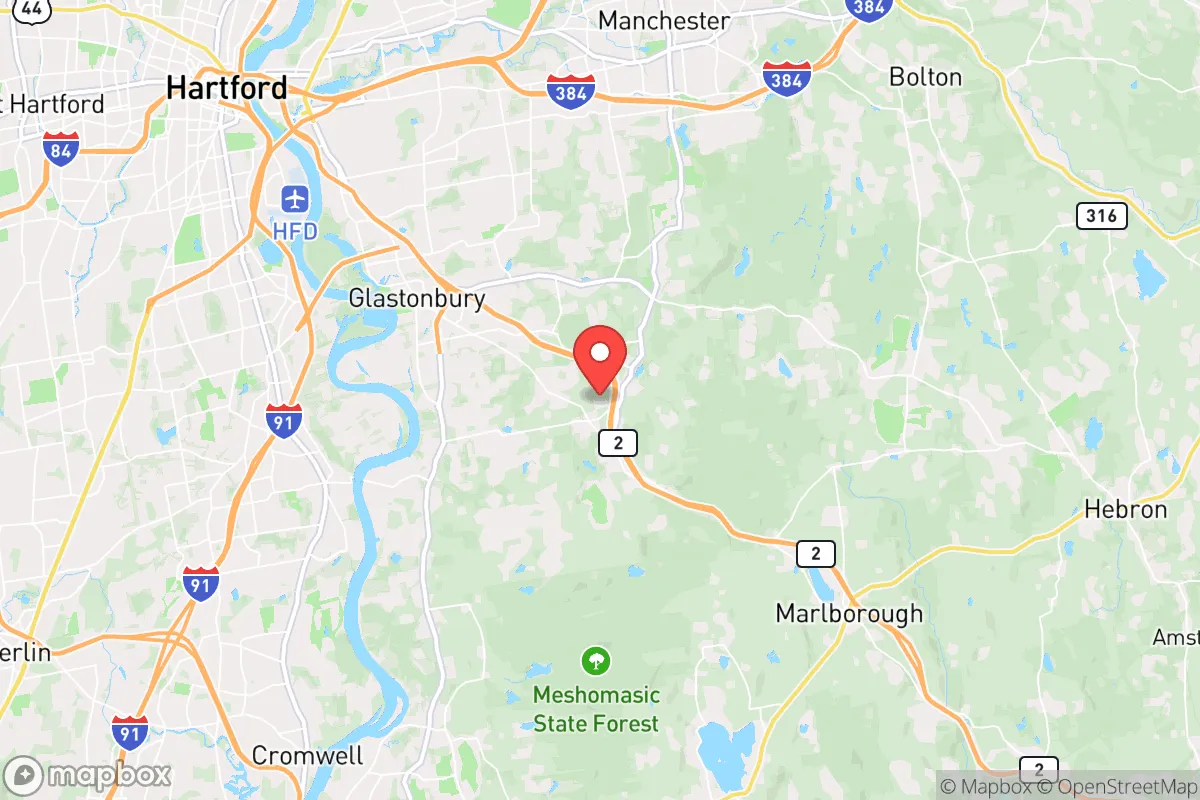
The political map around Glastonbury is more varied than the town's own numbers suggest. To the south, Rocky Hill and Wethersfield are solidly Democratic and track close to Glastonbury's lean. To the east, Marlborough and Hebron run noticeably redder — Hebron and the surrounding towns of the rural eastern highlands are among the more Republican-leaning communities in Hartford County. Manchester, just to the north, is a Democratic stronghold with a D+20-plus lean, while East Hartford is even more heavily Democratic. So Glastonbury sits in a transition zone: more Democratic than the rural towns to its east, less Democratic than Manchester or Hartford to its north and west. Compared with the state's D+8, Glastonbury's D+12 puts it in the same camp as Fairfield County's inner suburbs — affluent, college-educated, and trending Democratic in federal races while local politics stays focused on schools, zoning, and taxes.
What this means for residents
For liberal residents, Glastonbury is comfortable ground: Democratic candidates for state legislature and Congress typically carry the town, and local boards have generally reflected that. For conservative residents, the reality is more nuanced than the PVI suggests. Town elections are officially nonpartisan in many races, and the town's large unaffiliated bloc means a Republican can win a Board of Education or Town Council seat on local issues — school spending, development, road maintenance — without the national headwind being decisive. In practice, conservatives in Glastonbury are outnumbered in federal races but not shut out locally, and the town's politics tend to be managerial rather than ideological.
The cultural and policy distinctions matter too. Glastonbury's politics are shaped less by national party conflict than by land-use fights — the town has wrestled with affordable housing under Connecticut's 8-30g statute, which allows developers to bypass local zoning when a town falls short of the state's affordable-housing threshold. That issue cuts across party lines and has driven more local engagement than any federal race. Looking ahead, the town's trajectory looks stable: continued Democratic lean in state and federal contests, with local outcomes hinging on turnout among unaffiliated voters and how candidates handle growth, schools, and taxes. For anyone moving in, the practical takeaway is that Glastonbury is a left-leaning suburb where local politics still rewards pragmatism over partisanship.

State Political ClimatePolitical Climate in Connecticut
State Political AnalysisPolitical Environment in the State
Connecticut is a solidly Democratic state — Cook Political Report rates it D+8 — and it has been for a generation. Democrats hold every statewide constitutional office, both U.S. Senate seats (Richard Blumenthal and Chris Murphy), all five U.S. House seats, and veto-proof supermajorities in both chambers of the General Assembly. The last Republican to win a statewide federal race was Lowell Weicker in 1988, and the last Republican presidential candidate to carry Connecticut was George H.W. Bush in 1988. The coalition driving that dominance is concentrated: Hartford, New Haven, Bridgeport, and Stamford turn out huge Democratic margins that swamp the state's smaller, more conservative interior. The trajectory over 20 years has been one-directional — towns that were once competitive, like Fairfield and Trumbull in Fairfield County, have drifted blue, while the rural northwest has drifted harder red. If you're moving here from a red state, the honest framing is that your vote will matter less in state races than it did where you came from, but your local town government may still be genuinely competitive.
Urban vs. rural divide
The political map of Connecticut is essentially a ring: dense, Democratic cities and inner suburbs surrounded by a Republican-leaning rural and exurban perimeter. Hartford, New Haven, and Bridgeport are among the most Democratic cities in New England and drive the statewide result almost single-handedly. Fairfield County is the interesting middle — Greenwich and Darien remain reliably Republican at the local level and among the wealthiest GOP-leaning towns in the country, while Stamford and Norwalk have become solidly Democratic. The Naugatuck Valley — Waterbury, Derby, Ansonia — is the state's classic swing region: culturally conservative, heavily Catholic, historically union-Democrat, and now genuinely up for grabs. Litchfield County in the northwest is the reddest corner of the state, and the small towns of eastern Connecticut like Killingly and Brooklyn have become flashpoints over school and library policy. The state's 169 towns each run their own government, so local politics varies enormously — you can live in a town that votes Republican for first selectman while your state senator is a Democrat.
Policy environment
Connecticut is a high-tax, high-regulation state with a strong public-sector footprint. It has no county government, which keeps local control unusually granular. The income tax is graduated, topping out around 6.99%, and the state has one of the highest per-capita property tax burdens in the country because towns fund schools almost entirely through the grand list. The 2017 state budget crisis and subsequent fiscal guardrails — a constitutional spending cap and volatility cap — have stabilized finances but constrained new spending. Education is heavily state-regulated through the Connecticut State Department of Education, with a strong teachers' union presence (CEA) and a 2019 law requiring African American and Latino studies in public schools. Healthcare is generous: Medicaid expansion under the ACA, a state-based exchange (Access Health CT), and a 2021 public option law that never fully launched. On election law, Connecticut allows no-excuse absentee voting (approved by voters in 2022) but still requires a reason for early in-person voting except during a limited window; same-day registration exists. Gun law is among the strictest in the nation — an assault weapons ban, magazine limits, red flag law, and a 2023 open-carry restriction.
Recent policy direction
The last several legislative sessions have moved Connecticut further in a progressive direction on social policy while staying cautious on taxes. In 2022 the legislature passed a law expanding abortion protections and shielding providers from out-of-state lawsuits; in 2023 it passed one of the nation's stricter gun laws, banning open carry and tightening permit rules. Parental rights have become a live fight: a 2022 law allowing minors to access mental health care without parental consent drew intense Republican opposition, and school curriculum battles in towns like Killingly and Granby have drawn statewide attention. On speech and privacy, Connecticut has a strong free-speech tradition but also a 2022 law regulating online data privacy (the Connecticut Data Privacy Act). Property rights are generally secure, though the state's affordable-housing statute (8-30g) allows developers to override local zoning in towns that lack sufficient affordable units — a perennial source of local friction. On voting, the 2022 constitutional amendment on absentee voting and a 2023 law expanding early voting point toward easier ballot access. The overall direction is clear: socially liberal, fiscally cautious, and increasingly willing to use state law to override local resistance.
Civil unrest & political movements
Connecticut has a long history of organized labor and progressive activism — the state was a union stronghold in the 20th century and remains one today, with the CEA and SEIU among the most influential political players. On the right, the Tea Party wave of 2010 and the 2020 "Stop the Steal" movement both had visible presences, particularly in Litchfield County and the Naugatuck Valley, though neither produced sustained street movements. Immigration politics is a real flashpoint: Connecticut is a sanctuary state (a 2019 law limits cooperation with federal immigration enforcement), and ICE operations in Hartford and New Haven have drawn protests. The state has seen relatively little civil unrest compared to larger metros, but the 2020 George Floyd protests in Hartford and New Haven were large, and school-board meetings in towns like Killingly and Guilford have become genuinely contentious over curriculum and library books. Election integrity controversies have been limited — no serious fraud allegations have gained traction — but the 2020 and 2022 cycles saw organized "election audit" efforts in several towns. Secession or nullification rhetoric is essentially absent; this is not that kind of state.
Projection
Over the next 5-10 years, Connecticut is likely to remain Democratic at the statewide level, but the margins may narrow slightly as the state's population ages and out-migration continues. The state has lost population in recent years, particularly among younger and middle-income residents, and that trend — if it continues — could erode the Democratic advantage in the Naugatuck Valley and eastern Connecticut. At the same time, in-migration from New York and Massachusetts is bringing more progressive voters into Fairfield County and the Hartford suburbs, which could offset that. The realistic expectation is a state that stays blue but becomes more internally divided, with local politics in places like Waterbury, Meriden, and Killingly increasingly contested. On policy, expect continued movement on gun regulation, climate (the 2022 law requiring 100% carbon-free electricity by 2040), and housing (the 8-30g statute is likely to be expanded, not repealed). Taxes are unlikely to rise dramatically given the fiscal guardrails, but they are also unlikely to fall.
For a new resident, the practical takeaway is this: Connecticut is a high-tax, high-service, socially liberal state where your state-level vote will rarely be decisive but your local vote absolutely will be. If you're conservative, you'll find genuine community in Litchfield County, the Naugatuck Valley, and the eastern quiet corner — and you'll find that local government, zoning, and school boards are where your influence actually lives. If you're liberal, you'll find a state government that broadly aligns with you and a strong public-sector infrastructure. Either way, the state's fiscal constraints and aging population mean that services and taxes will be a live debate for the next decade, and the towns that manage that tension best — likely the ones with strong grand lists and moderate politics — are the ones worth watching.
* Values derived from national, state, county, city and local statistics and may differ in a specific area. Last updated: 2026-11-03T16:05:01.000Z
Narrative content on this page is AI-generated and may contain mistakes. Verify any details that matter before acting on them.
ReloMaps may earn a commission from affiliate links at no extra cost to you.

