
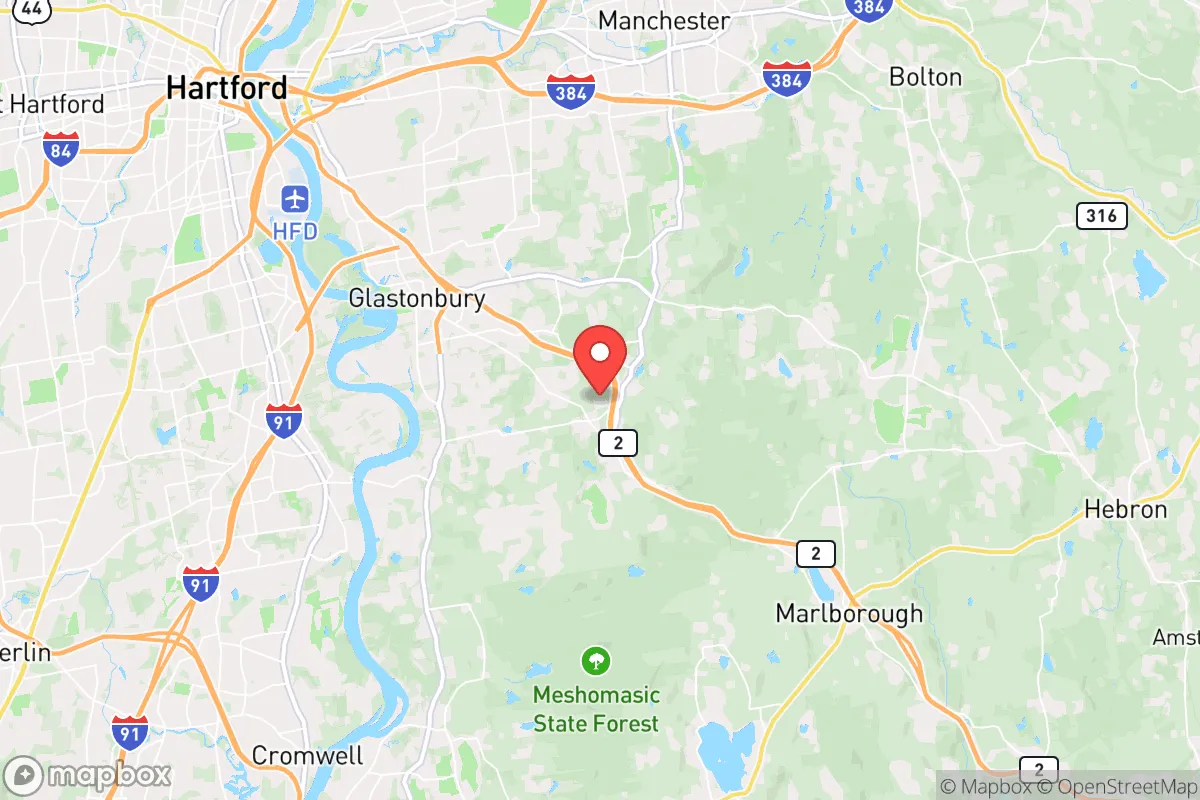
Photo: Wikipedia
Personal Sovereignty in Glastonbury, CT
Viable for self-reliance. Generally workable, though some barriers may limit total independence.
What does Personal Sovereignty tell us?
Personal Sovereignty measures your capacity for self-reliance and independence with minimal government friction. Higher scores mean fewer barriers between you and the way you want to live... but it assumes you have the space you need and good neighbors.
What does this tell us?
Personal Sovereignty measures your capacity for self-reliance and independence with minimal government friction. Higher scores mean fewer barriers between you and the way you want to live... but it assumes you have the space you need and good neighbors.
State Policy
Energy independence: Importer (30% of energy produced in-state)
Personal Liberty
Homesteading

Personal Liberty Analysis
Glastonbury sits in Hartford County as one of Connecticut's wealthier suburbs — roughly 35,000 residents, median household income well above $120,000, and a regulatory posture that tracks closely with the state's overall approach: comparatively heavy on taxation and land-use oversight, moderate on firearms, and mixed on personal liberties depending on the issue. For a buyer or renter prioritizing personal sovereignty, Glastonbury is best understood as a high-amenity, high-cost, high-regulation town where autonomy is preserved most reliably in private financial decisions and least reliably in land use and property-level self-determination. It is not a low-friction jurisdiction, but it is also not the most restrictive in the state.
How heavy is the tax and regulatory burden in Glastonbury?
Connecticut consistently ranks among the highest-taxed states in the country, and Glastonbury reflects that baseline with a mill rate that has hovered in the low-to-mid 30s per $1,000 of assessed value in recent years — meaning a home assessed at $400,000 carries a property tax bill in the neighborhood of $13,000 to $14,000 annually before any motor vehicle or personal property levies. The state income tax tops out at 6.99%, the sales tax is 6.35%, and Connecticut is one of a handful of states that still imposes both an estate tax and a gift tax, a detail that matters to anyone thinking about generational wealth transfer. Regulatory overhead is real but not unusual for a New England suburb: building permits, inland wetlands approvals, zoning variances, and a fairly active Planning and Zoning Commission. Home-based businesses are permitted but subject to special permit review in many zones. The practical read is that Glastonbury is a jurisdiction where compliance costs are a line item you budget for, not an afterthought — the town is well-run and predictable, but it is not a place where you can build first and ask questions later.
What Connecticut's gun laws mean for self-defense in Glastonbury
Connecticut is a "may-issue" state in practice, though the permitting statute is technically shall-issue with a suitability standard that gives local issuing authorities — here, the Glastonbury Police Department — meaningful discretion. Residents must obtain a state pistol permit to purchase handguns or ammunition, complete a safety course approved by the Department of Emergency Services and Public Protection, and submit to fingerprinting and a background investigation that typically runs eight to twelve weeks. The state's assault weapons ban is one of the older and more expansive in the country, magazine capacity is capped at 10 rounds, and the 2013 post-Sandy Hook legislation added registration requirements for certain firearms classified as assault weapons. Connecticut does not recognize out-of-state permits, and open carry is legal only with a valid permit but is uncommon and socially discouraged in a town like Glastonbury. Castle doctrine exists in limited statutory form — there is no duty to retreat inside one's home — but Connecticut is not a stand-your-ground state in public spaces. For a self-defense-focused household, the operative reality is that lawful ownership is achievable but requires patience, paperwork, and strict compliance; the town itself adds no local ordinances beyond state law.
Is homesteading or off-grid living realistic in Glastonbury?
Largely no, and this is the sharpest constraint on self-reliance in town. Glastonbury's residential zoning is dominated by lots in the quarter-acre to one-acre range in the dense southern and central sections, with larger two-to-five-acre parcels concentrated in the northern and eastern rural edges toward East Glastonbury and the Meshomasic State Forest boundary. Even on those larger lots, the town enforces minimum lot sizes, setback requirements, and health code rules that effectively require connection to public water and sewer in most of the developed area — private wells and septic systems are permitted only where infrastructure doesn't reach. Backyard chickens are allowed under specific setback and coop requirements; livestock such as goats or horses generally require larger parcels and special review. Off-grid electrical systems face interconnection rules through Eversource and building code requirements for permitted solar and battery installations. Rainwater harvesting for potable use is heavily regulated under state public health code. The honest assessment: Glastonbury supports gardening, small-scale poultry, and permitted solar, but it is not a jurisdiction where you can legally pursue meaningful food or energy independence without significant capital and permitting effort. Households serious about homesteading typically look further east toward Coventry, Mansfield, or the Quiet Corner towns.
How personal liberties play out for Glastonbury families
Connecticut's parental rights framework is generally considered one of the more state-assertive in the country. The state requires school districts to provide instruction on certain topics, and while Connecticut does not mandate specific curricula at the town level, Glastonbury Public Schools — a well-regarded district — follows state frameworks closely. The state's 2022 update to its school health curriculum and its policies on student privacy have drawn attention from parents seeking more direct control over what their children are exposed to. Medical autonomy is a mixed picture: Connecticut does not mandate childhood vaccines for school attendance without a religious or medical exemption (the religious exemption was repealed in 2021 for schoolchildren, though it remains for some other settings), and the state's response to COVID-19 included some of the more sustained school and business restrictions in the region. On speech and property, Glastonbury is conventional suburban Connecticut — strong property rights in the sense of clear title and enforcement, but with meaningful regulatory encumbrance through zoning, wetlands, and historic district review in the town center. Firearms storage, short-term rental regulation, and accessory dwelling unit rules have all seen local attention in recent years, generally trending toward more oversight rather than less.
Weighed against the broader national landscape, Glastonbury lands in the middle-to-heavy end of the sovereignty spectrum: high tax burden, meaningful regulatory friction on land and property use, moderate firearms access, and a state government inclined toward prescriptive policy on family and health matters. It compares unfavorably on autonomy metrics to low-tax, low-regulation states in the South and Mountain West, and even to neighboring towns in eastern Connecticut with larger lots and lighter zoning. What it offers in exchange is a well-administered town, strong schools, low crime, and predictable institutions — a trade many families accept. For a reader whose priority is maximizing personal independence, Glastonbury is a place to visit for its amenities and to weigh carefully before committing, not a jurisdiction to choose on sovereignty grounds alone.

* Values derived from national, state, county, city and local statistics and may differ in a specific area. Last updated: 2026-11-03T16:05:01.000Z
Narrative content on this page is AI-generated and may contain mistakes. Verify any details that matter before acting on them.
ReloMaps may earn a commission from affiliate links at no extra cost to you.

