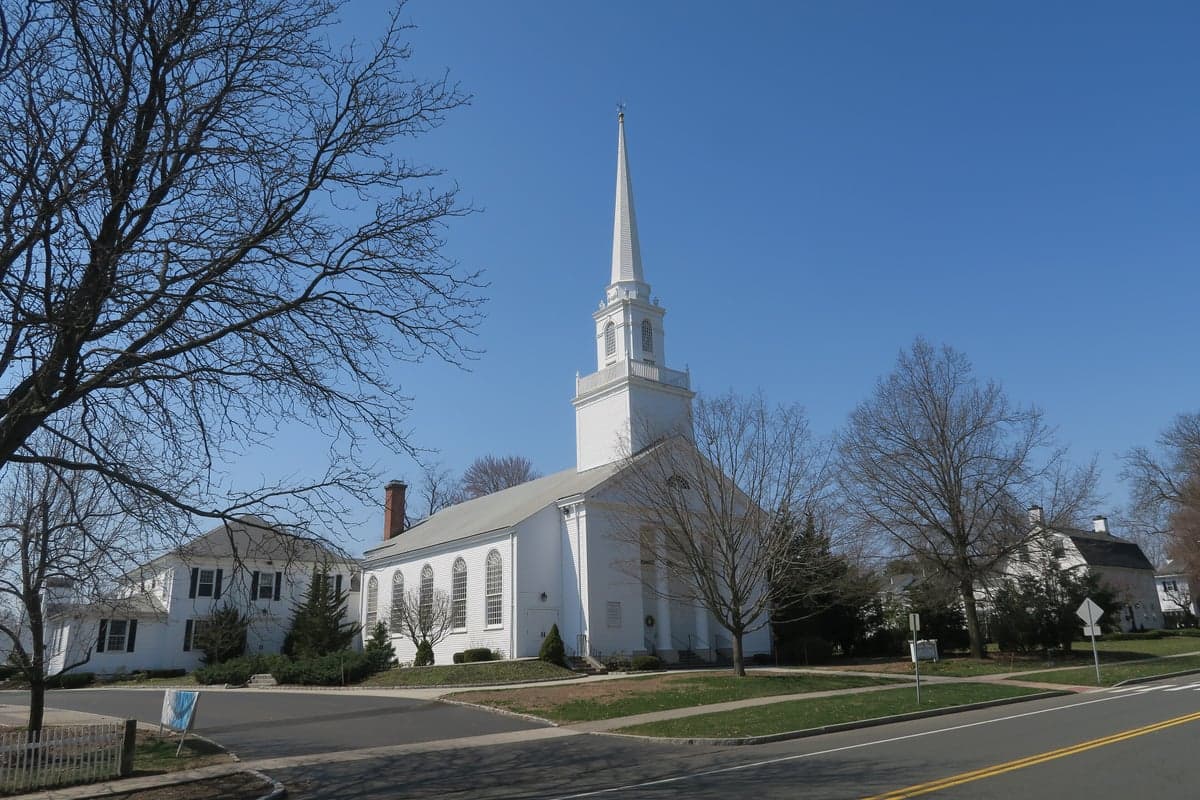
Photo: Wikipedia
Demographics of Glastonbury, CT
Affluence Level in Glastonbury, CT
An upper-middle-class area. Household wealth, education levels, and homeownership run ahead of national benchmarks.
People of Glastonbury, CT
Glastonbury, Connecticut is a town of about 7,860 residents in Hartford County, and its population profile is unusually well-educated and largely white, with a small but growing Indian-subcontinent community. Nearly 69% of adults hold a college degree, and 79.6% of residents are white, while 6.6% are Indian, 5.2% Hispanic, 3.7% East/Southeast Asian, and 1.0% Black. Only 4.4% of residents are foreign-born, giving Glastonbury a demographic identity that is more rooted in long-settled New England stock than in the immigrant gateway patterns of larger cities.
How the town was settled and grew
Glastonbury was incorporated in 1693, settled by English colonists pushing south from Wethersfield along the Connecticut River's east bank. The town's early population clustered in what is now the South Glastonbury and Main Street historic districts, where fertile river-bottom land supported tobacco farming, one of the region's defining cash crops for more than two centuries. The Naubuc area near the river became an early industrial node, and by the 19th century Glastonbury was known for shipbuilding, woolen mills, and the J.B. Williams soap works. Through the 1800s and early 1900s, the population remained small and overwhelmingly Yankee, with modest Irish and later Italian and Polish arrivals drawn to mill work in Naubuc and the Welles Street corridor. The town stayed rural and lightly populated well into the 20th century, with the East Glastonbury and Hopewell sections remaining farm country.
Modern era (post-1965)
The Immigration and Nationality Act of 1965 reshaped the nation's demographics, but Glastonbury's transformation came less from immigration than from suburbanization. Between the 1960s and 1990s, Hartford's professional class moved outward, and Glastonbury's population roughly tripled as subdivisions spread across East Glastonbury, Hopewell, and the Addison area. The town's reputation for strong schools and low density made it a destination for white-collar families, and that legacy shows today in the 68.9% college-educated share. The foreign-born population remains just 4.4%, and the town's diversity is modest and uneven: the Indian-subcontinent community (6.6%) is the largest non-white group, concentrated among professional households drawn to Hartford-area employers in insurance, healthcare, and engineering. Hispanic residents (5.2%) and East/Southeast Asian residents (3.7%) are smaller presences, and the Black population (1.0%) is among the lowest in the region. Unlike Hartford or nearby Manchester, Glastonbury never developed a large immigrant enclave; its minority residents are dispersed across subdivisions rather than clustered in identifiable neighborhoods.
The future
Glastonbury's population is aging and growing slowly, and the demographic trajectory points toward modest, gradual diversification rather than rapid change. The Indian-subcontinent share is the most likely to expand, driven by the same professional migration that built the town's modern character, while white residents will likely remain a strong majority for decades. The town's low foreign-born rate and high education levels suggest that new arrivals will continue to be college-educated professionals rather than the immigrant working class that has reshaped other Connecticut cities. Growth will concentrate in the remaining developable parcels of East Glastonbury and along the Hebron Avenue commercial corridor, while the historic South Glastonbury and Naubuc districts will see turnover among older homeowners rather than new construction. The cultural identity is unlikely to shift dramatically: Glastonbury will probably remain a high-income, low-density, school-driven suburb with a small but visible Indian professional community and limited racial mixing at the neighborhood level.
For someone moving to Glastonbury now, the town offers a stable, well-educated, and demographically quiet environment — a place where the population is changing slowly and where the dominant story is continuity rather than reinvention. Families seeking strong schools and low density will find a community that is more homogeneous than the Connecticut average and likely to stay that way, while buyers hoping for a diverse, fast-evolving neighborhood culture should look elsewhere in the Hartford metro.

* Values derived from national, state, county, city and local statistics and may differ in a specific area. Last updated: 2026-11-03T16:05:01.000Z
Narrative content on this page is AI-generated and may contain mistakes. Verify any details that matter before acting on them.
ReloMaps may earn a commission from affiliate links at no extra cost to you.

