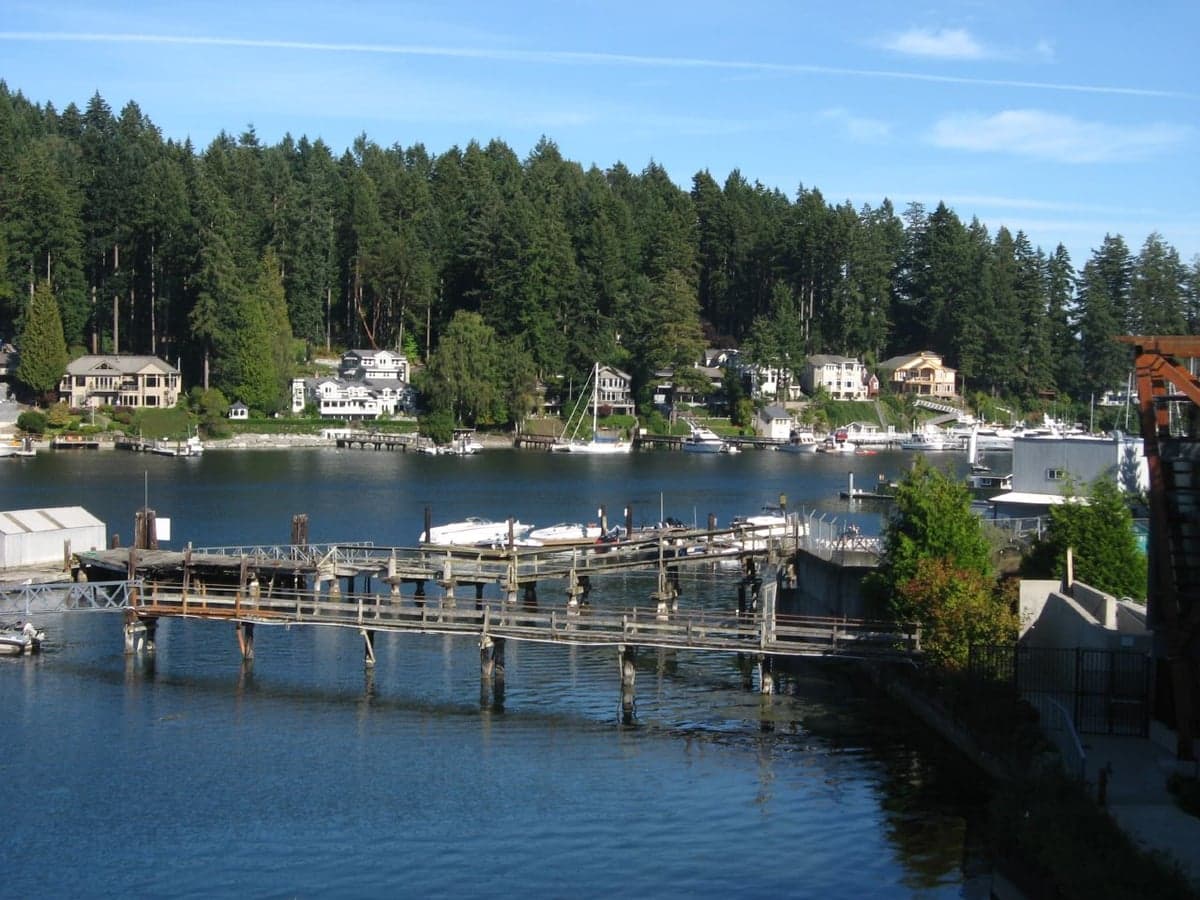
Photo: Wikipedia
Political ClimatePolitical Climate in Gig Harbor, WA
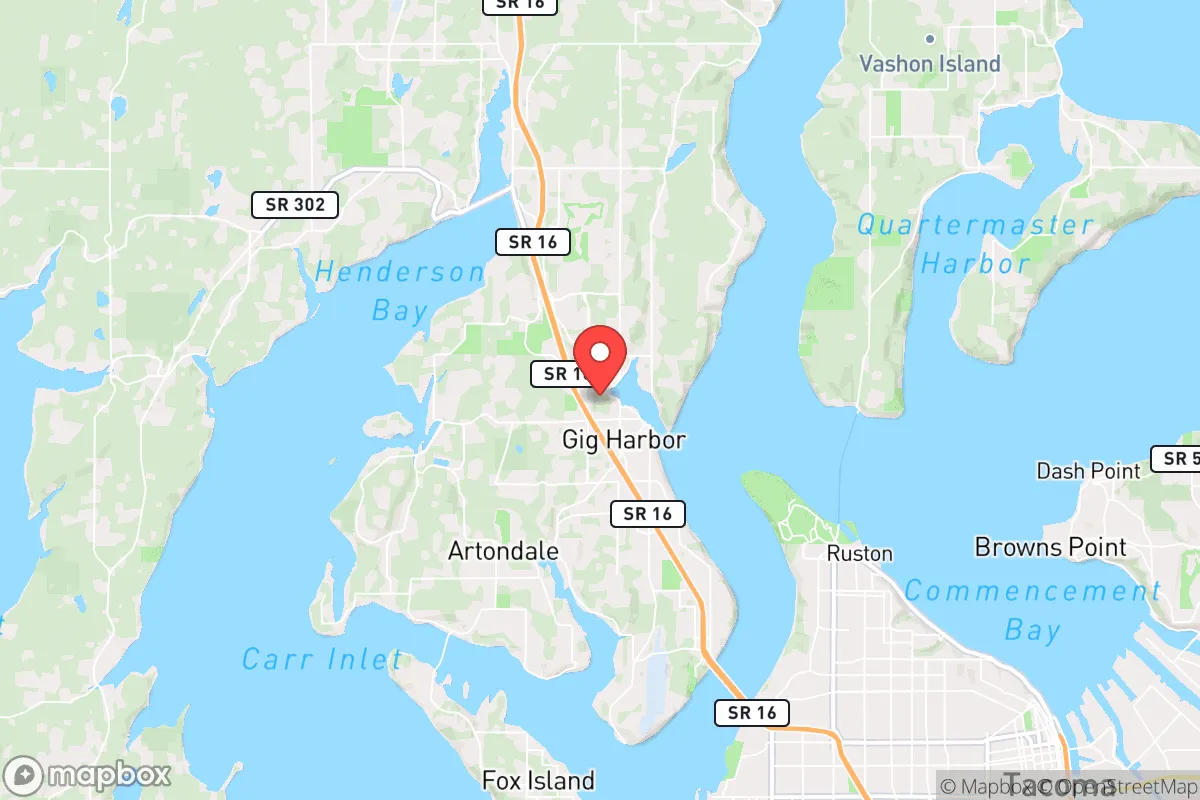
District shown is the primary district for this city’s centroid. Cities may span multiple districts.
* Lean and PVI are calculated from Gig Harbor, WA’s own 2020 presidential results (precinct returns summed to the city), with 2024 estimated from the surrounding county’s 2020–2024 shift, Cook-style. Sources: state election offices; VEST 2020 precinct results (CC BY 4.0).
Political rankings in Washington
- Most Conservative Cities in Washington
- Most Liberal Cities in Washington
- Best Conservative-Leaning Towns on the West Coast
- Best Conservative-Leaning Towns in the Pacific Northwest
- Most Affordable Liberal-Leaning Small Towns in the U.S.
- Safest Liberal-Leaning Cities in the U.S.
- Most Conservative Counties in Washington
- Most Liberal Counties in Washington
Local Political AnalysisPolitical Analysis of Gig Harbor, WA
Gig Harbor leans to the right of its surrounding county, but the broader political reality is that it sits inside a reliably Democratic state. The area’s Cook Partisan Voting Index (PVI) of D+10 reflects the statewide trend, but local voting patterns tell a more nuanced story. In recent presidential elections, Pierce County has voted Democratic by margins of 10 to 15 points, yet Gig Harbor itself often runs 5 to 8 points more Republican than the county as a whole. That gap has narrowed slightly since 2020, as new arrivals from King County and California have nudged the city’s politics a few points leftward, but it remains a place where you’ll see as many Trump signs as Harris signs in a given neighborhood.
How it compares
Compared to Washington state as a whole, Gig Harbor is noticeably more conservative on fiscal and land-use issues. The state’s Democratic supermajority in Olympia has pushed through policies like a capital gains tax and stricter growth-management rules, both of which draw vocal opposition in Gig Harbor. Neighboring towns like Tacoma (D+18 PVI) and University Place lean heavily Democratic, while rural areas east of the Narrows Bridge—like Purdy and Key Peninsula—vote more Republican than Gig Harbor does. The city itself is a kind of political buffer zone: retirees and long-time residents tend to vote Republican on taxes and development, while younger families and remote workers often split tickets or vote Democratic on social issues. The result is a community where a city council race can turn on a few hundred votes, and where the local Republican and Democratic clubs both hold well-attended monthly meetings.
What this means for residents
For conservative residents, Gig Harbor offers a relatively friendly environment compared to Seattle or even Tacoma. You’ll find active Republican precinct committee officers, a strong local chamber of commerce that pushes back on new regulations, and a school board that has debated curriculum transparency. For liberal residents, the city is not hostile—most neighbors keep politics private—but you won’t find the same density of progressive organizing as in downtown Tacoma. Practical effects: property tax levies for schools and parks usually pass, but by slim margins. The city’s growth plan, which limits density in the historic waterfront district, reflects a cautious, property-rights-oriented ethos that frustrates developers but pleases many homeowners. Gun laws are a live issue: Washington’s 2023 ban on certain semiautomatic rifles is widely ignored in Gig Harbor gun shops, and local law enforcement has said they won’t actively enforce it.
Culturally, Gig Harbor feels more like a small town than a suburb of a major metro. The political divide shows up most clearly in local debates over the new city hall project and the proposed expansion of the Cushman Trail system—both of which have been delayed by arguments over cost and environmental impact. Long-time residents will tell you that the city used to be a solidly Republican enclave where Democrats were rare; now, they’re common enough that neither side dominates a city council meeting. The trajectory points toward a slow, steady drift leftward, driven by in-migration from bluer areas, but Gig Harbor’s geography—separated from Tacoma by the Narrows Bridge—keeps it insulated from the most aggressive progressive policies. For the next decade, expect it to remain a purple pocket in a blue state, where the real fights are over local land use and school funding, not national culture wars.

State Political ClimatePolitical Climate in Washington
State Political AnalysisPolitical Environment in the State
Washington State has been a reliably Democratic stronghold for over a decade, with the party controlling the governorship, both U.S. Senate seats, and both chambers of the state legislature since 2012. The state’s overall partisan lean is roughly D+8 to D+10 in presidential elections, but this masks a deep and widening urban-rural chasm. The trajectory over the past 20 years has been a steady march leftward, driven by explosive growth in the Seattle metro area and the Puget Sound corridor, while much of Eastern Washington has grown more conservative in response.
Urban vs. rural divide
The political map of Washington is essentially two states. The western third, anchored by the Seattle-Tacoma-Bellevue metroplex, King County alone delivers about a third of the state’s total vote and consistently votes 70-75% Democratic. Seattle, Redmond, and Bellevue are the engine of the state’s progressive politics, with high concentrations of tech workers, young professionals, and union households. Moving south, Tacoma and Olympia are also reliably blue, though with a more working-class, union flavor. The I-5 corridor from Everett to Olympia is the Democratic heartland. In contrast, the eastern half of the state is overwhelmingly Republican. Spokane, the largest city east of the Cascades, is a purple-to-red city that has trended right in recent cycles, while its surrounding suburbs and rural areas are deep red. Yakima and the Tri-Cities (Kennewick, Pasco, Richland) are conservative strongholds, with agriculture and energy driving a more libertarian-leaning Republicanism. The rural counties of Ferry, Stevens, Pend Oreille, and Garfield routinely vote 75-80% Republican. The divide is so stark that the 4th Congressional District (central Washington) is one of the most Republican districts in the nation, while the 7th (Seattle) is one of the most Democratic. A few suburbs like Vancouver (across from Portland) and Bellingham (near the Canadian border) have flipped from purple to solid blue over the past decade, reflecting the broader trend of college-educated, suburban voters moving left.
Policy environment
Washington’s policy environment is defined by a progressive tax structure and a heavy regulatory hand. The state has no personal income tax, relying instead on a high sales tax (state rate 6.5%, with local add-ons pushing it to 9-10% in many cities) and high property taxes. This is a key selling point for conservatives, but the trade-off is that the state is one of the most aggressive in the nation on business regulation, environmental rules, and labor laws. The state has a strong public-sector union presence, a $16.28 minimum wage (indexed to inflation), and a paid family and medical leave program funded by payroll deductions. Education policy is a flashpoint: the state has a “paramount duty” clause in its constitution to fund K-12, but school choice is virtually nonexistent, with no voucher or charter school programs of any significance. Healthcare is dominated by the state’s own exchange, Washington Healthplanfinder, which operates under the ACA. Election laws are among the most accessible in the nation: all elections are conducted by mail, with ballots automatically sent to every registered voter. Voter registration is same-day, and there is no voter ID requirement beyond a signature match. This is a point of pride for progressives and a source of concern for conservatives who worry about ballot security.
Recent policy direction
The last five years have seen a rapid acceleration of progressive legislation. In 2021, the state passed a capital gains tax on high earners (over $250k in gains), which was upheld by the state Supreme Court in 2023, effectively creating a new income tax by another name. On gun policy, the state enacted a ban on “assault weapons” (defined by features) in 2023, a ban on high-capacity magazines, and a requirement for a 10-day waiting period and safety training for all firearm purchases. A 2024 law requires a permit to purchase any semi-automatic rifle. Self-defense law is relatively restrictive: there is no “stand your ground” statute, and the duty to retreat applies outside the home. On education and parental rights, the state has moved in the opposite direction of many red states: it passed a law in 2023 requiring all public schools to provide “comprehensive sexual health education” starting in kindergarten, and it has strong anti-discrimination protections for LGBTQ+ students. Parental notification for gender-affirming care is not required, and the state has become a “sanctuary” for minors traveling from other states for such care. On privacy and surveillance, the state passed the Washington Privacy Act in 2021, giving consumers rights over their data, but law enforcement access to cell-site simulators and facial recognition is regulated but not banned. On property rights, the state’s Growth Management Act heavily restricts development in rural areas, and a 2023 law effectively ended single-family zoning in most cities, allowing duplexes and fourplexes in formerly single-family neighborhoods. The state has also moved to protect abortion access, codifying it into law in 2023 and creating a shield law for providers who treat out-of-state patients.
Civil unrest & political movements
Washington has a visible history of political activism, particularly on the left. The 2020 protests in Seattle, including the Capitol Hill Autonomous Zone (CHAZ), were a national flashpoint, though they were short-lived and widely criticized even within the city. Since then, organized left-wing activism has focused on housing, police reform, and climate policy. The state’s sanctuary status (dating to 2019) means local law enforcement does not cooperate with federal immigration enforcement, and “ICE out” protests are common in Seattle and Olympia. On the right, the Washington State Republican Party has struggled to gain traction, but grassroots conservative movements are strong in Eastern Washington. The “Three Percenters” and other militia-adjacent groups have a presence in rural counties, and there have been periodic standoffs over land use and federal authority. Election integrity has been a persistent issue: after the 2020 election, Republican activists filed multiple lawsuits challenging the mail-in ballot system, all of which were dismissed. The state’s all-mail voting system remains a point of contention, with conservatives arguing it is vulnerable to fraud and progressives defending it as convenient and secure. A new resident in Seattle or Olympia would see frequent protests on the state capitol grounds, while a resident in Spokane or Yakima would see more conservative rallies and gun rights demonstrations.
Projection
Over the next 5-10 years, Washington is likely to continue its leftward drift, but at a slower pace. In-migration from California and other high-cost states is a major factor: many newcomers are tech workers and professionals who lean Democratic, but a significant number are also retirees and remote workers seeking lower taxes and more space, who may be more moderate or libertarian. The growth of Spokane and the Tri-Cities as affordable alternatives to the west side could slowly shift the balance in Eastern Washington, but not enough to flip the state. The state’s Democratic supermajority in the legislature is likely to hold, but internal divisions between the Seattle progressive wing and more moderate Democrats from the suburbs and the east side may slow the pace of new legislation. The capital gains tax will likely be expanded, and a full income tax remains a long-term possibility, though politically difficult. Gun laws will continue to tighten, with potential for a permit-to-purchase requirement for all firearms and a ban on open carry. The state’s housing crisis will force more state intervention in local zoning, which will be a major political battleground. For a conservative relocator, the bottom line is that Washington will remain a blue state with a growing regulatory and tax burden, but with significant geographic and cultural refuges in the eastern half of the state.
For a new resident, the practical takeaway is that Washington offers a stark choice depending on where you land. If you move to Seattle or the I-5 corridor, you will be in a deep-blue, high-cost, heavily regulated environment where your vote is unlikely to change the outcome. If you move to Spokane, the Tri-Cities, or a rural county east of the Cascades, you will find a more conservative, lower-cost, and less regulated lifestyle, but you will still be subject to state-level policies you may disagree with. The state’s lack of an income tax is a real benefit, but it comes with high sales and property taxes and a regulatory climate that can be frustrating for small business owners and gun owners. The best advice is to visit both sides of the state, talk to locals, and understand that Washington is not a monolith—it’s two states in one, and your experience will depend entirely on which one you choose to call home.
* Values derived from national, state, county, city and local statistics and may differ in a specific area. Last updated: 2026-11-15T00:00:33.000Z
Narrative content on this page is AI-generated and may contain mistakes. Verify any details that matter before acting on them.
ReloMaps may earn a commission from affiliate links at no extra cost to you.

