
Photo: Wikipedia
Political ClimatePolitical Climate in Oconee County
Showing district-level results — no local-only data available.
Local Political AnalysisPolitical Analysis of Oconee County
Oconee County, Georgia, is one of the most reliably Republican counties in the state, with a Cook Partisan Voting Index (PVI) of R+11, meaning it votes about 11 points more Republican than the national average. This isn't a recent shift—the county has been a GOP stronghold for decades, and the trend has only intensified as metro Atlanta's growth has pushed conservative-leaning families eastward from Athens and Atlanta. In the 2024 presidential election, Oconee County delivered roughly 72% of its vote to the Republican candidate, a margin that puts it well to the right of even the broader Georgia state average, which has become a competitive swing state in recent cycles.
How it compares to Georgia as a whole
Georgia as a state has a Cook PVI of R+3, reflecting its status as a true battleground—narrowly decided in both the 2020 and 2024 presidential elections. Oconee County's R+11 rating makes it significantly more conservative than the state as a whole. To put that in perspective, while Georgia's statewide races are often decided by 1-2 points, Oconee County routinely votes for Republican candidates by 20-30 point margins. This means that a Republican running statewide can count on Oconee as a reliable base of support, while a Democrat would need to run up huge margins in metro Atlanta's core counties (like DeKalb and Fulton) to offset the GOP advantage here. The county's politics align more closely with neighboring conservative strongholds like Barrow County or Walton County than with the state's overall purple hue.
What this means for residents
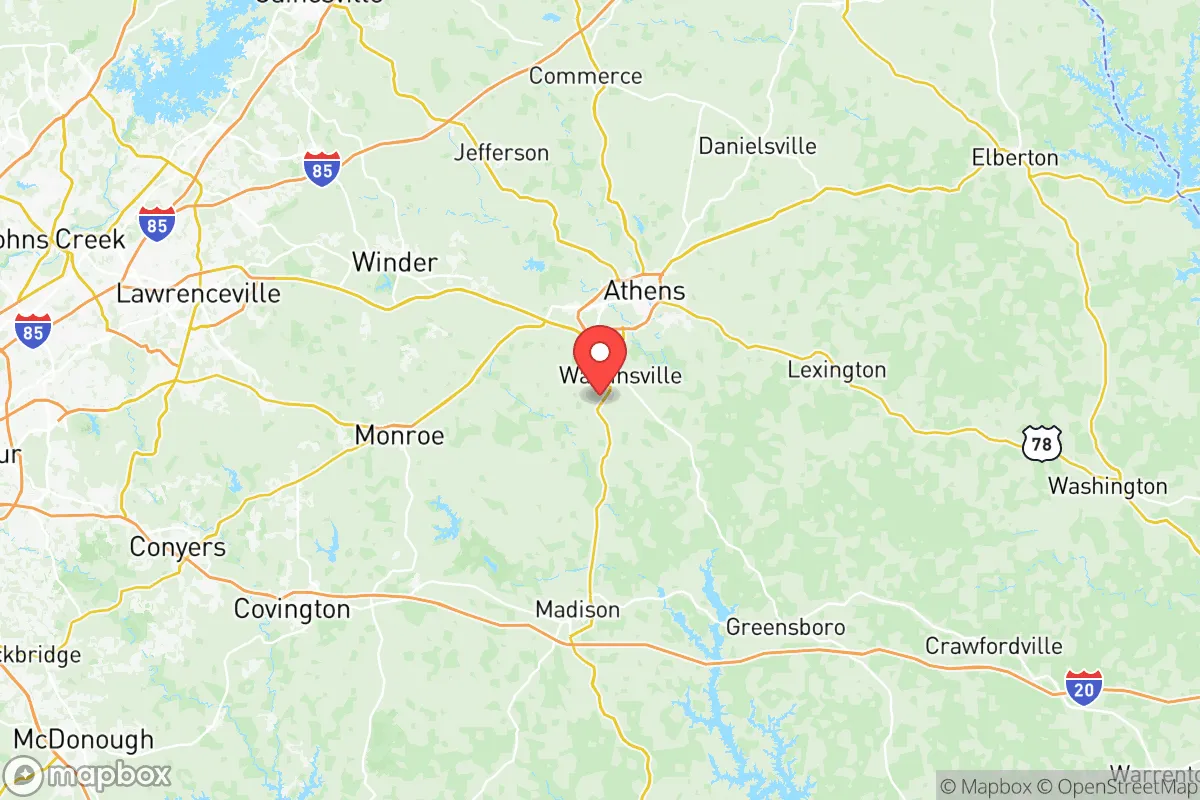
For conservative residents, Oconee County offers a political environment where their views are the clear majority. Local elected offices—from the Board of Commissioners to the school board—are overwhelmingly held by Republicans, and policy decisions tend to reflect conservative priorities on taxes, development, and education. The county has resisted some of the more progressive zoning and housing policies seen in Athens-Clarke County just to the west. For liberal residents, the reality is different: they are a distinct minority, and local elections rarely feature competitive Democratic candidates. However, the proximity to Athens (home to the University of Georgia) provides a nearby outlet for progressive politics and cultural amenities. There is no significant "blue island" within Oconee County itself—even the town of Watkinsville, the county seat, votes reliably Republican, though its precincts tend to be slightly less conservative than rural areas like Bishop or Bogart.
Culturally, Oconee County's politics translate into a few tangible distinctions. The county has a strong "home rule" ethos, with local leaders often pushing back against state mandates they see as overreach, particularly on land use. Property taxes are relatively low compared to neighboring Clarke County, and the school system (Oconee County Schools) is consistently ranked among the top in Georgia—a point of pride that transcends party lines. The county's rapid growth has brought some tension between long-time residents who want to preserve its rural character and newcomers who favor more development, but this debate largely plays out within a conservative framework. Looking ahead, as the Atlanta exurban sprawl continues to push east, Oconee County's political lean is likely to remain solidly red, though the specific flavor of conservatism may shift from agrarian to suburban as the population grows.

State Political ClimatePolitical Climate in Georgia
State Political AnalysisPolitical Environment in the State
Georgia has transformed from a reliably Republican stronghold into the nation’s most competitive swing state, with a partisan lean that now tilts just barely right-of-center — Joe Biden won it by 0.23% in 2020, and Donald Trump lost it by 1.2% in 2024. The dominant coalition is a classic Sun Belt mix: fast-growing, diverse metro Atlanta suburbs that lean Democratic, pitted against a deeply conservative exurban, small-town, and rural base that stretches from the North Georgia mountains to the Wiregrass. Over the past 20 years, the state has shifted from a safe +15-point GOP state to a true battleground, driven by explosive population growth in the Atlanta region, an influx of out-of-state transplants, and rising turnout among Black, Hispanic, and Asian voters. If you’re moving here, you’re landing in a place where your vote actually matters — and where the political temperature is rising accordingly.
Urban vs. rural divide
The political map of Georgia is a story of two Georgias. Metro Atlanta — specifically the core counties of Fulton, DeKalb, Cobb, Gwinnett, and Clayton — now delivers roughly 60% of the state’s Democratic votes. Gwinnett County, once a GOP bastion, flipped blue in 2016 and has only deepened since; in 2024, Kamala Harris carried it by 18 points. Meanwhile, rural and small-town Georgia remains overwhelmingly Republican. Counties like Murray, Gilmer, and Union in the north regularly vote 80%+ GOP, as do the vast agricultural counties of the southwest, like Colquitt and Thomas. The real battlegrounds are the exurban “donut” counties around Atlanta — Cherokee, Forsyth, Paulding, and Henry — where fast growth and demographic change are slowly eroding GOP margins. Forsyth County, once infamous for being 98% white and deeply conservative, is now 30% non-white and voted for Trump by only 12 points in 2024, down from 40 points in 2012. Outside Atlanta, the only other Democratic-leaning areas are the Black Belt counties of the central and eastern part of the state (like Hancock, Macon, and Taliaferro), and the cities of Savannah, Augusta, Columbus, and Macon — each a blue island in a red sea.
Policy environment
Georgia’s policy environment is a study in contrasts: a low-tax, business-friendly posture combined with a culturally conservative social framework. The state has a flat income tax rate of 5.39% (down from 5.75% in 2024, with a path to 4.99% by 2029), and no state-level estate or inheritance tax. Property taxes are locally set and generally moderate, though they vary wildly — Fulton County’s effective rate is about 1.2%, while rural counties like Dooly are under 0.6%. Sales tax is 4% state plus local options, topping out around 8.9% in Atlanta. On education, Georgia has a robust school choice system: the Georgia Promise Scholarship Act (2024) provides $6,500 per student for private school or homeschooling expenses, and the state has 10 charter school authorizers. Healthcare policy is mixed: the state did not expand Medicaid under the ACA, leaving roughly 300,000 low-income adults in the coverage gap, but it has a strong telehealth law and a certificate-of-need (CON) system that keeps hospital competition limited. Election laws are a flashpoint: the 2021 SB 202 (the “Election Integrity Act”) added voter ID requirements for absentee ballots, limited drop boxes, and banned mobile voting centers. Georgia also has a “stand your ground” self-defense law (2014), constitutional carry (2022), and a six-week abortion ban (HB 481, 2019) that took effect after Dobbs.
Recent policy direction
The last five years have seen Georgia lurch rightward on cultural issues while maintaining its pro-business posture. On guns, the 2022 passage of constitutional carry (SB 319) means no permit is needed to carry a concealed firearm — a major win for Second Amendment advocates. On education, the 2024 Georgia Promise Scholarship Act and the 2022 “Parents’ Bill of Rights” (SB 449) give parents explicit authority over their child’s medical decisions and curriculum objections. On speech and privacy, the state has no broad data privacy law (unlike California or Virginia), but it does have a 2023 law (HB 133) banning TikTok on government devices and a 2024 law (SB 394) restricting foreign ownership of agricultural land. On medical and bodily autonomy, the six-week abortion ban is among the strictest in the nation, with no exceptions for rape or incest — only for life of the mother or fatal fetal anomaly. Property rights are strong: Georgia is a “right-to-farm” state with strong agricultural protections, and it has no statewide rent control (preempted by law). On voting, SB 202 also made it a crime to hand out food or water to voters waiting in line — a provision that drew national criticism. The net direction: Georgia is becoming more culturally conservative on social issues while remaining a low-tax, low-regulation haven for business.
Civil unrest & political movements
Georgia has been a national epicenter of political activism in recent years. The 2020 election aftermath saw massive protests in Atlanta — both from Trump supporters alleging fraud (including a rally at the state capitol on January 6, 2021) and from voting rights groups opposing SB 202. In 2021, the “Stop Cop City” movement erupted over the planned Atlanta Public Safety Training Center, drawing thousands of protesters and resulting in the state’s largest-ever RICO indictment against 61 activists. Immigration politics are heated: Georgia has a 2011 law (HB 87) that allows local police to check immigration status during traffic stops, and several counties — including Gwinnett and Cobb — have seen heated school board debates over immigrant student enrollment. There is no sanctuary city in Georgia; state law (SB 160, 2024) actually bans any local “sanctuary” policies and requires cooperation with ICE. Election integrity remains a live issue: the 2024 election saw record turnout, but also a series of legal challenges over absentee ballot deadlines and drop box access. You’ll see “Stop the Steal” flags in rural counties and “Defend Democracy” signs in Atlanta suburbs — the divide is visible and real.
Projection
Over the next 5-10 years, Georgia will likely remain a toss-up state, but the demographic trends favor Democrats. The Atlanta region is adding 100,000+ new residents annually, many from blue states, and the state’s non-white population (now 48% of the total) is growing fastest among young voters. By 2030, metro Atlanta will account for nearly 65% of the state’s population, and the exurban counties — Forsyth, Cherokee, Paulding — will continue to diversify. However, the rural vote is not shrinking as fast as in other states; Georgia’s agricultural economy is strong, and small towns are holding steady. The wild card is turnout: if Democrats can maintain their Atlanta coalition while making inroads in the suburbs, Georgia could become a lean-blue state by 2032. If Republicans continue to dominate rural turnout and hold the exurbs, it stays a toss-up. For a new resident, expect the political climate to remain highly competitive, with constant campaign ads, tight races, and a state government that will likely flip control at least once in the next decade.
For a relocator, the bottom line is this: Georgia offers a low-tax, business-friendly environment with strong gun rights and school choice, but also a deeply polarized political culture where your vote carries real weight. If you’re conservative, you’ll find a welcoming state government and a strong rural base. If you’re liberal, you’ll find a vibrant, diverse metro area that is increasingly influential — but you’ll also face a state government that is actively restricting abortion and voting access. The practical takeaway: Georgia is not a place where you can ignore politics. It’s a state where your neighbors will have strong opinions, where every election is a nail-biter, and where the direction of the state is genuinely up for grabs. If you want a predictable political environment, look elsewhere. If you want to be where the action is, welcome to Georgia.
* Values derived from national, state, county, city and local statistics and may differ in a specific area. Last updated: 2026-09-29T14:51:01.000Z
Narrative content on this page is AI-generated and may contain mistakes. Verify any details that matter before acting on them.
ReloMaps may earn a commission from affiliate links at no extra cost to you.

