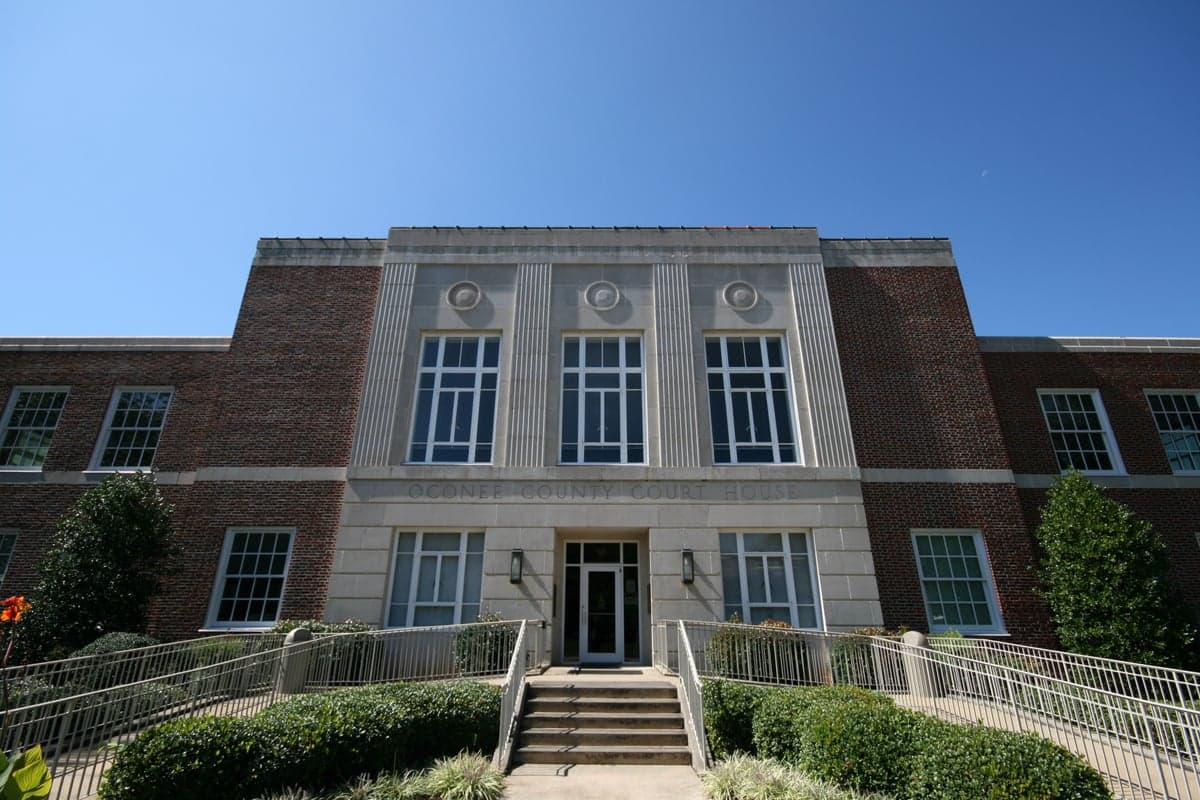
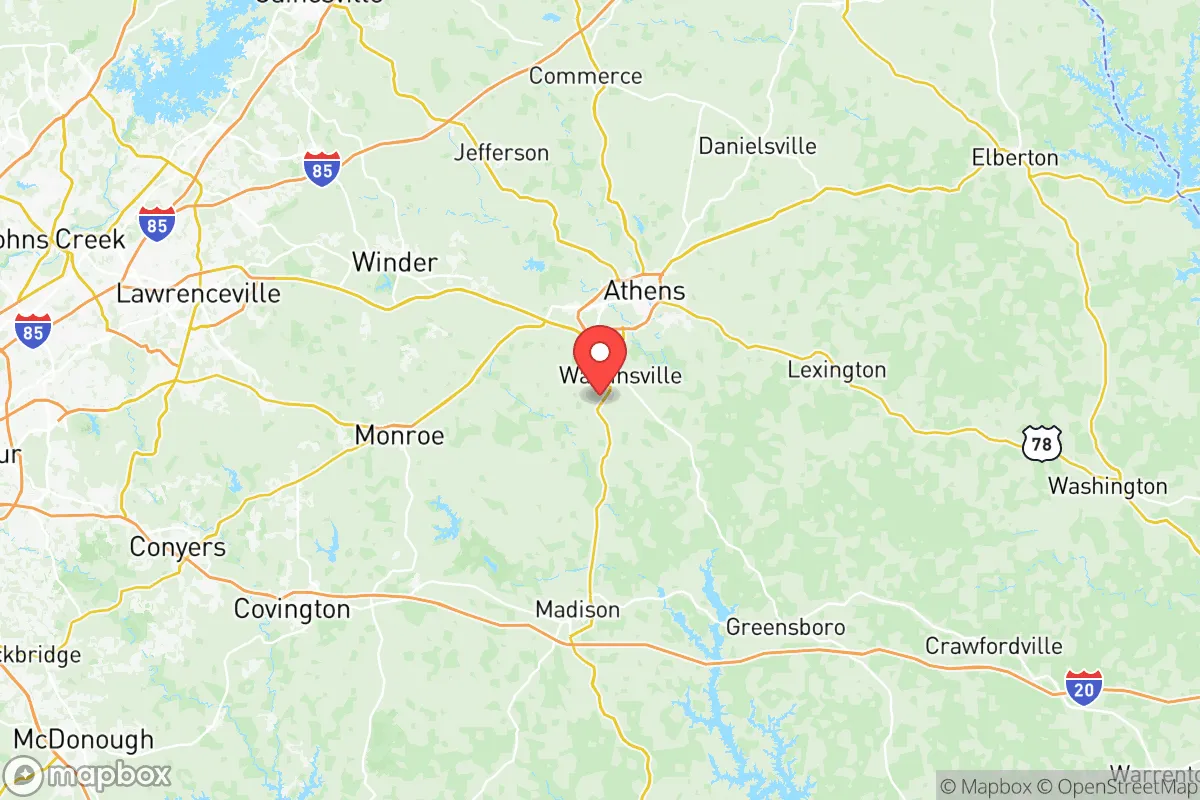
Photo: Wikipedia
Demographics of Oconee County
Affluence Level in Oconee County
An upper-middle-class area. Household wealth, education levels, and homeownership run ahead of national benchmarks.
People of Oconee County
The people of Oconee County, Georgia, today number roughly 42,788, forming a predominantly white (82.6%), highly educated (54.9% college degree) community that blends small-town heritage with suburban growth. The county’s identity is rooted in its rural past but increasingly shaped by professionals and families drawn to its top-ranked schools and proximity to Athens. With a foreign-born population of just 2.8%, it remains one of Georgia’s less diverse counties, though Hispanic (5.8%) and East/Southeast Asian (3.3%) communities are slowly growing.
Settlement & growth (pre-1960)
Before European settlement, the area now known as Oconee County was part of the ancestral homeland of the Creek (Muscogee) Nation, who lived in scattered villages along the Oconee River and its tributaries. The Creeks ceded the land in the 1802 Treaty of Fort Wilkinson, opening it to white settlement. The first wave of Anglo-American settlers, primarily of Scots-Irish and English descent, arrived in the 1810s and 1820s, drawn by the promise of fertile cotton land distributed through the Georgia land lottery system. These early settlers established small farming communities like Watkinsville, which became the county seat in 1875, and Bishop, a railroad stop founded in the 1880s. The county was officially created in 1875 from parts of Clarke County, a move driven by local farmers who wanted a government closer to their agricultural interests.
Cotton dominated the economy through the 19th and early 20th centuries, with enslaved African Americans making up a significant portion of the population before the Civil War. After emancipation, many Black families remained as sharecroppers and tenant farmers, forming small rural settlements such as Farmington and the area around High Shoals. The post-Reconstruction era saw little new immigration; Oconee County remained a closed, agrarian society. The boll weevil infestation of the 1910s and 1920s devastated cotton farming, prompting a slow outmigration of both white and Black residents to industrial cities in the North and to Atlanta. By 1960, the county’s population had stagnated at around 6,000, with a nearly all-white population and an economy still heavily tied to agriculture and timber.
Modern era (post-1965)
The 1965 Hart-Cellar Act had little direct impact on Oconee County, as the area did not attract significant international immigration. Instead, the county’s modern transformation began in the 1970s and accelerated through the 1990s, driven by domestic migration from the Rust Belt and from metro Atlanta. The expansion of the University of Georgia in nearby Athens created a spillover effect: professionals, academics, and medical workers sought affordable housing and better schools in Oconee County, leading to the development of subdivisions in Watkinsville and along the U.S. 441 corridor. The county’s population more than doubled between 1990 and 2020, from roughly 17,000 to over 42,000.
This growth was overwhelmingly white and native-born. The small Black population, which had been concentrated in historic rural settlements like Farmington and High Shoals, declined as a share of the total, from about 8% in 1990 to 3.1% today, as younger generations moved to larger cities. The Hispanic population began to grow in the 2000s, reaching 5.8% by 2025, largely through domestic migration from other parts of Georgia and the Southeast, with families settling in Watkinsville and Bogart for construction and service jobs. The East/Southeast Asian community (3.3%) is a more recent arrival, concentrated among professionals and academics working at the University of Georgia or in the Athens tech sector, with small clusters in Watkinsville and newer subdivisions near Oconee Connector. The Indian-subcontinent population (0.9%) is similarly small and dispersed, with no distinct enclave.
Suburbanization reshaped the county’s geography. The once-rural crossroads of Oconee Connector and Epps Bridge Parkway became a commercial hub, lined with big-box stores and chain restaurants, serving a population that largely commutes to Athens or works in the county’s growing healthcare and education sectors. The county’s identity shifted from agricultural to exurban, with a strong emphasis on school quality and low crime rates attracting conservative-leaning families.
The future
Oconee County is projected to continue growing, likely reaching 55,000–60,000 by 2040, driven by continued domestic migration from the Atlanta metro and other parts of the Southeast. The population will remain predominantly white and native-born, but the Hispanic and East/Southeast Asian shares are expected to rise slowly, perhaps to 8–10% and 5–6% respectively, as the county’s economy diversifies beyond agriculture and education. The Black population share is unlikely to increase significantly without targeted economic development or affordable housing initiatives. New residential development is concentrating in the Oconee Connector corridor and along U.S. 441 south of Watkinsville, while the historic villages of Bishop and Farmington are seeing slower growth and retaining their rural character. The county’s cultural identity is likely to remain conservative and family-oriented, with a growing tension between long-time residents who value the rural past and newcomers who want suburban amenities.
For someone moving in now, Oconee County offers a stable, safe, and highly educated community with excellent schools and a low-tax environment, but it is not a place of rapid demographic change or ethnic diversity. The county is becoming a well-off exurban enclave for families who prioritize education and proximity to Athens, while its historic agricultural and Black communities continue to shrink. The next decade will likely see more of the same: steady, managed growth that preserves the county’s character while slowly absorbing a modest influx of Hispanic and Asian professionals.

* Values derived from national, state, county, city and local statistics and may differ in a specific area. Last updated: 2026-09-29T14:51:01.000Z
Narrative content on this page is AI-generated and may contain mistakes. Verify any details that matter before acting on them.
ReloMaps may earn a commission from affiliate links at no extra cost to you.

