
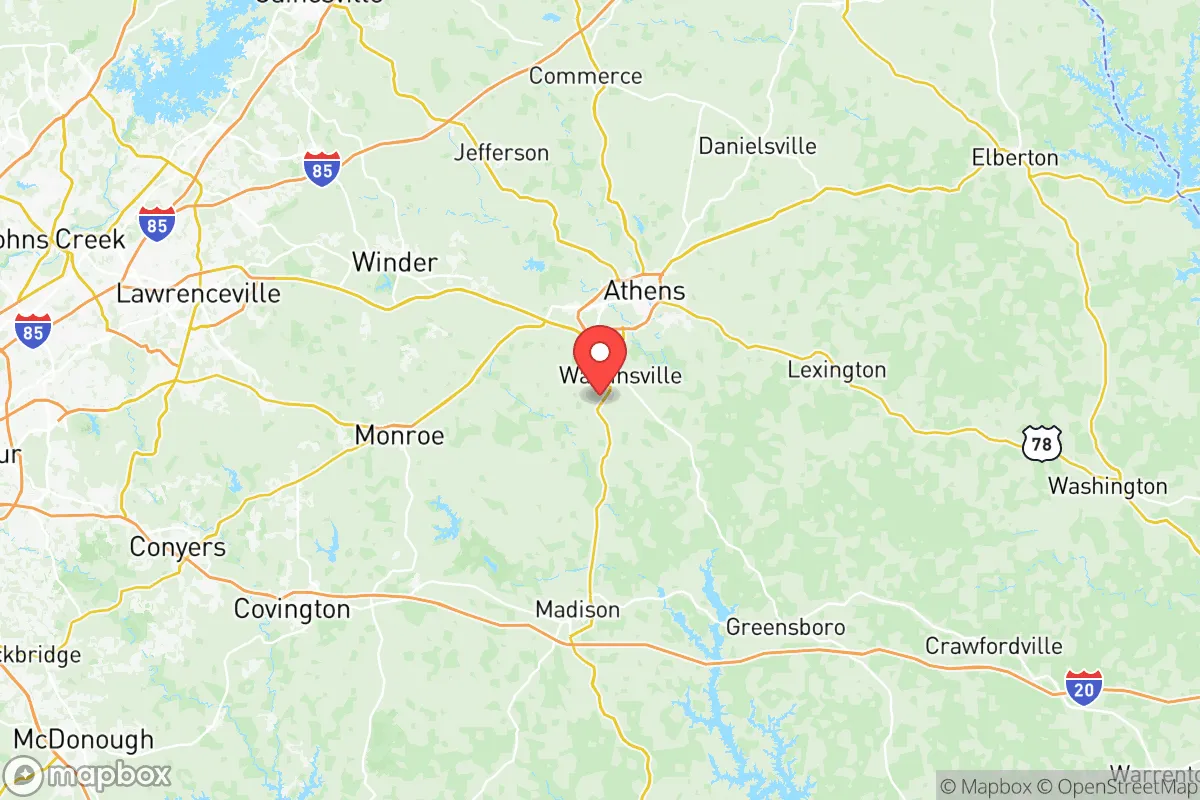
Photo: Wikipedia
Quality of Life in Oconee County
A livable area that tracks near national norms for affordability, walkability, and neighborhood health.
What does Quality of Life tell us?
Quality of Life measures an area by evaluating factors like cost of living, nearby amenities, country club access, airport proximity, socioeconomic signals and neighborhood character. For large states, this is a general average — quality of life can vary dramatically between metro areas, suburbs, and rural communities within the same state.
What does this tell us?
Quality of Life measures an area by evaluating factors like cost of living, nearby amenities, country club access, airport proximity, socioeconomic signals and neighborhood character. For large states, this is a general average — quality of life can vary dramatically between metro areas, suburbs, and rural communities within the same state.
Cost of Living
30% above national average
95%
The Real Cost of Living in Oconee County for 2026
| Tier | Individual | Family (4) |
|---|---|---|
| Survival | $21k | $40k |
| Comfortable | $83k | $121k |
| Luxury | $209k+ | $325k+ |
| Elite (Top 5%) | $262k+ | $407k+ |
Quality-of-Life Analysis
Oconee County, Georgia, offers a spectrum of quality-of-life options that range from the suburban convenience of its largest town, Watkinsville, to the quiet, rural character of communities like Farmington and Bishop. This diversity attracts a broad mix of residents, from young families seeking top-rated schools and commuters working in Athens or Atlanta to retirees and horse-farm owners looking for land and privacy. The county’s character is defined by this balance: it is one of Georgia’s fastest-growing counties, yet it has preserved a distinctly small-town, agrarian feel outside its main corridors.
Largest town(s) & population centers
Watkinsville is the county seat and the primary population center, home to roughly 3,000 residents within its city limits but serving as the hub for the county’s 50,000-plus population. Daily life here centers on the historic downtown square, which features locally owned shops, restaurants like Chops & Hops, and community events such as the Oconee County Farmers Market. The town is walkable in its core, but most residents live in newer subdivisions like those off Hog Mountain Road, where sidewalks and neighborhood parks are common. The adjacent area along US-441 and SR-53 is the county’s commercial spine, with big-box retail, grocery stores, and medical offices. A second, smaller population node is the area around Bogart (partially in Oconee County), which blends suburban homes with proximity to Athens’ employment base and the University of Georgia.
Smaller towns & rural pockets
Beyond Watkinsville, Oconee County contains several distinct smaller communities. Bishop, with a population under 300, is a classic rural village centered on a single intersection, surrounded by farms and large-lot homes. Farmington is similarly small, known for its historic homes and the Farmington Depot, with residents often living on 2- to 10-acre tracts. Unincorporated areas like North High Shoals and Prospect offer even deeper rural character, with winding roads, horse pastures, and few commercial services. These pockets are popular with residents who prioritize privacy, acreage, and a slower pace, often commuting 20–30 minutes to Watkinsville or Athens for work and shopping.
Cost & lifestyle range
The cost of living across Oconee County is uniformly high relative to Georgia and national averages, with a countywide COL index of 130 (100 = US average). However, the lifestyle and housing costs vary significantly by location. At the higher end, newer subdivisions in and around Watkinsville—such as those near Oconee Veterans Park or along Mars Hill Road—see median home values well above the county median of $425,100, often exceeding $550,000 for 4-bedroom homes on half-acre lots. Rents in these areas average $1,347 per month, but can reach $1,800 for a single-family rental. At the lower end, older homes in Bishop or Farmington, or smaller starter homes in unincorporated areas, can be found in the $300,000–$375,000 range, though inventory is limited. The average commute of 25.3 minutes reflects the county’s role as a bedroom community: most residents drive to jobs in Athens (15–20 minutes), Atlanta (60–75 minutes), or the growing industrial parks along US-78 near Bogart. Amenities follow the same gradient: Watkinsville offers walkable dining and events, while rural areas require a 10–15 minute drive to the nearest grocery store or pharmacy.
Oconee County is best suited for those who value high-performing public schools (consistently ranked among Georgia’s top 5 districts), low crime rates, and a semi-rural setting within commuting distance of urban jobs. Families with children, professionals working at the University of Georgia or in Atlanta’s northern suburbs, and retirees seeking land without total isolation all find their niche here. The trade-off is a higher cost of living and limited rental options, but for those who can afford it, the county offers a rare blend of community, nature, and convenience.

Crime in Oconee County
Generally safer than 56% of comparable U.S. locations.
Violent CrimeViolent Crime Analysis
Property CrimeProperty Crime Analysis
Crime Analysis
Oconee County, Georgia, is one of the safest communities in the Athens metropolitan area, with violent and property crime rates that fall well below both state and national averages. Located just south of Athens-Clarke County, Oconee County recorded a violent crime rate of 272.9 per 100,000 residents and a property crime rate of 1,271.3 per 100,000 in the most recent reporting period. These figures place the county in a strong position for families and professionals seeking a low-crime environment within commuting distance of a major university and regional employment hub.
Crime in context
Oconee County’s violent crime rate of 272.9 per 100,000 is roughly 30% lower than the Georgia state average of approximately 390 per 100,000 and about 25% below the national median for non-metropolitan counties. Property crime in Oconee County, at 1,271.3 per 100,000, is similarly favorable — roughly 20% below the Georgia average of 1,600 per 100,000 and well under the national average of 1,954 per 100,000. The county benefits from its location in the Western Judicial Circuit, which includes Oconee and Oglethorpe counties. Unlike the progressive prosecutorial policies seen in some metro Atlanta circuits (such as the Stone Mountain Judicial Circuit covering DeKalb County), the Western Circuit has maintained a more traditional, law-and-order approach. District Attorney James A. "Jim" Paulk has emphasized victim-centered prosecution and consistent sentencing, which correlates with the county’s sustained low crime rates. By contrast, neighboring Athens-Clarke County, which operates under a separate judicial circuit with more progressive policies, reports violent crime rates nearly double those of Oconee County.
What residents experience
Residents of Oconee County’s primary towns — Watkinsville, Bogart, Bishop, and North High Shoals — report that serious violent crime is rare and typically isolated to domestic incidents or disputes among known parties. The most common property crimes are theft from vehicles and residential burglary, particularly in unincorporated areas near major highways like US-441 and GA-53. Watkinsville, the county seat, has a notably low crime profile, with its historic downtown and surrounding subdivisions experiencing very few incidents. Bogart, straddling the Oconee-Barrow county line, sees slightly higher property crime due to its proximity to commercial corridors, but violent crime remains negligible. Bishop and North High Shoals, both small rural communities, report crime rates even lower than the county average. The Oconee County Sheriff’s Office maintains a visible presence, with proactive community policing and a dedicated school resource officer program in the Oconee County School District.
Neighborhood-level variation is modest but worth noting. The area around Epps Bridge Parkway, which contains most of the county’s retail and dining, experiences a higher concentration of shoplifting and vehicle break-ins, though violent incidents are rare. Subdivisions like Callaway Creek, Jennings Mill, and the newer developments near Mars Hill Road report near-zero violent crime and very low property crime. The county’s lack of a major urban center and its strong property tax base — funding well-equipped law enforcement — contribute to a safety profile that consistently ranks among the top 10% of Georgia counties. For prospective residents, the key takeaway is that Oconee County offers a secure environment where crime is an exception rather than a daily concern, particularly when compared to the higher-crime, progressive-prosecutor jurisdictions found in much of metro Atlanta.
* Values derived from national, state, county, city and local statistics and may differ in a specific area. Last updated: 2026-09-29T14:51:01.000Z
Narrative content on this page is AI-generated and may contain mistakes. Verify any details that matter before acting on them.
ReloMaps may earn a commission from affiliate links at no extra cost to you.

