
Photo: Wikipedia
Personal Sovereignty in Oconee County
Viable for self-reliance. Generally workable, though some barriers may limit total independence.
What does Personal Sovereignty tell us?
Personal Sovereignty measures your capacity for self-reliance and independence with minimal government friction. Higher scores mean fewer barriers between you and the way you want to live... but it assumes you have the space you need and good neighbors.
What does this tell us?
Personal Sovereignty measures your capacity for self-reliance and independence with minimal government friction. Higher scores mean fewer barriers between you and the way you want to live... but it assumes you have the space you need and good neighbors.
State Policy
Energy independence: Importer (12% of energy produced in-state)
Personal Liberty
Homesteading

Personal Liberty Analysis
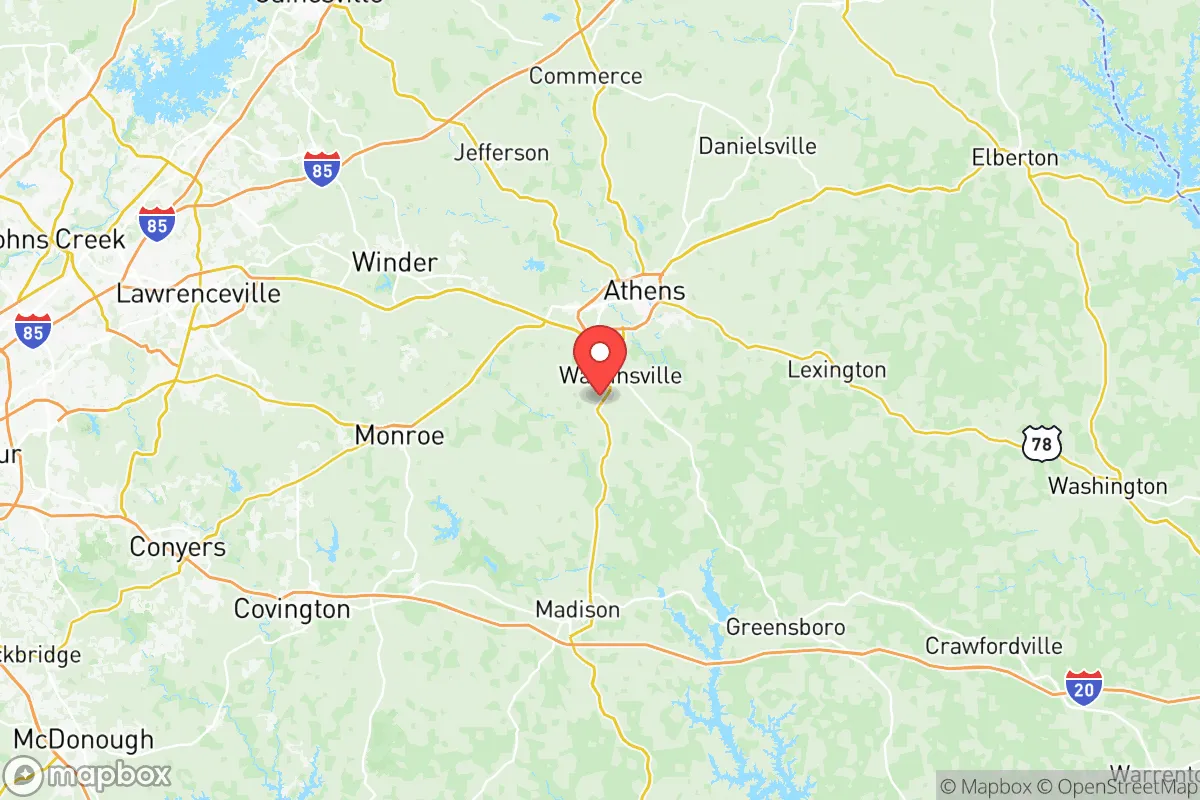
Oconee County, Georgia, offers a notably high degree of personal sovereignty, particularly for those who value limited government interference in daily life, property rights, and self-reliance. Located just east of Athens, the county consistently ranks as one of the most fiscally conservative and freedom-oriented jurisdictions in the state, with a regulatory environment that is intentionally light-touch compared to nearby urban centers like Athens-Clarke County or metro Atlanta. For single individuals and families seeking a place where local governance respects individual autonomy—from tax policy to self-defense—Oconee County presents a compelling option within the broader Georgia Piedmont region.
Tax burden and regulatory posture in Oconee County
Oconee County’s tax structure is among the most favorable in Georgia for residents prioritizing financial independence. The county levies no property tax for school operations—a rare distinction—funded instead by a 1% Special Purpose Local Option Sales Tax (SPLOST) that shifts the burden to consumption rather than property ownership. The total millage rate for the unincorporated county hovers around 9.5 mills, roughly half the rate of neighboring Athens-Clarke County. This means a $300,000 home in Oconee County carries an annual property tax bill of approximately $2,850, compared to over $5,000 in Athens. The county government maintains a lean administrative footprint: there is no county-wide zoning in unincorporated areas, though cities like Watkinsville and Bishop enforce their own modest codes. Business licensing is straightforward, with no occupational tax for most home-based enterprises, and the county’s development services department is known for quick permit approvals—typically under 10 business days for residential construction. This regulatory posture reflects a deliberate local culture of minimal interference, where the county commission has historically resisted state-level mandates on land use and business operations.
Self-defense and gun law specifics in Oconee County
Georgia is a constitutional carry state, and Oconee County fully embraces that framework. No permit is required to carry a concealed firearm for anyone legally able to possess a weapon, and the county sheriff’s office issues Georgia Weapons Carry Licenses (GWCL) on a shall-issue basis, typically processed within 30 days. The county is home to several private shooting ranges, including the Oconee County Shooting Range on Hog Mountain Road, which offers public access for rifle and pistol practice. Stand-your-ground and castle doctrine laws apply fully, with no duty to retreat in any place where a person is lawfully present. Local law enforcement, led by Sheriff James Hale, has a publicly stated policy of not enforcing federal firearms regulations that conflict with state law—a stance shared by the county commission. In practical terms, this means residents in towns like Bogart and North High Shoals can store firearms in vehicles on school parking lots (per state law) and face no local ordinances restricting magazine capacity or firearm types. The gun culture is deeply embedded: the annual Oconee County 4-H shooting sports program is one of the largest in the state, and the county’s gun shows at the Oconee County Civic Center draw attendees from across northeast Georgia.
Self-reliance and homesteading viability in Oconee County
Oconee County is one of the most homestead-friendly jurisdictions in the Atlanta-Athens corridor, largely due to its lack of county-wide zoning and permissive agricultural policies. In unincorporated areas, minimum lot sizes are 1 acre in most residential-agricultural districts, though parcels as small as 0.5 acres are common in older subdivisions. The county allows keeping livestock—including chickens, goats, and up to two cows—on lots of 1 acre or more, with no permit required for standard fencing. For those seeking true off-grid living, areas around Farmington and Bishop offer 5- to 20-acre tracts where well water and septic systems are standard, and solar panel installations face no HOA restrictions. The county’s building codes are based on the 2020 Georgia State Minimum Standard Codes, but enforcement is limited to structural safety and septic compliance; there is no county energy code or mandate for grid connection. Rainwater collection is legal and encouraged, with the county extension office offering free workshops on cistern systems. For families wanting to raise their own food, the Oconee County Farmers Market in Watkinsville provides a direct-to-consumer outlet, and the county’s agricultural exemption for property taxes applies to parcels of 5 acres or more in active production. The only notable constraint is in the city of Watkinsville, where zoning restricts livestock to lots of 2 acres or more and requires a $25 annual permit for beekeeping—a minor friction point in an otherwise permissive environment.
Personal liberties in Oconee County: parental rights, medical autonomy, speech, and property
Oconee County’s culture of personal sovereignty extends into several key liberty domains. Parental rights are strongly protected: the Oconee County School District has a policy of not administering any medical treatment or mental health screening without written parental consent, and the district’s library media centers allow parents to restrict their child’s access to specific materials. Medical autonomy is respected at the county level, with no local mandates for vaccinations or mask requirements during public health emergencies—a stance codified by a 2023 county commission resolution affirming individual choice. Free speech is robustly protected; the county has no noise ordinances that restrict political or religious expression in public spaces, and the Watkinsville City Council has twice rejected proposals to regulate signs on private property. Property rights are the bedrock of the county’s identity: the Oconee County Tax Assessor’s office maintains a transparent appeals process, and the county has never adopted a tree ordinance or view corridor restriction. In High Shoals, residents can operate home-based businesses—from auto repair to welding—without a business license, as long as they don’t generate excessive traffic. The county’s approach to short-term rentals is also hands-off: no registration or occupancy limits exist outside the city limits of Watkinsville, where a 30-day minimum stay is required. This combination of policies creates an environment where individuals and families can largely live as they see fit, provided they respect their neighbors’ property lines.
Compared to other areas in Georgia, Oconee County stands out as a moderate-to-high sovereignty jurisdiction, particularly for those who prioritize low taxes, gun rights, and homesteading flexibility. It is not as libertarian as rural counties like Glascock or Taliaferro, which have no building codes at all, but it offers a more practical balance of freedom and infrastructure—good schools, reliable utilities, and proximity to Athens’ healthcare and employment. For the conservative-leaning reader who values personal independence without total isolation, Oconee County represents a sweet spot where local government acts as a facilitator rather than a manager of daily life.

* Values derived from national, state, county, city and local statistics and may differ in a specific area. Last updated: 2026-09-29T14:51:01.000Z
Narrative content on this page is AI-generated and may contain mistakes. Verify any details that matter before acting on them.
ReloMaps may earn a commission from affiliate links at no extra cost to you.

