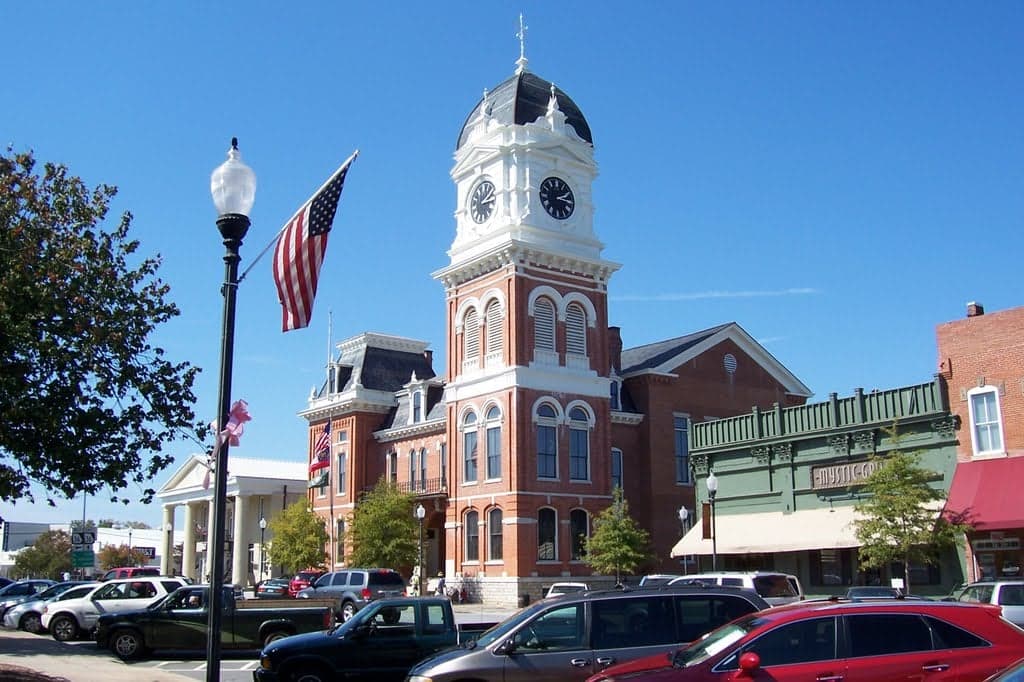
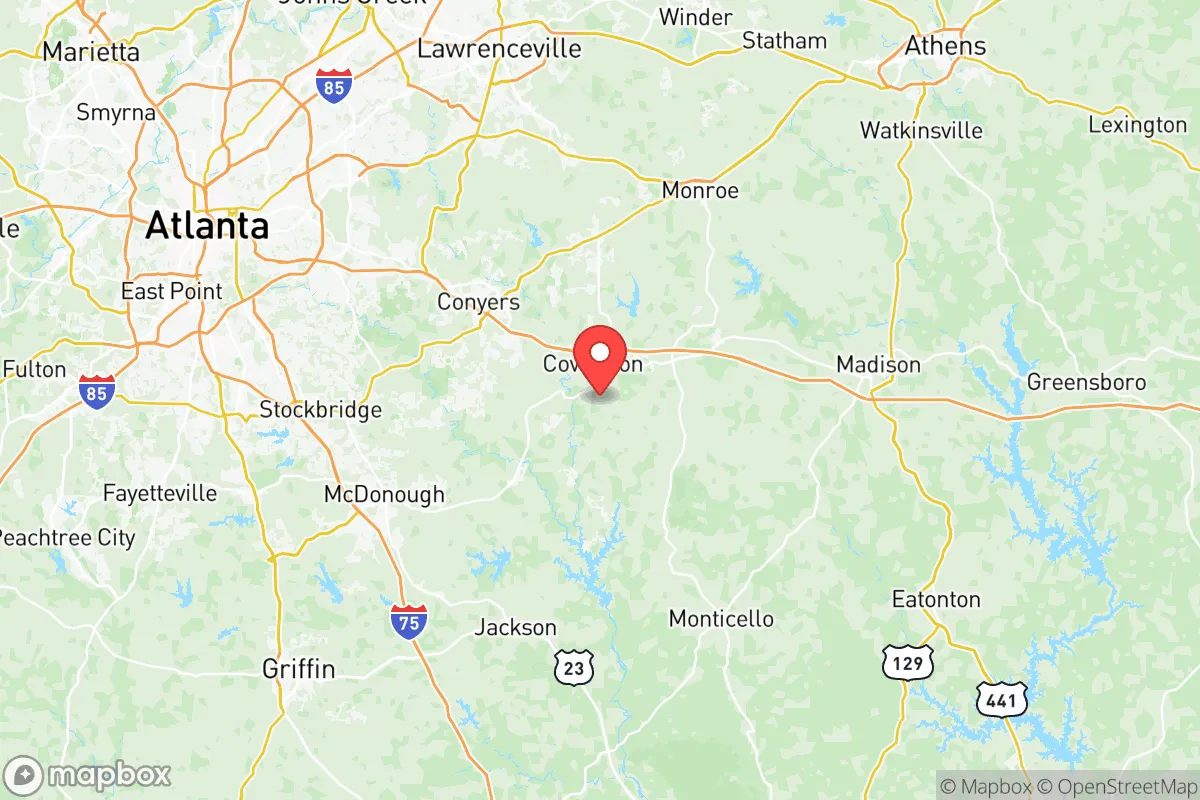
Photo: Wikipedia
Political ClimatePolitical Climate in Newton County
Showing district-level results — no local-only data available.
Local Political AnalysisPolitical Analysis of Newton County
Newton County has shifted decisively blue over the past decade, now carrying a Cook Partisan Voting Index of D+21 — one of the strongest Democratic leans in metro Atlanta outside of the core urban counties. That wasn't always the case. As recently as 2012, the county voted for Mitt Romney by a narrow margin. The rapid transformation is driven by explosive population growth, particularly in the southern and western parts of the county, where new subdivisions have drawn a wave of younger, more diverse, and more Democratic-leaning residents from DeKalb and Rockdale counties. The old guard — mostly white, older, and more conservative — still holds sway in the northern and eastern rural pockets, but their electoral influence has been steadily diluted.
How it compares
Compared to the rest of Georgia, Newton County is an outlier in its partisan intensity. While the state as a whole has become a competitive battleground — flipping blue for Biden in 2020 by less than 0.3 points — Newton County voted for Biden by roughly 20 points. That's a wider margin than even DeKalb County's D+25, though DeKalb is denser and more urban. Within Newton County itself, the political geography is stark. The city of Covington, the county seat and largest municipality, leans heavily Democratic, with precincts around the historic square and newer subdivisions routinely delivering 65-70% of the vote to Democratic candidates. Porterdale, a small mill town just south of Covington, is similarly blue. In contrast, the rural precincts around Newborn and Mansfield in the eastern part of the county still vote Republican by 10-15 points. The swing precincts — the ones that determine local races — are in the unincorporated areas along Highway 36 and near the Alcovy River, where new construction meets older farmland. These precincts have trended Democratic in presidential years but can flip in low-turnout local elections.
What this means for residents
For liberal residents, the D+21 lean means their votes carry weight in countywide races — the Board of Commissioners and school board have been reliably Democratic for several cycles now. Progressive policies like expanded public transit (the county recently joined the Atlanta-Region Transit Link Authority) and affordable housing initiatives have gained traction. For conservative residents, the reality is more nuanced. While they are outnumbered in countywide elections, they still hold influence in the northern and eastern commission districts, and the county's Republican Party remains active, particularly around gun rights and property tax issues. The practical effect is that Newton County government tends to be moderate — not as progressive as DeKalb, but not as conservative as neighboring Walton County. The school board, for instance, has avoided the culture-war battles seen in nearby districts, focusing instead on growth management and teacher pay.
Culturally, the shift has created a subtle but real divide. The old Covington — the one that filmed "The Vampire Diaries" and "In the Heat of the Night" — still exists in the historic district, but the new Covington is a bedroom community for Atlanta commuters. You'll see more "Coexist" bumper stickers than "Don't Tread on Me" in the Target parking lot. The county's policy distinctions reflect this: Newton was one of the first in the region to adopt a comprehensive LGBTQ+ non-discrimination ordinance for county employees, and it has been aggressive in pursuing state and federal grants for transit and affordable housing. At the same time, the county has maintained relatively low property tax rates compared to DeKalb and Rockdale, a nod to its still-significant conservative base. The bottom line: Newton County is a blue island in a purple state, and its politics will continue to be shaped by the tension between its rural past and its suburban future.

State Political ClimatePolitical Climate in Georgia
State Political AnalysisPolitical Environment in the State
Georgia has transformed from a reliably Republican stronghold into the nation’s most competitive swing state, with a partisan lean that now sits at roughly R+3 to D+1 depending on the election cycle. The state’s 16 electoral votes have flipped twice in the last four presidential elections — going for Trump in 2016 and 2024, but narrowly for Biden in 2020 — and both Senate seats are currently held by Democrats. The long arc shows a state that was solidly red (Republicans held every statewide office and both legislative chambers from 2005 to 2020) now defined by a razor-thin margin: Trump won Georgia by just 1.2 points in 2024, down from 5.1 points in 2016. The dominant coalitions are a fast-growing, diverse, and college-educated suburban electorate pulling left, balanced against a deeply entrenched rural and exurban conservative base that turns out heavily in non-presidential years.
Urban vs. rural divide
The political map of Georgia is a story of three Georgias: metro Atlanta, the smaller cities, and everywhere else. Metro Atlanta — a 29-county region home to 60% of the state’s population — drives the Democratic surge. Fulton and DeKalb counties (Atlanta proper) vote 75-80% Democratic, while the inner-ring suburbs like Gwinnett, Cobb, and Henry counties have flipped from red to blue over the past decade. Gwinnett, once a GOP stronghold, voted for Biden by 18 points in 2020 and has elected Democratic county commissioners and school board members. The outer exurbs — Cherokee, Forsyth, and Paulding counties — remain deeply Republican, often voting 65-70% for Trump. Outside Atlanta, the state’s second-largest city, Augusta, leans Democratic (Richmond County votes about 55-60% blue), while Columbus (Muscogee County) is a toss-up that has trended Democratic. Savannah (Chatham County) is solidly blue, but the surrounding coastal counties like Effingham and Bryan are deep red. The rural “Black Belt” counties stretching from Macon southwest to Albany vote overwhelmingly Democratic (often 70-80%), driven by African American majorities. Meanwhile, north Georgia’s mountain counties — Fannin, Union, Towns — vote 80%+ Republican, as do the agricultural counties of south-central Georgia like Tift and Colquitt. The result is a state where the partisan split is almost exactly 50-50, but the geography is starkly polarized.
Policy environment
Georgia’s policy environment is a mix of conservative governance with pragmatic moderation on economic issues. The state has a flat income tax of 5.49% (down from 6% in 2022, with a scheduled phase-down to 4.99% by 2029), no estate tax, and a sales tax that averages 7-8% with local options. Property taxes are relatively low, with a median effective rate of about 0.87% of home value. The regulatory posture is business-friendly: Georgia is a right-to-work state with weak unions, and the state consistently ranks in the top five for business climate. Education policy is a flashpoint: the state has a robust school choice program (the Georgia Promise Scholarship Act, passed in 2024, provides $6,500 vouchers for private school tuition), but public school funding remains below the national average per pupil. Healthcare policy is notably conservative: Georgia did not expand Medicaid under the Affordable Care Act, leaving roughly 300,000 low-income adults in the coverage gap. The state’s election laws have been a national focus: the Election Integrity Act of 2021 (SB 202) added voter ID requirements for absentee ballots, limited drop boxes, and restricted third-party ballot collection. Gun laws are among the most permissive in the country: Georgia is a constitutional carry state (permitless carry for adults 21+ since 2022), with no state-level red flag law, no waiting period, and no universal background check requirement.
Recent policy direction
Over the past five years, Georgia has moved decisively in a conservative direction on several fronts while holding the line on others. On gun and self-defense law, the 2022 permitless carry law (HB 218) was the most significant expansion in decades, and the state’s Stand Your Ground law (enacted in 2006) remains intact. On parental and education rights, the 2024 Promise Scholarship Act created the state’s first universal school choice program, and the 2022 “Parents’ Bill of Rights” (SB 449) requires schools to notify parents of any changes to a child’s mental, emotional, or physical health — a law that has drawn both praise from conservative families and criticism from LGBTQ+ advocates. On speech and privacy, Georgia passed a broad data privacy law (the Georgia Data Privacy Protection Act) in 2023, but it is weaker than California’s and exempts most small businesses. On medical and bodily autonomy, the state enacted a six-week abortion ban (HB 481) in 2019, which took effect in 2022 after the Dobbs decision; the law includes exceptions for rape, incest, and life of the mother, but has been a major driver of political mobilization. On property rights, Georgia is a strong property rights state with no statewide rent control and limited eminent domain abuse. On taxation, the trend is toward lower rates: the income tax is being phased down, and the state eliminated the state sales tax on groceries in 2022. On voting and ballot access, SB 202 tightened rules, but early voting hours were actually expanded in many counties, and turnout in 2024 was the highest in state history for a presidential election.
Civil unrest & political movements
Georgia has been a battleground for political movements on both sides. The 2020 election aftermath saw massive protests in Atlanta over the killing of George Floyd, as well as a sustained “Stop the Steal” movement that culminated in the Fulton County grand jury investigation into Trump’s election interference. The state has seen organized activist movements on the right, including the Georgia Republican Assembly (a conservative grassroots group that has pushed for stricter election integrity measures) and the Georgia Carry organization, which successfully lobbied for permitless carry. On the left, the Fair Fight Action group, founded by Stacey Abrams, has been a major force in voter registration and turnout, particularly among Black and young voters. Immigration politics are less visible than in border states, but the 2024 Georgia law (SB 452) requires local law enforcement to cooperate with federal immigration authorities and penalizes “sanctuary” policies — though no Georgia county has formally declared itself a sanctuary. Election integrity remains a live issue: the 2024 election saw record turnout and no major irregularities, but the state’s Republican-controlled legislature has continued to push for additional restrictions, including a 2025 bill to require hand-counting of ballots (which failed). A new resident would notice the intensity of political engagement: yard signs, bumper stickers, and campaign mailers are ubiquitous in swing counties like Cobb and Gwinnett, and local news covers politics year-round.
Projection
Over the next 5-10 years, Georgia is likely to remain a toss-up state, but the demographic trends favor a slow shift toward the Democratic column. The Atlanta metro area is adding about 100,000 new residents per year, many from blue states like California and New York, and the state’s growing Asian American and Hispanic populations (now 5% and 10% of the electorate, respectively) lean Democratic. However, the rural and exurban base is also growing, and the state’s Republican legislature has shown no sign of moderating on social issues. The most likely scenario is a state that continues to be decided by 1-3 points in presidential elections, with Republicans maintaining control of the legislature and governorship through 2030 due to gerrymandered maps and the advantage of off-year turnout. A wild card is the potential for a major shift in Atlanta’s suburbs: if the outer exurbs (Cherokee, Forsyth) continue to diversify and trend purple, the state could become solidly blue by 2032. For now, a relocator should expect a state where their vote will genuinely matter — and where the political climate will remain intensely competitive, with all the polarization and engagement that entails.
For a new resident, the bottom line is that Georgia offers a low-tax, business-friendly environment with a conservative social policy framework, but in a state where the political future is genuinely uncertain. Conservatives will find a state that protects gun rights, offers school choice, and keeps taxes low, but they will also live in a state where Democrats hold the governor’s mansion only rarely and where the legislature is reliably red. Liberals will find a state with a vibrant, growing Democratic base in Atlanta and the smaller cities, but they will face a six-week abortion ban, no Medicaid expansion, and a legislature that is likely to remain Republican for the foreseeable future. The practical takeaway: Georgia is not a red state or a blue state — it’s a battlefield, and anyone moving here should be prepared for that reality.
* Values derived from national, state, county, city and local statistics and may differ in a specific area. Last updated: 2026-09-07T07:15:40.000Z
Narrative content on this page is AI-generated and may contain mistakes. Verify any details that matter before acting on them.
ReloMaps may earn a commission from affiliate links at no extra cost to you.

