Photo: Wikipedia
Demographics of Newton County
Affluence Level in Newton County
A middle-class area roughly in line with national averages across income, home values, education, and employment.
People of Newton County
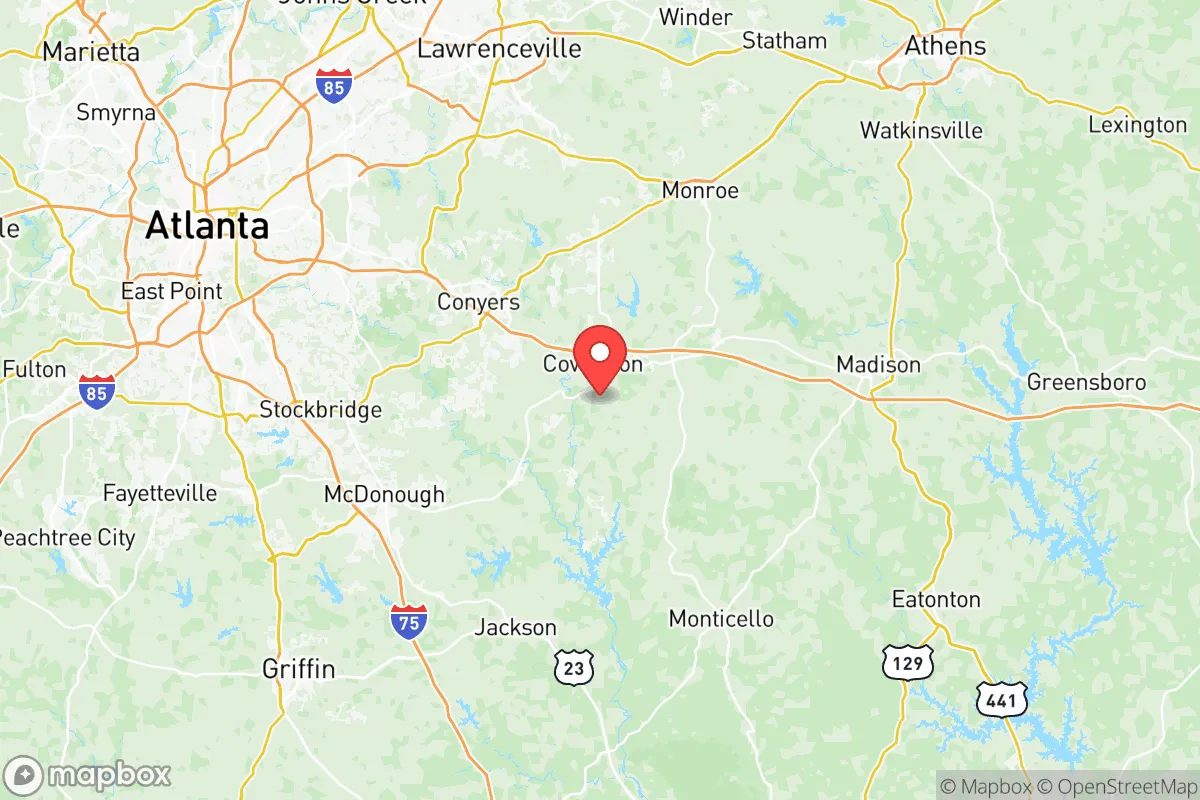
Newton County, Georgia, today is a predominantly Black-majority suburban county of 115,530 residents, where African American families make up 47.1% of the population and White residents account for 40.4%. The county’s identity is shaped by its dual character: a historic small-town core in Covington and Porterdale, and rapidly expanding subdivisions along the I-20 corridor that draw Atlanta commuters seeking more affordable housing. With a foreign-born population of just 3.4% and a college attainment rate of 23.6%, Newton County remains a largely native-born, working-to-middle-class community where church life, high school football, and family ties anchor daily life.
Settlement & growth (pre-1960)
The land that became Newton County was originally Creek Indian territory, with the Creek Confederacy maintaining villages and hunting grounds along the Alcovy River and Yellow River until the 1820s. Through the 1825 Treaty of Indian Springs, the Creeks ceded their remaining Georgia lands, and white settlers—primarily of Scots-Irish and English descent—poured in from the Carolinas and Virginia. The Georgia General Assembly created Newton County in 1821, naming it after Revolutionary War hero John Newton, and designated Covington as the county seat in 1822. These early settlers were small-scale cotton farmers who cleared the piney woods for plantations, and by 1840, enslaved African Americans already made up roughly 40% of the county’s population.
The arrival of the Georgia Railroad in 1845 transformed Covington from a sleepy courthouse town into a regional cotton-shipping hub. The railroad also spurred the founding of Porterdale in the 1890s, a mill village built around the Porterdale Cotton Mills along the Yellow River. For the next six decades, Porterdale was a company town where poor white families from the Georgia upcountry and Appalachia moved for mill work, living in company-owned houses and shopping at the company store. Meanwhile, the post-Reconstruction era saw freed Black families establish their own communities, most notably Newborn (founded 1850s, incorporated 1908) and the Starrsville area, where Black landowners built churches, schools, and farms in the face of Jim Crow segregation. By 1900, Newton County’s population was roughly 60% White and 40% Black, a ratio that held steady through the Great Depression.
The boll weevil infestation and the collapse of cotton prices in the 1920s devastated the county’s agricultural economy, triggering an outmigration of both Black and White residents to Northern industrial cities like Detroit and Chicago. This Great Migration continued through the 1940s and 1950s, draining Newton County of much of its young adult population. The county’s population actually declined from 15,000 in 1920 to 14,000 in 1950, even as Georgia’s overall population grew. The one bright spot was the establishment of the Oxford College of Emory University in Oxford (founded 1836), which brought a small but steady stream of faculty families and Methodist-affiliated residents to the county.
Modern era (post-1965)
The 1965 Hart-Cellar Act had little direct effect on Newton County—its foreign-born population remains tiny at 3.4%, far below the national average. Instead, the county’s modern demographic transformation has been driven overwhelmingly by domestic migration: the suburbanization of Atlanta’s Black middle class. Beginning in the 1990s and accelerating after 2000, Black families from DeKalb County and southern Fulton County began moving east along I-20 to Newton County, drawn by newer housing stock, larger lots, and lower property taxes. This wave concentrated in Covington’s western subdivisions (such as the Fairview and Oak Hill areas) and in the unincorporated communities around Salem Road and Highway 36.
The 2010 Census recorded Newton County as 50.5% White and 43.5% Black, but by the 2020 Census, the county had flipped to a Black majority: 47.1% Black versus 40.4% White. This shift reflects both the continued in-migration of Black families and the out-migration of some White families to more rural counties like Morgan and Walton. The Hispanic population, while still modest at 6.8%, has grown steadily since 2000, with most families settling in Covington’s southern and eastern edges and in the Porterdale area, where they work in construction, landscaping, and the poultry processing plants in neighboring Jasper County. East/Southeast Asian residents (1.0%) and Indian-subcontinent residents (0.4%) remain very small populations, concentrated among professionals working at the Covington Regional Medical Center or commuting to tech jobs in Atlanta.
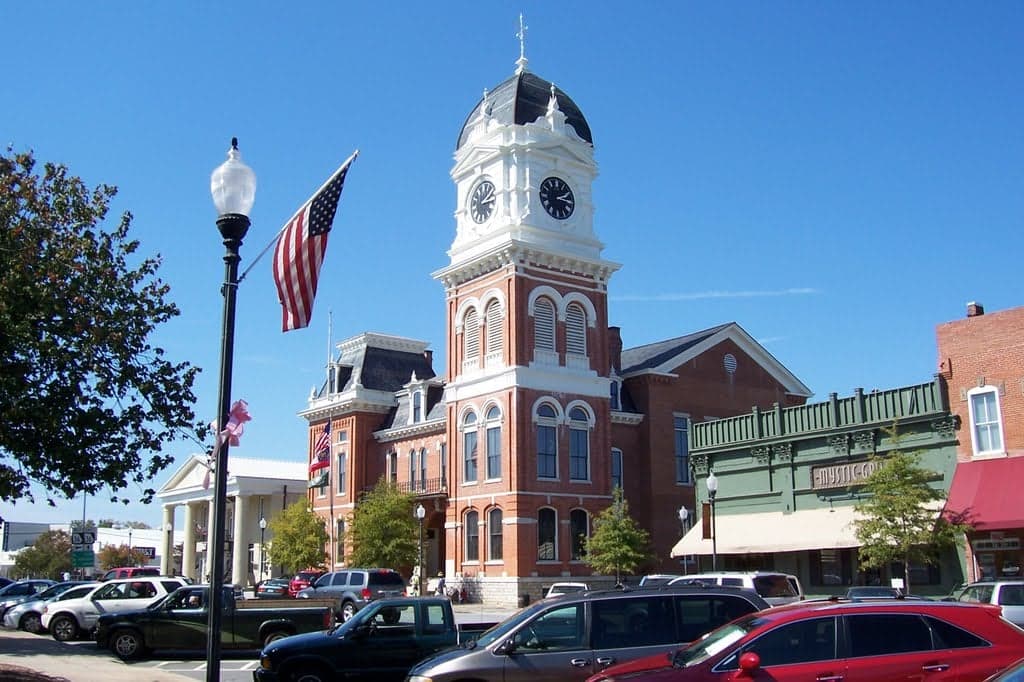
The county’s economy has shifted from agriculture and textiles to logistics and distribution. The I-20 East Industrial Corridor has attracted major warehouses and distribution centers for companies like Amazon and Home Depot, bringing jobs but also increasing truck traffic through Covington. The historic downtowns of Covington and Porterdale have seen modest revitalization, with Covington leveraging its status as the filming location for The Vampire Diaries to draw tourists, though the county remains overwhelmingly residential and commuter-oriented.
The future
Newton County is projected to continue its trajectory toward becoming a more heavily Black-majority, suburban county. The Atlanta Regional Commission forecasts the county’s population will reach roughly 150,000 by 2040, driven by continued spillover from DeKalb and Rockdale counties. New subdivisions are spreading south and east of Covington, particularly around Highway 162 and Brown Bridge Road, where large-lot developments are attracting families priced out of Gwinnett and Henry counties. The Hispanic share is likely to grow slowly, reaching perhaps 10-12% by 2040, as the construction and service sectors continue to draw immigrant labor, but the county is unlikely to see the rapid diversification of metro Atlanta’s northern suburbs.
The White population is expected to continue a gradual decline in percentage terms, though the absolute number may stabilize as some retirees and remote workers are drawn to the county’s lower cost of living and rural feel. The county’s cultural identity is evolving from its historic “Old South” small-town character toward a more suburban, Black-majority community with strong church networks, active civic organizations, and a growing emphasis on economic development. The challenge for Newton County will be managing growth without losing the sense of community that draws residents there—a tension visible in debates over zoning, school funding, and the preservation of historic downtown Covington.
For someone moving in now, Newton County offers a predominantly Black-majority, family-oriented suburban environment with affordable housing, good interstate access to Atlanta, and a slower pace of life than the core metro. The county is becoming more diverse slowly, more suburban steadily, and more economically tied to logistics and distribution. It is a place where church and family remain central, where high school sports still draw Friday-night crowds, and where the biggest change in the last generation has been the color of the faces in those crowds—a shift that has been peaceful, gradual, and largely unremarked upon by the people who live there.

* Values derived from national, state, county, city and local statistics and may differ in a specific area. Last updated: 2026-09-07T07:15:40.000Z
Narrative content on this page is AI-generated and may contain mistakes. Verify any details that matter before acting on them.
ReloMaps may earn a commission from affiliate links at no extra cost to you.

