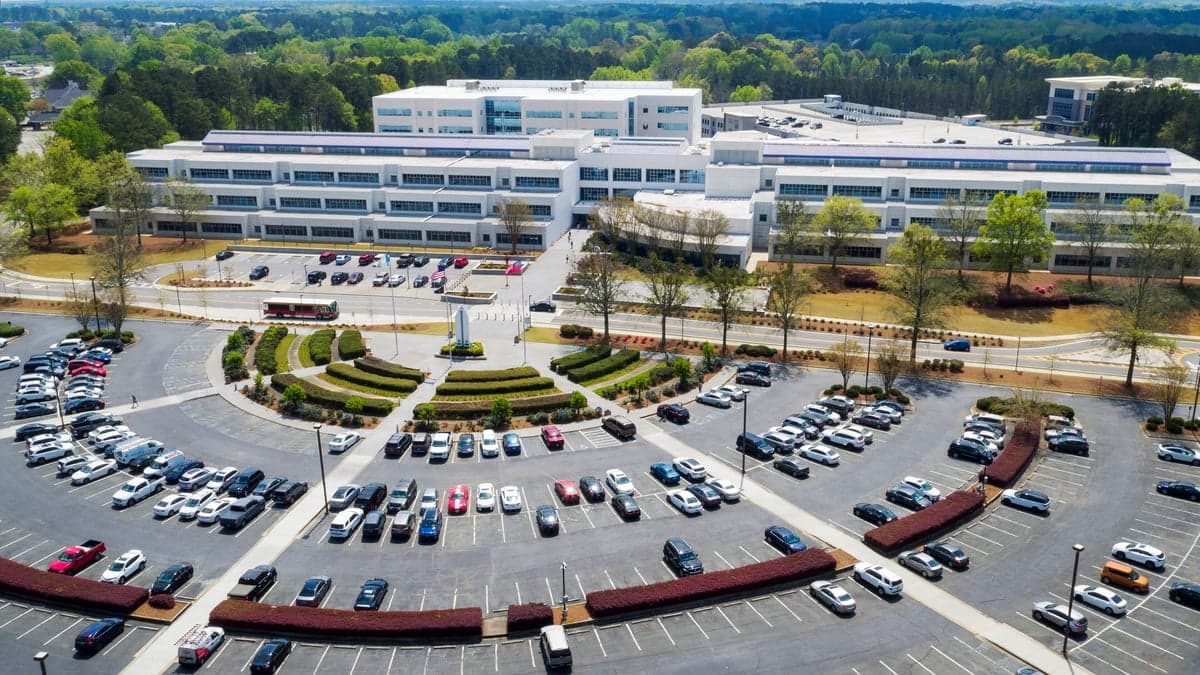
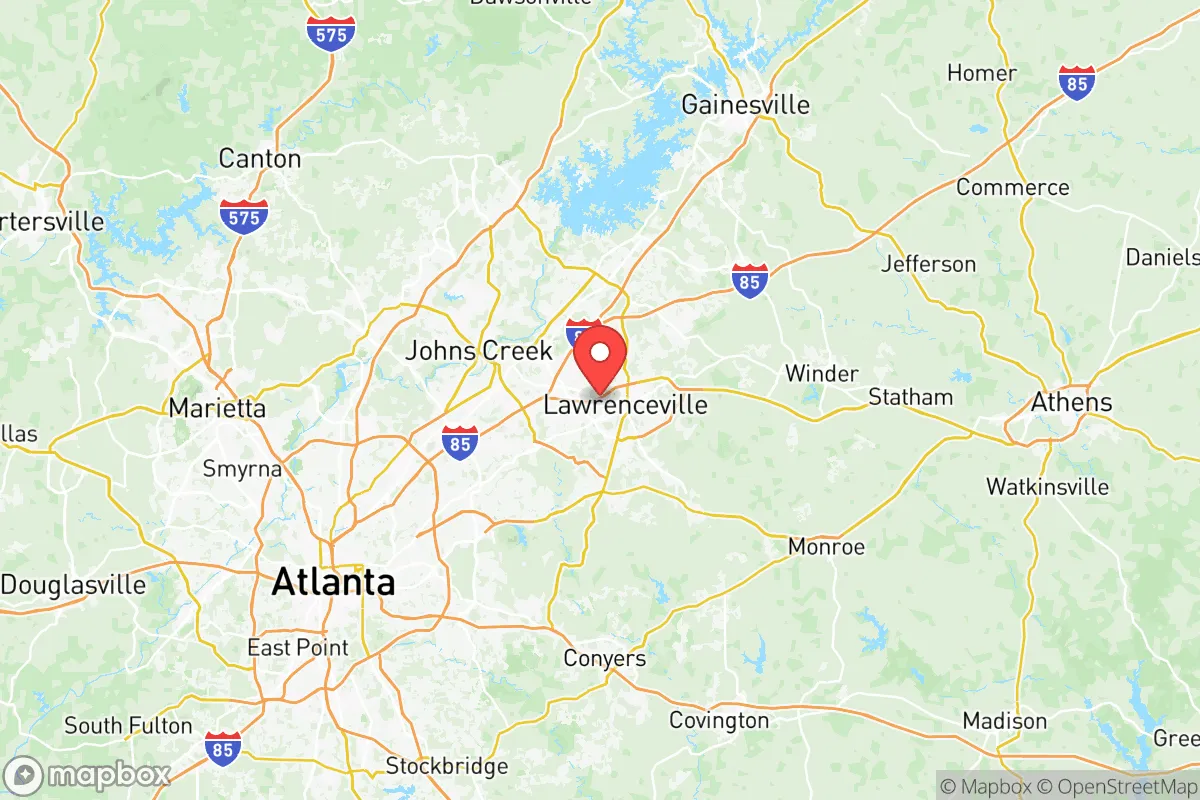
Photo: Wikipedia
Demographics of Gwinnett County
Affluence Level in Gwinnett County
A middle-class area roughly in line with national averages across income, home values, education, and employment.
People of Gwinnett County
Gwinnett County, Georgia, is a majority-minority suburban powerhouse of nearly one million residents, defined by its extraordinary racial and ethnic diversity: 32% White, 27.8% Black, 23.2% Hispanic, and 12.9% Asian and Indian combined. Its population is young, well-educated (38.7% college graduates), and heavily foreign-born (13.7%), creating a distinctly international character that sets it apart from older, more homogenous Southern suburbs. The county’s identity today is less "Old South" and more "Global South," a place where a Korean church, a Mexican taqueria, and an Indian sweet shop sit within the same strip mall, reflecting a population that has been reshaped almost entirely since 1965.
Settlement & growth (pre-1960)
Before European contact, the area that became Gwinnett County was part of the vast homeland of the Cherokee and Creek (Muscogee) nations, who used the region for hunting and seasonal settlements along the Chattahoochee River and its tributaries. The Cherokee ceded the land in the 1821 Treaty of Indian Springs, and the state of Georgia created Gwinnett County in 1818, named after Button Gwinnett, a signer of the Declaration of Independence. The first white settlers were primarily Scots-Irish and English yeoman farmers who moved down from Virginia and the Carolinas in the 1820s and 1830s, drawn by cheap, fertile land in the Piedmont. They established small farming communities like Lawrenceville (the county seat, founded 1821), Norcross, and Buford, growing cotton and corn with enslaved Black labor. By 1860, enslaved people made up roughly one-third of the county's population, a typical share for Georgia's upcountry. After the Civil War and Reconstruction, the Black population remained largely rural and tied to sharecropping, with small enclaves forming in places like Lilburn and Snellville. The county remained overwhelmingly rural and agricultural through the early 1900s, with a population that barely topped 30,000 by 1940. A modest wave of Appalachian white migrants arrived during the Great Depression, seeking work in the region's small textile mills. The post-World War II era brought the first hints of suburbanization, as Atlanta's expanding highway system made commutes from Duluth and Norcross feasible, but Gwinnett remained a sleepy, predominantly white farming county of about 60,000 people in 1960.
Modern era (post-1965)
The 1965 Hart-Cellar Act, combined with Atlanta's rise as a Sun Belt economic hub, completely transformed Gwinnett County. The first major shift was white domestic migration from the Rust Belt and other parts of the South during the 1970s and 1980s, as families and corporations relocated to metro Atlanta's booming suburbs. This wave settled in master-planned subdivisions across Lawrenceville, Snellville, and Lilburn, swelling the county's population from 72,000 in 1970 to 352,000 by 1990. At the same time, Black families began moving from Atlanta's inner-city neighborhoods and other parts of Georgia into Gwinnett's affordable housing stock, particularly in Norcross and southern parts of the county, a trend that accelerated after 2000. The most dramatic change, however, came from international immigration. Hispanic immigrants, primarily from Mexico and Central America, arrived in large numbers from the 1990s onward, drawn by construction, landscaping, and service jobs in the booming suburb. They concentrated in Norcross and Duluth, where a vibrant commercial corridor of panaderías, tiendas, and taquerias now anchors a community that makes up nearly a quarter of the county's population. East and Southeast Asian communities—particularly Korean, Chinese, Vietnamese, and Filipino—began arriving in the 1980s and 1990s, many as professionals in tech, healthcare, and academia. Duluth became the epicenter of a Koreatown-like corridor along Pleasant Hill Road, while Suwanee and Johns Creek (part of Gwinnett until 2006) attracted a mix of Chinese and Korean families seeking top-rated schools. The Indian subcontinent community (Indian, Pakistani, Bangladeshi) grew rapidly after 2000, drawn by IT and engineering jobs in the Atlanta tech corridor. They established a strong presence in Lilburn and Lawrenceville, where Indian grocery stores, temples, and community centers now serve a population that makes up nearly 4% of the county. By 2020, Gwinnett had become one of the most ethnically diverse counties in the United States, with no single racial or ethnic group holding a majority.
The future
Gwinnett County's population is projected to continue diversifying, with the White share declining further as both domestic and international migration bring more Hispanic, Black, and Asian residents. The county is likely to become even more majority-minority, with the Hispanic and Asian populations growing fastest, particularly in the northern and eastern corridors around Buford, Suwanee, and Dacula. The Indian subcontinent community is expected to expand its footprint beyond Lilburn and Lawrenceville into newer subdivisions, while East/Southeast Asian enclaves in Duluth and Johns Creek will likely densify and mature. The county's cultural identity is evolving from a generic Sun Belt suburb into a genuinely polyglot, multi-ethnic region where no single group dominates. This shift is already visible in school demographics, restaurant offerings, and political representation. The next 10-20 years will likely see Gwinnett become a model of a new American suburb: diverse, educated, and economically dynamic, but also grappling with the challenges of rapid growth, traffic congestion, and school overcrowding.
For someone moving to Gwinnett County today, the bottom line is clear: this is not your grandparents' Southern suburb. It is a rapidly maturing, majority-minority community where diversity is not a future trend but a present reality. The county offers a unique blend of strong schools, relatively affordable housing, and a genuinely global cultural landscape, but newcomers should expect a place where change is constant and the old demographic certainties of the 20th century are long gone.

* Values derived from national, state, county, city and local statistics and may differ in a specific area. Last updated: 2026-06-22T03:37:16.000Z
Narrative content on this page is AI-generated and may contain mistakes. Verify any details that matter before acting on them.
ReloMaps may earn a commission from affiliate links at no extra cost to you.

