
Photo: Wikipedia
Political ClimatePolitical Climate in Greene County
Showing district-level results — no local-only data available.
Local Political AnalysisPolitical Analysis of Greene County
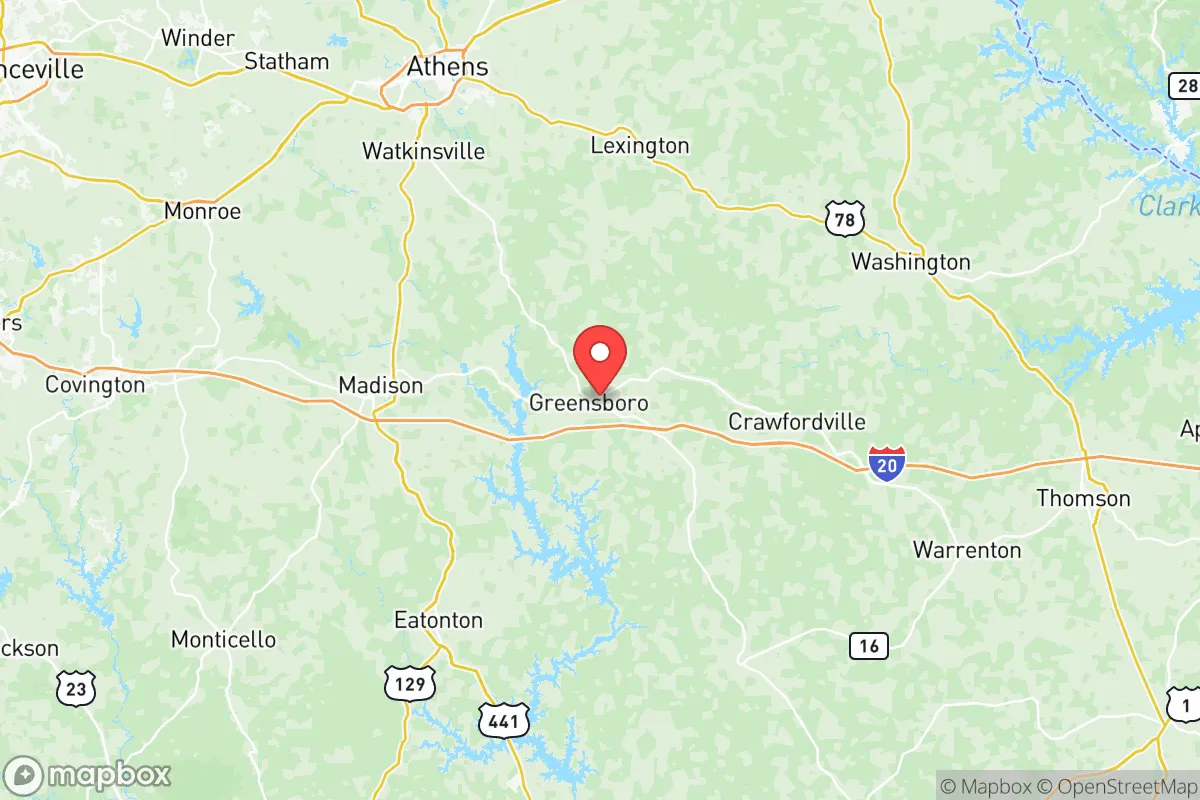
Greene County, Georgia, is a reliably Republican stronghold with a Cook Partisan Voting Index (PVI) of R+11, meaning it votes about 11 points more Republican than the national average. This isn't a recent shift; the county has been trending red for decades, driven by a mix of rural conservatism and the influx of affluent, often conservative-leaning retirees and second-home owners drawn to Lake Oconee. While Georgia as a state has become a competitive battleground—flipping blue in the 2020 presidential election and electing two Democratic U.S. Senators in 2021—Greene County has only deepened its Republican roots. In 2024, Donald Trump carried the county by roughly 30 points, a margin that has held steady or widened since 2016, even as the state overall tightened.
How it compares
Compared to Georgia as a whole, Greene County is a political outlier. The state’s Cook PVI is not publicly assigned, but its recent elections show a near-even split—Biden won by 0.2% in 2020, and Trump carried it by 2.2% in 2024. Greene County, by contrast, is far more conservative. The biggest internal divide isn’t between parties but between towns. Greensboro, the county seat and largest town, leans Republican but has a small, consistent Democratic base, especially in the historic downtown and among Black residents who make up about 30% of the city’s population. Eatonton, to the south, is more mixed—its precincts near the lake (like those around Reynolds Plantation) vote heavily Republican, while the older, more rural parts of town and the predominantly Black neighborhoods near the Oconee River vote solidly Democratic. Union Point and White Plains, smaller towns in the county’s northern and eastern reaches, are deeply red, with Republican margins often exceeding 40 points. The swing precincts are almost nonexistent; the only competitive area is a narrow band along Highway 44 between Greensboro and Eatonton, where a mix of newer subdivisions and older farmhouses creates a slight purple tint. In state-level races, Greene County reliably sends Republicans to the Georgia General Assembly—Senator John F. Kennedy (R-Macon) and Representative Trey Rhodes (R-Greensboro) both represent the area—while statewide Democrats like Stacey Abrams and Raphael Warnock have consistently lost the county by double digits.
What this means for residents
For conservative residents, Greene County offers a comfortable political environment. Local government—the county commission, school board, and city councils—is dominated by Republicans, and policy decisions tend to favor low taxes, limited regulation, and Second Amendment rights. The county’s property tax rate is among the lowest in the region, and there’s little appetite for zoning or land-use restrictions, which appeals to both farmers and lakefront developers. For liberal residents, the reality is more isolating. Democratic voters in Greensboro or Eatonton often feel their voices are marginalized in local elections, and progressive causes—like expanding public transit or affordable housing—rarely gain traction. That said, the county’s growing population of remote workers and retirees from metro Atlanta has introduced a small but vocal contingent of moderates, particularly around the lake, who push for better schools and environmental protections. These newcomers don’t flip elections, but they do create a subtle cultural shift, making Greene County slightly less monolithic than it was a decade ago.
Culturally, Greene County is defined by a tension between its rural, agricultural roots and its lake-centric, resort-driven economy. The county is dry—no alcohol sales on Sundays—a policy that reflects its conservative Christian values, though many restaurants and golf clubs in the Lake Oconee area operate under special exemptions. Gun rights are a given; open carry is common, and the county sheriff is a vocal supporter of the Second Amendment. For newcomers, especially those from more liberal parts of Georgia, the biggest adjustment is the pace of life and the expectation of community involvement—church membership, volunteer fire departments, and local civic clubs are still the social backbone. The political climate here isn’t hostile, but it is clear: Greene County is a place where conservative values shape daily life, and anyone moving here should be comfortable with that reality.

State Political ClimatePolitical Climate in Georgia
State Political AnalysisPolitical Environment in the State
Georgia has transformed from a reliably Republican stronghold into the nation’s most competitive swing state over the past two decades, a shift driven by explosive growth in the Atlanta metro and a diversifying electorate. The state voted for Joe Biden in 2020 and narrowly for Donald Trump in 2024, with the margin hovering around 2 points each time. This 10-20 year arc shows a state that was +8 R in 2004, +5 R in 2012, and is now essentially 50-50, making it the epicenter of American political realignment.
Urban vs. rural divide
The political map of Georgia is a stark study in contrast. Atlanta and its inner-ring suburbs (DeKalb, Fulton, Clayton counties) are the engine of Democratic power, delivering margins of 70-85% for Biden and Harris. These areas are home to a large Black professional class, a growing Hispanic and Asian population, and young white transplants drawn to the city’s economy. Meanwhile, the exurbs and rural areas have hardened into Republican strongholds. Cherokee County, north of Atlanta, voted +40 R in 2024, while Murray County in the far northwest hit +72 R. The real story is the “collar counties” that flipped: Cobb and Gwinnett counties, once GOP bastions, are now reliably blue, while Forsyth County (north of Atlanta) has moved from +60 R to a competitive +12 R as Asian and Hispanic families move in. Outside the Atlanta orbit, Savannah (Chatham County) is a blue island in a red coastal plain, and Augusta (Richmond County) is solidly Democratic due to its large Black population. Columbus (Muscogee County) leans blue but is tightening. The rest of the state—from Valdosta to Dalton to Macon—votes overwhelmingly Republican, driven by white rural voters and evangelical Christians.
Policy environment
Georgia’s policy environment is a mix of conservative governance with pragmatic business-friendly elements. The state has a flat income tax rate of 5.49% (down from 6% in 2022, with a scheduled drop to 4.99% by 2029). Sales tax is 4% state-wide, with local options pushing it to 7-8% in most cities. Property taxes are relatively low, with a median effective rate of 0.87% of home value. The regulatory posture is light-touch: Georgia is a right-to-work state, has no state-level minimum wage above the federal $7.25, and has a strong tort reform environment. Education policy is a flashpoint: the state has a robust school voucher program (the Georgia Promise Scholarship Act, passed in 2024) that gives $6,500 per student for private school or homeschooling, but it’s limited to students in low-performing schools. Public schools are funded through a mix of state and local property taxes, with wide disparities between wealthy suburban districts (like North Fulton County) and rural ones (like Terrell County). Healthcare policy is conservative: Georgia did not expand Medicaid under the ACA, leaving roughly 300,000 low-income adults in a coverage gap. The state has a limited “Pathways to Coverage” work requirement program that has enrolled only about 4,000 people. Election laws have been a national focus: the 2021 SB 202 law added voter ID requirements for absentee ballots, limited drop boxes, and restricted third-party ballot collection. Early voting hours were actually expanded in rural counties, but critics say the law suppresses urban turnout.
Recent policy direction
The last three years have seen a sharp conservative turn in state policy, even as the state’s politics have become more competitive. Gun and self-defense law: Georgia is a “constitutional carry” state since 2022 (SB 319), allowing permitless carry of handguns in public. Stand-your-ground laws have been on the books since 2006. Parental and education rights: The 2022 “Parents’ Bill of Rights” (HB 1178) requires schools to notify parents of any medical or counseling services provided to students and allows parents to review curriculum materials. In 2023, the state banned instruction on “divisive concepts” related to race and gender in K-12 schools (SB 88). Speech and privacy: Georgia has a broad anti-SLAPP law (2019) that protects free speech in public debates, but it’s rarely used. The state’s “Heartbeat Bill” (HB 481, 2019) bans abortion after six weeks, with no exceptions for rape or incest. This was upheld by the Georgia Supreme Court in 2024. Medical and bodily autonomy: Beyond abortion, Georgia has no shield law for gender-affirming care for minors, and in 2023 the state banned such care for those under 18 (SB 140). Property rights: Georgia is a strong property rights state, with no state-level rent control and a relatively quick eminent domain process. Taxation: The flat tax is trending downward, and the state eliminated the state-level tax on retirement income in 2022 (HB 1337), a big draw for retirees. Voting and ballot access: The 2024 election saw no major changes, but the State Election Board (controlled by Trump-aligned Republicans) passed new rules requiring hand-counts of ballots and expanded poll watcher access, though these were blocked by courts for the 2024 cycle. Expect more fights here.
Civil unrest & political movements
Georgia has been a focal point for political activism on both sides. The “Stop the Steal” movement was intense here after 2020, with protests at the state capitol and a high-profile investigation by Fulton County DA Fani Willis into Trump’s election interference, resulting in a 2023 indictment. This has made Fulton County a target for Republican ire, with calls to abolish or split the county. On the left, the “Cop City” protests in 2023-2024 against a planned police training facility in DeKalb County turned violent, with one activist killed by law enforcement. Immigration politics are heated: Georgia has a strict 2011 law (HB 87) that allows police to check immigration status during lawful stops, and the state has sent National Guard troops to the Texas border. There are no sanctuary cities in Georgia; in fact, the state passed a law in 2024 (SB 140) that penalizes local governments that adopt sanctuary policies. Election integrity remains a live wire: the 2024 election saw Trump campaign lawsuits over absentee ballot processing in Fulton County, and the State Election Board’s new rules (later blocked) were seen as an attempt to sow doubt. A new resident would notice the constant political ads on Atlanta TV, the yard signs for both parties in suburban neighborhoods, and the occasional protest at the state capitol.
Projection
Over the next 5-10 years, Georgia will likely remain a toss-up state, but with a slight Democratic lean due to demographic trends. The Atlanta metro is growing by about 100,000 people per year, and the new arrivals are disproportionately young, diverse, and college-educated—a Democratic-leaning demographic. The exurbs (like Forsyth and Paulding counties) are also growing, but with more conservative transplants from the Midwest and Northeast. The rural population is shrinking and aging, which hurts Republicans. By 2030, expect the state to be a lean-Democratic presidential target, with a 1-2 point Democratic advantage in statewide races. However, the state legislature will remain Republican-controlled through 2030 due to gerrymandered maps (the 2024 maps were redrawn after a court order, but still favor the GOP). Policy will continue to be conservative on social issues (abortion, guns, education) but pragmatic on economics (low taxes, business incentives). The biggest wildcard is the Fulton County election interference case: if Trump is convicted or pardoned, it could supercharge Republican turnout in 2028. A new resident moving in now should expect a state that is politically divided, with a Republican legislature and a Democratic-leaning statewide electorate, meaning gridlock on major issues but stability on taxes and business climate.
For a new resident, the bottom line is that Georgia offers a low-tax, business-friendly environment with a conservative social policy framework, but you’ll live in a state that is constantly in the national political spotlight. If you’re conservative, you’ll find your values reflected in state law, but you’ll be in a state that votes for Democrats in presidential elections. If you’re liberal, you’ll have a vibrant urban community in Atlanta and growing suburban blue areas, but you’ll face restrictive abortion laws and a legislature that won’t expand Medicaid. The practical takeaway: Georgia is a place where your vote truly matters, and where the political culture is as dynamic and contested as anywhere in the country. You’ll see more campaign ads than you ever thought possible, but you’ll also live in a state with a booming economy and a cost of living that still beats the Northeast and West Coast.
* Values derived from national, state, county, city and local statistics and may differ in a specific area. Last updated: 2026-08-21T02:24:49.000Z
Narrative content on this page is AI-generated and may contain mistakes. Verify any details that matter before acting on them.
ReloMaps may earn a commission from affiliate links at no extra cost to you.

